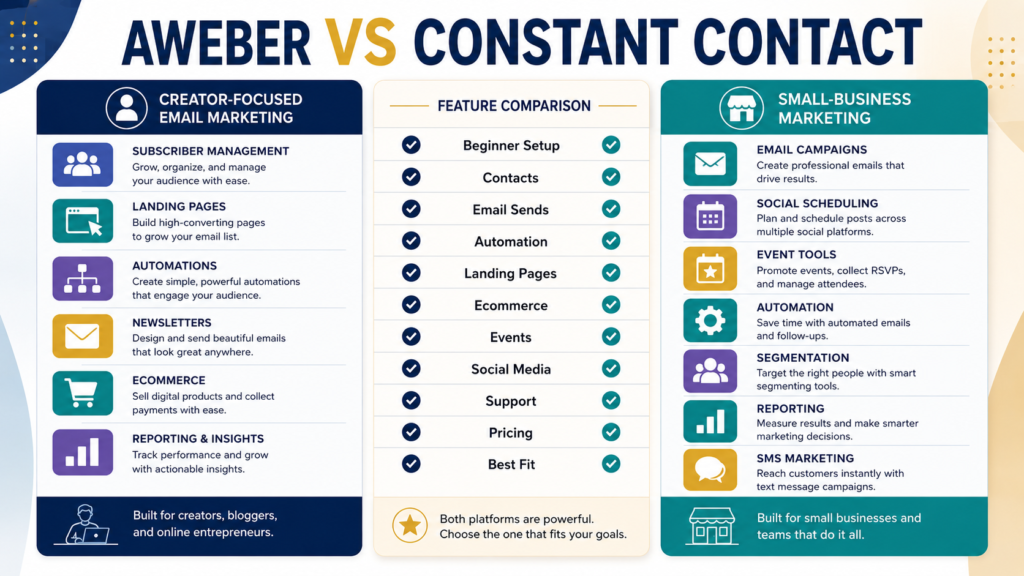
AWeber and Constant Contact are both established email-marketing platforms, but they are increasingly differentiated by the type of business workflow surrounding the email list.
AWeber remains strongly centered on creators and online marketers who want subscriber management, email campaigns, landing pages, automation, and selling tools in one email-focused environment.
Constant Contact combines email with a broader collection of small-business marketing functions, including social marketing, event capabilities, automation, segmentation, reporting, integrations, and optional SMS.
For a simple creator or digital-product business, AWeber may be the more natural fit when email and list building are the center of the system. Constant Contact may be more attractive when email needs to sit beside events, social marketing, and broader local or small-business promotional activity.
Neither is automatically the better platform.
Review Methodology: This comparison is based on official AWeber and Constant Contact information reviewed on September 2, 2026. No firsthand product testing or personal product-use claim is made. Pricing, promotional offers, limits, and features can change, so verify the current offer before purchasing.
Start With the Business Model
Before comparing prices, ask what you are building.
Creator-Oriented Business
You may need:
- Lead magnet.
- Signup form.
- Landing page.
- Welcome sequence.
- Newsletter.
- Product promotion.
- Subscriber tags.
- Simple automation.
AWeber fits naturally into this model.
Broader Small-Business Marketing
You may also need:
- Events.
- Social-media scheduling.
- Multiple users.
- SMS.
- Advertising tools.
- Local customer marketing.
- Broader campaign management.
Constant Contact may deserve additional weight.
The distinction is not absolute.
It simply gives you a better starting point than comparing fifty features equally.
AWeber’s Current Approach
AWeber’s current public pricing page emphasizes creator-focused email marketing, landing pages, subscriber management, automation, reporting, ecommerce, and related tools.
Its public pricing currently highlights Lite at $12.49 per month when billed annually for the displayed entry subscriber level and Plus at $19.99 per month when billed annually, while actual pricing scales with subscriber volume and plan. AWeber is currently promoting a 14-day trial on these options.
You can review the current details on AWeber’s official pricing page.
The important point is not the temporary entry price.
It is how cost changes as your list grows.
Constant Contact’s Current Approach
Constant Contact’s current public pricing page lists Lite, Standard, and Premium.
At the time of review, the page displays annual-prepayment starting equivalents of approximately:
- Lite: $10.20 per month
- Standard: $29.75 per month
- Premium: $68 per month
The page also explains that actual pricing depends on plan, contact count, and sending allowances. Current monthly email-send allowances are tied to contact volume, with different multiples for Lite, Standard, and Premium.
You can verify the latest offer through Constant Contact’s official pricing page.
Because both companies can change promotions, compare the checkout you would actually purchase rather than relying on an old screenshot.
Email Campaigns
Both platforms handle the central email-marketing job:
- Maintain contacts.
- Create email campaigns.
- Send newsletters.
- Track performance.
- Segment subscribers.
- Automate follow-up.
For a beginner, this means neither product should be eliminated simply because it lacks basic email functionality.
The decision comes from how the workflow expands.
Landing Pages
AWeber puts substantial emphasis on landing pages as part of its creator workflow.
Its current Plus offering includes unlimited landing pages and additional landing-page features.
That can be useful if your funnel is:
Article → Lead Magnet Landing Page → Email Signup → Welcome Sequence
A beginner may be able to build a functional list-building system without buying a separate landing-page platform.
Constant Contact provides signup and campaign tools but approaches the broader marketing workflow differently.
If landing pages are central to your business, compare the exact landing-page features in the plan you would actually buy.
Automation
AWeber’s current Plus plan emphasizes unlimited automations and custom segments.
Constant Contact separates automation depth more noticeably by plan.
Its current pricing page identifies progressively more automation capabilities as you move from Lite to Standard to Premium, with Premium providing broader custom automation options.
Ask what you really need.
A beginner may only require:
Subscriber Joins → Welcome Email → Helpful Follow-Up → Relevant Offer
Do not pay for a complicated automation engine because you might use it someday.
Events Are a Strong Constant Contact Difference
Constant Contact includes event-related tools as a visible part of its current platform offering.
That can matter for businesses running:
- Workshops.
- Local classes.
- Fundraisers.
- Conferences.
- Community events.
- Paid registrations.
A digital-product creator who never runs events may assign almost no value to that feature.
A local organization could assign substantial value.
Feature importance depends on the business.
Social Marketing
Constant Contact also integrates social-media marketing more directly into its current plan structure.
The pricing page includes social posting and scheduling capabilities across plan levels, with more advanced scheduling available on higher tiers.
This may help a small business that wants fewer separate tools.
But integration does not automatically mean you should use every feature.
If you already have a social scheduler you like, the additional capability may be redundant.
Ecommerce and Selling
AWeber supports creator-commerce functions including product and service sales, subscriptions, payment plans, purchase tagging, and sales tracking on current paid offerings.
The public pricing information also identifies AWeber transaction fees that vary by plan.
This can help a creator who wants a relatively simple email-plus-selling environment.
If you already use a dedicated checkout platform, however, do not automatically move selling into the email platform.
Your existing checkout may provide:
- Better order bumps.
- More flexible payment options.
- Better affiliate management.
- More sophisticated delivery integration.
Evaluate the complete system.
Contact and Sending Limits
Both platforms require you to understand list size and email frequency.
Do not compare:
“Plan A costs $X.”
against:
“Plan B costs $Y.”
without checking what happens at your actual contact level.
Estimate:
Expected subscribers × campaigns per month = approximate sending demand
Then compare:
- Contact limit.
- Email-send allowance.
- Overage rules.
- Automation level.
- Users.
- Landing pages.
- Reporting.
This produces a more realistic cost comparison.
Support
Support matters more for beginners than feature tables often suggest.
Constant Contact’s current pricing information promotes live phone and chat support across its marketing plans, with higher service levels on Premium.
AWeber’s current Plus positioning highlights priority support and creator-focused assistance.
When comparing support, ask:
- What channels are available?
- Are hours convenient?
- Is support available on my plan?
- Do I prefer chat, email, or phone?
- Do I need implementation help?
A feature you cannot successfully configure has little practical value.
AWeber May Fit Better If…
Consider AWeber when:
- Email is the center of your marketing system.
- You are a creator, blogger, affiliate marketer, or digital-product seller.
- Landing pages matter.
- You want strong email automation without building a broad local-marketing suite.
- Subscriber tagging and segmentation matter.
- You want ecommerce features close to your email system.
My existing AWeber review for beginners provides additional context on AWeber by itself.
Affiliate Disclosure: This article contains affiliate links. If you purchase through one of these links, I may earn a commission at no additional cost to you. Affiliate compensation does not determine the conclusions or recommendations presented in this article.
If AWeber appears to match your requirements, you can review the current AWeber offer through this approved partner link.
Constant Contact May Fit Better If…
Consider Constant Contact when:
- You run a traditional small business or organization.
- Events matter.
- Social-media scheduling matters.
- Multiple marketing channels should live together.
- You value integrated campaign tools.
- SMS may become useful.
- Phone and chat support are important.
Compare AWeber With Other Email Platforms Too
Do not assume Constant Contact is the only alternative.
If your business is primarily creator-focused, the AWeber vs Mailchimp comparison provides another useful perspective.
If Constant Contact’s broader small-business marketing approach appeals to you but you want deeper automation and creator features, my GetResponse vs Constant Contact comparison can help clarify that tradeoff.
The Simplicity Test
A beginner often asks:
“Which platform has more?”
A better question is:
“Which platform lets me run my business with fewer unnecessary moving parts?”
Suppose you only need:
- One list.
- One lead magnet.
- One welcome sequence.
- One weekly email.
- Occasional affiliate promotion.
You may not benefit from broader event or social features.
But suppose your business operates:
- Workshops.
- Community events.
- Social promotions.
- Email campaigns.
- Customer announcements.
Then a broader platform may reduce tool switching.
Conclusion
AWeber and Constant Contact both provide mature email-marketing capabilities, but they increasingly serve different styles of small-business marketing.
AWeber is particularly attractive for creators and online marketers who want email, landing pages, automation, subscriber management, and selling tools organized around list building.
Constant Contact is especially worth examining for broader small-business marketing where events, social tools, campaign management, support, and additional channels matter.
Do not choose from the entry price alone.
Write down:
- Expected subscriber count.
- Monthly sending frequency.
- Automations required.
- Landing-page needs.
- Event requirements.
- Social-media requirements.
- Number of users.
- Support preference.
Then compare the current plans against that list.
The better email platform is the one that matches the business you plan to operate—not the one with the longest feature page.