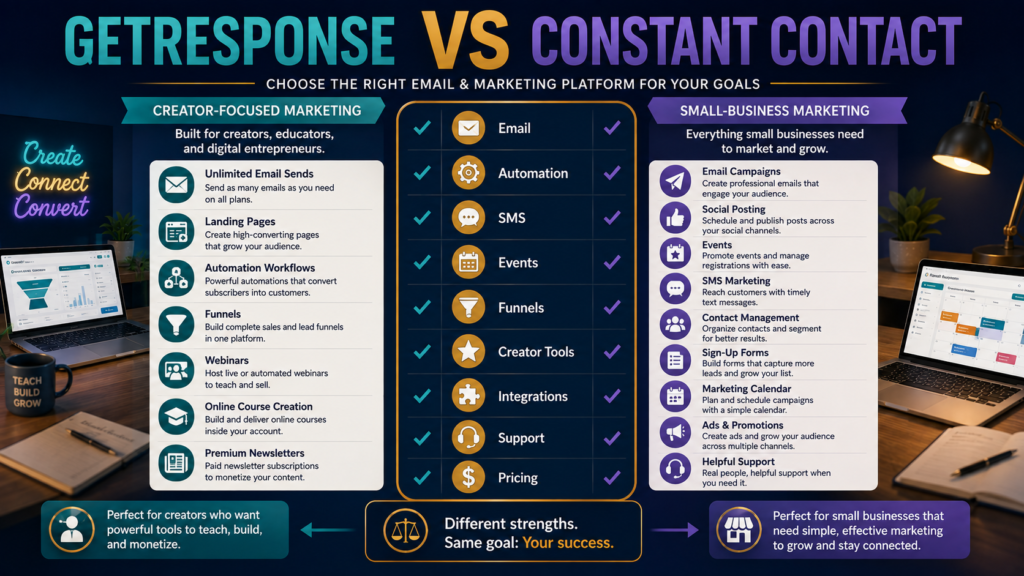
GetResponse and Constant Contact are established email-marketing platforms, but their current product directions make them increasingly different.
GetResponse emphasizes email marketing, autoresponders, automation workflows, landing pages, funnels, ecommerce features, webinars, course creation, and premium newsletters depending on plan.
Constant Contact combines email marketing with social publishing, events, SMS, contact management, advertising tools, sign-up forms, integrations, and other small-business marketing functions.
That makes this less about:
Which one sends newsletters?
and more about:
Which surrounding marketing system better matches the business I want to operate?
Review Methodology: This comparison is based on official GetResponse and Constant Contact pricing pages, help documentation, and publicly available product information reviewed on August 19, 2026. No firsthand product testing or personal experience is claimed.
Key Takeaways
- GetResponse Starter currently begins at $19/month for monthly billing at the entry list size shown, or $15.58/month when paid annually, and includes unlimited monthly email sends.
- GetResponse Marketer currently begins at $59/month monthly or $48.38/month when billed annually at the displayed entry tier.
- GetResponse Creator currently begins at $69/month monthly or $56.58/month annually and adds webinars, course creation, a website builder, up to 500 students, and premium newsletters.
- Constant Contact currently lists Lite from $12/month, Standard from $35/month, and Premium from $80/month, with pricing also affected by contact count.
- Constant Contact’s current monthly email-send allowances are 10× contact count on Lite, 12× on Standard, and 24× on Premium; overage sends are billed separately.
- Constant Contact includes social marketing and event tools across its product structure, with more automation, segmentation, reporting, and SMS capabilities at higher levels.
- GetResponse’s strongest distinction is its broader automation/funnel/creator stack.
- Constant Contact’s strongest distinction is its approachable multi-channel small-business marketing orientation.
Affiliate Disclosure: This article contains affiliate links. If you purchase through one of these links, I may earn a commission at no additional cost to you. Affiliate compensation does not determine the conclusions or recommendations presented in this article.
What Is GetResponse?
GetResponse is an email-marketing and automation platform with three primary standard paid plans:
- Starter.
- Marketer.
- Creator.
Enterprise is available separately.
You can explore GetResponse’s current email-marketing features through Michael’s approved affiliate link.
MichaelELeeReviews also has a dedicated GetResponse review for beginners for a deeper look at the platform itself.
What Is Constant Contact?
Constant Contact is a digital-marketing platform oriented strongly toward small businesses and organizations.
Its current plans are:
- Lite.
- Standard.
- Premium.
Current functionality includes combinations of:
- Email.
- Contact management.
- Social posting.
- Events.
- SMS.
- Advertising.
- Integrations.
- Marketing reporting.
The Biggest Difference
A useful simplification is:
GetResponse
Email → automation → funnel → monetization
Constant Contact
Email → small-business outreach across several channels
There is substantial overlap.
The center of gravity is different.
Email Sending
This is an important pricing difference.
GetResponse currently lists unlimited monthly email sends across Starter, Marketer, and Creator.
Constant Contact currently applies plan-based monthly send allowances:
- Lite: 10× contact count.
- Standard: 12×.
- Premium: 24×.
Constant Contact says sends over the allowance continue but are currently charged at $0.002 per additional send.
A frequent sender should calculate this difference carefully.
Example
Suppose you have 2,000 contacts and send:
Three emails per week.
That could exceed 24,000 sends in some months.
A plan’s email allowance therefore matters.
Do not compare subscription prices without comparing sending habits.
Automation
GetResponse Starter currently includes:
- Welcome series.
- One custom automation workflow.
Marketer and Creator add unlimited workflows and advanced segmentation.
Constant Contact’s current feature structure includes automation templates and increasingly advanced automation capabilities across Standard and Premium.
For a simple newsletter business, either may provide enough.
For more elaborate behavior-based funnels, GetResponse’s broader automation positioning deserves closer examination.
Landing Pages
GetResponse includes a landing-page builder across its standard paid plans.
Constant Contact also offers sign-up and campaign-oriented page capabilities as part of its broader marketing platform.
If your main workflow is:
Lead magnet → landing page → email automation
test the entire process in both platforms.
Social Media
Constant Contact explicitly integrates social marketing into its current plan structure.
Its pricing table includes capabilities around:
- Facebook.
- Instagram.
- LinkedIn.
- Short video posting.
- Scheduling.
- Social reporting at applicable levels.
If you want email and routine social publishing coordinated inside one system, this may matter.
GetResponse is much more centered on email, funnels, automation, and creator monetization.
Events
Constant Contact’s current plan table includes event registration and payment capabilities.
This can be useful for organizations running:
- Workshops.
- Local events.
- Classes.
- Fundraisers.
- Registrations.
A digital-product creator who never manages events may not care.
SMS
Constant Contact’s current Premium plan includes the first 500 SMS messages per month, while Lite and Standard customers can add SMS starting at $10/month for the first 500 messages. Constant Contact notes SMS availability in this part of its current pricing for U.S. customers.
GetResponse offers SMS at higher enterprise-level configurations rather than making it a core Starter feature in the current standard plan table.
If SMS is important, compare the exact configuration.
GetResponse’s Funnel Strength
GetResponse Marketer currently includes:
- Sales funnels.
- Abandoned-cart recovery.
- Promo codes.
- Revenue reports.
- Advanced segmentation.
- Unlimited automation workflows.
That is valuable for businesses that want email tied closely to the selling process.
GetResponse’s Creator Features
Creator currently adds:
- Webinars.
- Website builder.
- Course creator.
- Up to 500 students.
- Premium newsletters.
This changes the comparison substantially for:
- Course creators.
- Newsletter businesses.
- Webinar marketers.
- Digital knowledge sellers.
Constant Contact is not primarily trying to become a course platform.
Contact Management
Both manage subscriber/contact databases.
Constant Contact’s current tiers expand custom segmentation from one custom segment on Lite to more capacity on higher plans.
GetResponse Marketer and Creator include advanced audience segmentation.
The right question is not:
Which has segmentation?
Ask:
How many meaningful segments will I actually maintain?
Integrations
Constant Contact currently lists more than 300 integrations in its plan comparison.
GetResponse currently promotes more than 170 integrations.
The raw number is less important than whether each platform connects to:
- Your website.
- Checkout.
- Ecommerce system.
- CRM.
- Lead sources.
Support
Constant Contact’s current pricing page emphasizes live phone and chat support across plans alongside self-service resources.
For people who value direct human assistance, this may be an important buying factor.
GetResponse provides its own support channels and documentation, but compare support availability for your region and preferred communication method before buying.
Pricing: GetResponse
At the entry list size currently displayed:
Starter
$19/month monthly.
$15.58/month equivalent when billed annually.
Marketer
$59/month monthly.
$48.38/month annual equivalent.
Creator
$69/month monthly.
$56.58/month annual equivalent.
Pricing scales with contact count.
Pricing: Constant Contact
Current starting prices:
Lite
$12/month.
Standard
$35/month.
Premium
$80/month.
Constant Contact says exact cost depends on plan and contact count.
Its help center also documented pricing changes affecting August 2026 invoices, so verify the exact account quote rather than relying on older comparison articles.
Who Should Consider GetResponse?
GetResponse may fit better if:
- You send frequently.
- Marketing automation matters.
- Funnels matter.
- You sell digital products.
- Webinars matter.
- You may create courses.
- Premium newsletters matter.
- You want marketing and creator tools connected.
Who Should Consider Constant Contact?
Constant Contact may fit better if:
- Straightforward email marketing is the core job.
- Social posting matters.
- Events matter.
- SMS matters.
- Phone support is valuable.
- You want a small-business-focused marketing environment.
- Your automation needs are moderate.
Use a Real Trial Workflow
Do not compare screenshots.
Build:
- Signup form.
- Landing page.
- Welcome email.
- Three-email automation.
- Newsletter.
- Two segments.
- Test subscriber.
- Campaign report.
Then record:
- Setup time.
- Editing experience.
- Reporting.
- Automation flexibility.
- Cost at your real list size.
The site’s software free-trial evaluation guide provides a useful testing framework.
Compare Against AWeber Too
If your priority is a relatively straightforward beginner email platform, the existing GetResponse vs. AWeber comparison can provide another reference point.
Final Verdict
Choose GetResponse when email is part of a broader automation, funnel, webinar, newsletter, or digital-product system.
Choose Constant Contact when you want approachable email marketing combined with social, events, SMS, and small-business communication tools.
GetResponse is the stronger fit for a creator who expects email automation to connect directly with digital-product monetization.
Constant Contact deserves serious consideration for a traditional small business or organization that wants several communication channels in one approachable platform.
Conclusion
GetResponse and Constant Contact can both manage an email list.
Their surrounding ecosystems should determine the decision.
Write down the five jobs your platform must perform.
Then compare only those five jobs.
The platform with fewer unused features—and fewer missing features—is usually the more practical choice.