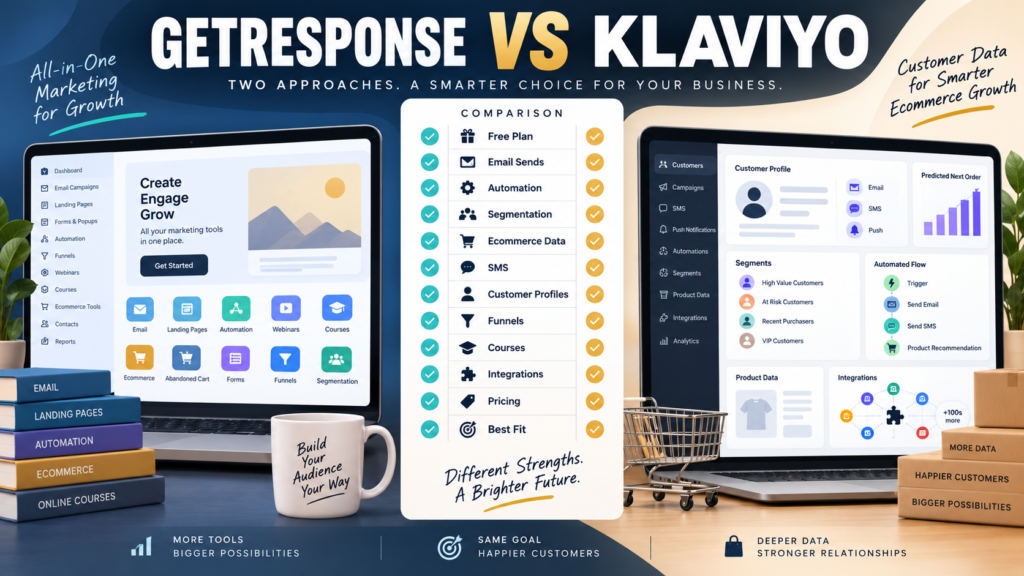
GetResponse and Klaviyo can both handle sophisticated email marketing.
Both support:
- Email campaigns.
- Automation.
- Segmentation.
- Ecommerce data.
- Forms.
- Customer communication.
But they are built around somewhat different priorities.
GetResponse provides a broader marketing environment that combines email with landing pages, automation, funnels, ecommerce tools, webinars, websites, and creator products depending on plan.
Klaviyo is strongly centered on customer data and B2C ecommerce lifecycle marketing across email, SMS, push, segmentation, automated flows, analytics, and customer profiles.
That creates a useful decision:
Do you need a broader all-in-one marketing toolkit—or deeper ecommerce customer-data capabilities?
Review Methodology: This comparison is based on official GetResponse and Klaviyo product information reviewed on September 9, 2026. No firsthand product testing or personal experience is claimed. Pricing, features, plan limits, promotions, messaging charges, and integrations may change. Verify the current checkout before purchasing.
GetResponse’s Current Plan Structure
GetResponse currently offers:
- Starter.
- Marketer.
- Creator.
- Enterprise.
Its public pricing page currently displays Starter at $19 per month when billed monthly at the 1,000-contact entry level, with $15.58 per month equivalent when paid annually. Marketer is currently displayed at $59 monthly or $48.38 monthly equivalent when annual, while Creator is $69 monthly or $56.58 annual equivalent.
Standard paid plans currently advertise unlimited monthly email sends.
GetResponse Starter
Starter currently includes:
- Email marketing.
- Unlimited sends.
- Landing pages.
- Signup forms.
- Basic segmentation.
- Contact management.
- One automation workflow.
- Ecommerce integrations.
That makes Starter useful when the business needs email and lead generation without advanced automation.
GetResponse Marketer
Marketer expands into:
- Unlimited automation workflows.
- Advanced segmentation.
- Ecommerce tools.
- Abandoned cart recovery.
- Sales funnels.
- Promo codes.
- Revenue reporting.
- Product recommendations.
This is where GetResponse becomes much more competitive for ecommerce use.
GetResponse Creator
Creator combines the marketing features with tools such as:
- Webinars.
- Website builder.
- Course creator.
- Student management.
- Paid newsletters.
That matters for businesses selling:
- Knowledge products.
- Courses.
- Membership-style educational content.
- Creator subscriptions.
Klaviyo is not primarily positioned as an online-course creation platform.
Klaviyo’s Free Plan
Klaviyo currently offers a permanent free plan for accounts within the stated limits.
Its current official pricing information lists:
- Up to 250 active profiles.
- 500 email sends per month.
- A small monthly mobile-message allowance.
- Built-in reporting.
- Segmentation.
- Automation.
- Customer Hub.
- Email support for the first 60 days on the free tier.
This lets a small business test the platform without immediately buying a paid subscription.
Klaviyo Paid Pricing
Klaviyo’s pricing is strongly tied to:
- Active profiles.
- Email volume.
- Mobile messaging.
- Additional products and services.
The current pricing interface is configurable rather than presenting one simple universal price for every business.
That means a useful comparison requires your real list size.
Do not use a random screenshot from someone else’s Klaviyo account as your expected price.
Klaviyo’s Customer-Data Emphasis
One of Klaviyo’s strongest differentiators is its customer-profile architecture.
Klaviyo says its customer profiles can combine:
- Purchase activity.
- Product views.
- Add-to-cart activity.
- Website activity.
- Channel consent.
- Email engagement.
- SMS engagement.
- Coupons.
- Custom properties.
- Predictive information.
Its current platform also advertises 350+ integrations.
That is especially useful for ecommerce businesses with rich customer behavior data.
Segmentation
Both platforms provide segmentation.
GetResponse supports segmentation using contact and ecommerce data.
Its current documentation includes ecommerce conditions based on behavior such as:
- Products purchased.
- Brands purchased.
- Purchase frequency.
- Amount spent.
Klaviyo emphasizes real-time segmentation using customer-profile data across multiple channels and historical activity.
If advanced ecommerce segmentation is central to the business, Klaviyo deserves close attention.
Automation
Both platforms provide visual automation.
GetResponse supports automation based on:
- Contact data.
- Email behavior.
- Website activity.
- Ecommerce events.
- Conditions and filters.
Marketer and higher provide broader workflow access.
Klaviyo’s Flows support:
- Email.
- SMS.
- Push.
- Customer behavior.
- Ecommerce activity.
- Prebuilt automation templates.
Klaviyo currently advertises more than 60 prebuilt flow templates and integration with 350+ tools and APIs.
Abandoned Cart
Both platforms can support abandoned-cart marketing.
GetResponse provides abandoned-cart recovery in its ecommerce-oriented plan structure.
Klaviyo is particularly well known for behavior-triggered ecommerce flows.
For either platform, confirm compatibility with your actual ecommerce system before buying.
Ecommerce Integrations
GetResponse currently highlights direct ecommerce connections with platforms including:
- Shopify.
- WooCommerce.
- Magento.
- BigCommerce.
- PrestaShop.
It can sync products, customer data, and order information for marketing use.
Klaviyo emphasizes a much broader integration ecosystem and centralized customer profiles.
The best choice may therefore depend on the store platform you already use.
Email Volume
This is an important pricing difference.
GetResponse’s standard paid plans currently include:
Unlimited monthly email sends
within its contact-based pricing structure.
Klaviyo’s plans use active-profile and sending allowances.
High-frequency senders should calculate actual monthly volume.
Example:
5,000 subscribers × 12 emails each month = 60,000 sends
Do not compare only contact limits.
SMS and Push
Klaviyo is designed for cross-channel B2C communication across:
- Email.
- SMS.
- Push.
GetResponse also supports additional channels, though some are associated with higher-tier or Enterprise capabilities.
If SMS is essential, compare:
- Message pricing.
- Countries supported.
- Consent management.
- Automation.
- Volume.
Landing Pages
GetResponse has a particularly clear advantage for businesses wanting landing pages integrated directly into the same general marketing platform.
Its standard plans include landing-page functionality.
Klaviyo includes forms and onsite customer capture but is not primarily positioned as an all-in-one funnel and landing-page platform in the same way.
Funnels
GetResponse Marketer includes sales-funnel functionality.
This can simplify a business that wants:
Landing Page → Email → Offer → Checkout Follow-Up
inside a broader marketing system.
Klaviyo is more likely to sit alongside the ecommerce store and use customer behavior to drive lifecycle communication.
Courses and Creator Products
GetResponse Creator adds another important distinction:
- Courses.
- Webinars.
- Paid newsletters.
- Creator monetization tools.
If your business sells educational content and you want marketing plus creator functionality, that may materially affect the decision.
Reporting
Both platforms provide reporting.
GetResponse includes email, automation, and ecommerce reporting appropriate to the selected plan.
Klaviyo places significant emphasis on:
- Revenue attribution.
- Customer behavior.
- Predictive data.
- Benchmarks.
- Product analysis.
For a mature ecommerce store, those customer-data capabilities may become more valuable.
GetResponse May Fit Better If…
Consider GetResponse when:
- Email is the core need.
- You send frequently and value unlimited paid-plan email sends.
- You want landing pages.
- You want funnels.
- You want webinars.
- You sell courses or creator products.
- You prefer a broader marketing toolkit.
- Your ecommerce needs are important but not extremely data-intensive.
My GetResponse review for beginners provides a deeper overview.
Affiliate Disclosure: This article contains affiliate links. If you purchase through one of these links, I may earn a commission at no additional cost to you. Affiliate compensation does not determine the conclusions or recommendations presented in this article.
If GetResponse fits your requirements, you can review the current GetResponse offer through this approved partner link.
Klaviyo May Fit Better If…
Consider Klaviyo when:
- Ecommerce is the center of the business.
- Rich customer behavior data matters.
- Advanced segmentation is important.
- Lifecycle marketing is a priority.
- Email and SMS need to work closely together.
- Predictive analytics matter.
- Your store generates enough customer activity to justify deeper personalization.
Compare GetResponse With ActiveCampaign
If advanced automation is more important than ecommerce customer-profile depth, the GetResponse vs ActiveCampaign comparison provides another useful option.
Compare GetResponse With Mailchimp
If you want to compare two broader email-marketing platforms, see GetResponse vs Mailchimp.
Do a Real Cost Comparison
Write down:
Active Contacts:
Monthly Email Sends:
SMS Needed?:
Landing Pages Needed?:
Funnels Needed?:
Courses Needed?:
Ecommerce Store Platform:
Automation Complexity:
Customer-Data Depth Needed:
Then price the actual configuration.
This avoids choosing a platform because its lowest advertised number looked better.
Conclusion
GetResponse and Klaviyo are both capable marketing platforms, but they solve somewhat different problems.
GetResponse is especially strong when you want a broad system combining:
Email → Automation → Landing Pages → Funnels → Ecommerce → Webinars → Creator Tools
Klaviyo is especially strong when the center of the business is:
Ecommerce Customer Data → Segmentation → Lifecycle Automation → Email → SMS → Predictive Insights
A small creator business may find GetResponse’s broader toolkit easier to consolidate around.
A data-rich ecommerce brand may find Klaviyo’s customer-profile and lifecycle-marketing depth more valuable.
The correct choice depends less on which platform has more features and more on which operating model matches your business.
Your Next Action
Write down these five numbers or requirements:
Active Contacts: _____
Monthly Email Sends: _____
Monthly Ecommerce Orders: _____
Need SMS?: Yes / No
Need Courses, Webinars, or Funnels?: Yes / No
Then create two columns:
GetResponse
and:
Klaviyo
Score each from 1 to 5 for:
- Monthly cost.
- Email volume.
- Automation.
- Ecommerce segmentation.
- Landing pages.
- Customer data.
- SMS.
- Creator tools.
- Required integrations.
- Ease of management.
Give double weight to the three categories most important to your business.
If one platform clearly leads after weighting your real requirements, test that platform first.
If the scores are close, build the same small workflow in each available trial or free account:
Signup → Welcome Email → Segment → Follow-Up
Choose the platform you can realistically maintain—not simply the one with the longest feature list.