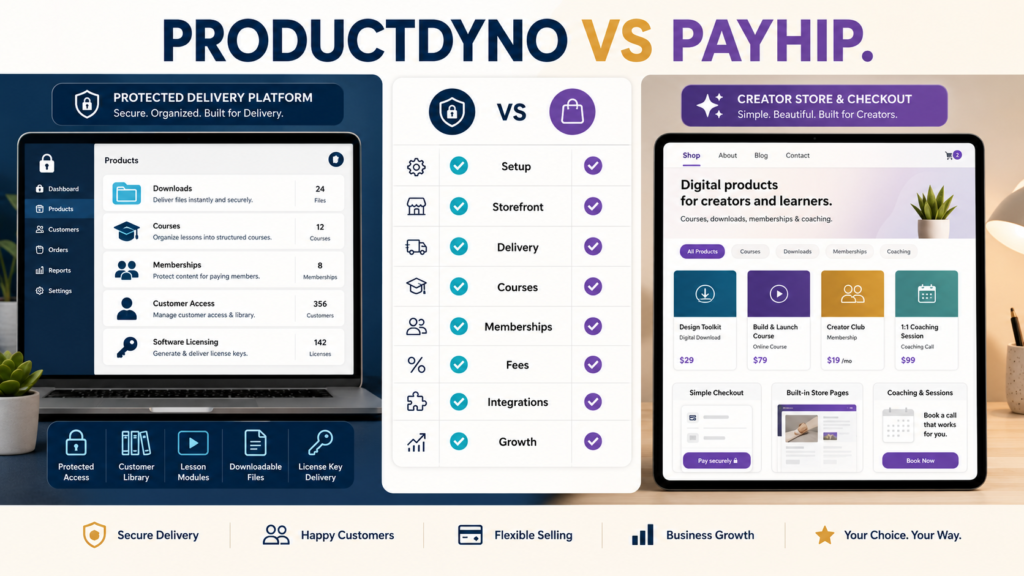
ProductDyno and Payhip can both help creators sell digital products, but they approach the job differently.
ProductDyno places substantial emphasis on protecting, delivering, and managing access to digital products, including downloads, memberships, courses, and other protected content.
Payhip combines selling and delivery inside a more obvious online storefront model, with support for digital downloads, courses, memberships, coaching, and additional ecommerce functions.
That makes the choice less about identifying a universal winner and more about answering this question:
Do you primarily need a dedicated digital-product delivery and access system, or do you want a straightforward storefront that handles selling and delivery together?
Review Methodology: This comparison is based on official product information, available documentation, and publicly available details reviewed on August 14, 2026. No firsthand product testing or personal experience is claimed.
Key Takeaways
- ProductDyno is worth considering when protected content delivery, member access, memberships, courses, software licensing, and integrations are important.
- Payhip is designed around a creator storefront and supports downloads, courses, coaching, memberships, and physical products.
- Payhip publishes three straightforward pricing levels with different transaction fees.
- ProductDyno’s official site currently presents more than one pricing page, so buyers should verify the exact offer and checkout terms before purchasing.
- Payhip’s free tier can reduce the upfront cost for a new seller, but it charges a transaction fee.
- ProductDyno may make more sense when the delivery environment itself is an important part of your business infrastructure.
- The best choice depends on what you sell, how customers should receive it, and how much surrounding ecommerce functionality you need.
Affiliate Disclosure: This article contains affiliate links. If you purchase through one of these links, I may earn a commission at no additional cost to you. Affiliate compensation does not determine the conclusions or recommendations presented in this article.
What Is ProductDyno?
ProductDyno is positioned as a platform for creating, protecting, delivering, and managing digital products.
Its current official information describes support for digital downloads, video courses, membership sites, downloadable or streamable files, and related digital-product delivery. ProductDyno’s official product overview provides the current platform description.
ProductDyno may be particularly relevant when the customer-access side of the business matters.
Examples include:
- PDF products.
- Ebooks.
- Video training.
- Audio.
- Downloadable files.
- Membership areas.
- Courses.
- Software-related products.
- Protected customer content.
You can review ProductDyno’s current digital-product delivery offer if those requirements match your business.
What Is Payhip?
Payhip describes itself as an all-in-one platform for selling digital downloads, courses, coaching, memberships, and other products through an online storefront.
Its official website emphasizes simple setup and allows a creator to build a store rather than requiring a separate website storefront for the basic sales process. Payhip’s official platform overview explains its current selling options.
That can be appealing to someone who wants:
- A product page.
- Storefront.
- Checkout.
- Digital delivery.
- Course functionality.
- Membership functionality.
- Marketing features.
in one creator-oriented system.
The Biggest Difference: Delivery System vs Storefront Mindset
A useful way to compare the two platforms is by considering their center of gravity.
ProductDyno
Think:
I need a professional system for protecting and delivering products and managing customer access.
Payhip
Think:
I need an online store where I can list, sell, and deliver products without assembling several ecommerce components.
There is overlap between the platforms.
But your starting need can make one more logical than the other.
Digital Downloads
Both platforms support digital downloads.
ProductDyno’s current material lists formats such as PDFs, ebooks, audio, videos, plugins, software, and other downloadable or streamable content.
Payhip also supports digital downloads and presents itself as an all-in-one system for selling ebooks, software, and other downloadable products. Payhip’s digital-download features provide current details.
If you are selling one simple PDF, both platforms may offer far more functionality than the file itself requires.
The important comparison becomes:
- Checkout.
- Customer experience.
- Fees.
- Branding.
- Delivery.
- Taxes.
- Marketing.
- Integrations.
- Future product needs.
Online Courses
Payhip currently provides course functionality including student accounts and drip content. Its official course page also describes lesson-based course delivery and communication features. Payhip’s course features provide the current details.
ProductDyno also promotes video-course creation and protected course delivery within its platform.
Before choosing either, define the course you actually plan to sell.
Ask:
- Is it mostly video?
- Does it contain downloads?
- Do lessons need to drip?
- Are quizzes required?
- Do you need certificates?
- Does the customer need a membership login?
- Will there be multiple courses?
- Are subscriptions required?
The term “online course platform” covers many different requirements.
Memberships
Both platforms can support membership-style offers.
That does not mean every creator needs a membership.
A membership creates ongoing obligations:
- Maintaining content.
- Managing access.
- Answering support questions.
- Handling cancellations.
- Keeping the membership valuable.
If you primarily sell standalone ebooks and downloadable resources, membership functionality may not influence your decision very much.
Payhip Pricing Is Easy to Understand
As of August 14, 2026, Payhip’s official pricing page lists:
- Free Forever: $0 per month plus a 5% Payhip transaction fee.
- Plus: $29 per month plus a 2% Payhip transaction fee.
- Pro: $99 per month with no Payhip transaction fee.
PayPal or Stripe processing fees still apply separately. Payhip states that all three plans receive the platform’s features rather than reserving feature sets for higher tiers. Payhip’s current pricing page should always be checked before purchase.
That structure gives a beginner a low-cost way to begin.
The tradeoff is straightforward:
A free monthly plan does not mean selling is free, because the platform transaction percentage and payment-processing costs remain relevant.
ProductDyno Pricing Deserves Extra Verification
ProductDyno’s official site currently exposes more than one pricing page with differing figures and offer structures.
One current page advertises plan pricing beginning at a monthly figure billed annually, while another official pricing URL displays materially different language and figures.
Because of that inconsistency, I would not make a purchase decision from a third-party article quoting a ProductDyno price.
Before buying:
- Open the current offer.
- Verify the checkout amount.
- Confirm whether billing is monthly, annual, or promotional.
- Review renewal terms.
- Check which features are included.
- Save the current purchase terms.
Pricing-page inconsistency does not by itself determine whether the software is good or bad.
It simply means the buyer should verify the exact transaction carefully.
Transaction Fees
Payhip’s pricing model makes platform transaction fees a clear part of the decision.
ProductDyno’s current pricing material states that its plans do not take a percentage of sales revenue, though the exact subscription terms should still be verified at checkout.
This creates an important calculation.
Suppose your product sales are small and occasional.
A low monthly cost plus transaction fee may be attractive.
Suppose your sales volume becomes much larger.
A fixed platform charge may become more attractive than an ongoing percentage.
Do the math using your own realistic sales activity.
Do not choose a platform because someone online says one pricing model is universally cheaper.
Taxes
Payhip’s current pricing information states that it handles collection and remittance of EU VAT and UK VAT on the seller’s behalf and provides options for configuring other taxes.
Tax handling can be a meaningful consideration for sellers serving customers in multiple jurisdictions.
However, platform tax features do not replace professional tax advice about your own business obligations.
Integrations
ProductDyno emphasizes integrations as part of its broader delivery environment.
This can matter when you want the purchase to communicate with:
- Email marketing.
- Payment systems.
- Automation tools.
- Checkout platforms.
- Other parts of your technology stack.
Payhip instead gives the creator more of the basic storefront-and-selling environment within Payhip itself.
Ask:
Am I connecting this platform to a larger business system, or do I want the platform itself to be most of the system?
That question can quickly separate the two approaches.
Customer Experience
Do not evaluate digital-product software only from the seller dashboard.
Test the customer’s path.
The buyer should be able to understand:
- What they purchased.
- Where to access it.
- How to log in.
- Where downloads are located.
- How to reset access information.
- How to obtain support.
A powerful back-end tool is not enough if customers become confused after checkout.
Who Should Consider ProductDyno?
ProductDyno may fit better when:
- Digital-product delivery is central to the business.
- You want protected downloads.
- You expect to build courses or memberships.
- Customer access management matters.
- Software or licensing capabilities matter.
- You use a broader marketing and checkout stack.
- Integrations are important.
- You prefer a dedicated delivery environment.
MichaelELeeReviews has a separate ProductDyno review focused specifically on digital-product delivery if you want a deeper look at ProductDyno by itself.
Who Should Consider Payhip?
Payhip may fit better when:
- You want to start with little or no monthly platform expense.
- You want a built-in storefront.
- You sell standard digital downloads.
- You want course or membership capabilities inside the same platform.
- You do not want to assemble a large checkout-and-delivery stack.
- Transaction fees on the chosen plan are acceptable.
- You value straightforward published pricing.
A beginner selling one ebook may find this model particularly easy to understand.
What If You Already Use a Checkout Platform?
This can change the decision.
If you already use a checkout system you like, you may not need another platform to become the center of the sales transaction.
You may simply need a reliable place to provide customer access after the purchase.
That makes ProductDyno’s delivery emphasis more relevant.
MichaelELeeReviews has also compared ProductDyno with ThriveCart Academy for digital-product businesses, which may help if your decision involves checkout, course access, and delivery architecture.
A Practical Buying Checklist
Before selecting either platform, write down your requirements.
Products
- Ebook?
- PDF?
- Templates?
- Video course?
- Membership?
- Software?
- Coaching?
Selling
- Built-in storefront?
- Separate website?
- Existing checkout?
- Coupons?
- Upsells?
- Affiliates?
Delivery
- Simple download?
- Protected member area?
- Course lessons?
- Drip content?
- Multiple products?
- Software licensing?
Money
- Monthly platform cost?
- Annual commitment?
- Transaction fee?
- Payment-processing fee?
- Tax requirements?
Operations
- How difficult is setup?
- How much maintenance is required?
- What happens when a customer loses access?
- Which integrations are essential?
- Can the system be handed to another person later?
Your answers matter more than the number of features printed on either sales page.
Final Verdict
Choose ProductDyno when your priority is a more dedicated digital-product delivery, access, course, membership, or protected-content environment that can connect with a broader online-business stack.
Choose Payhip when your priority is a straightforward creator storefront that lets you begin listing, selling, and delivering common digital products with a simple published pricing model.
For a brand-new seller with one uncomplicated download, Payhip’s free-entry model may be easier to begin evaluating.
For a seller building a larger delivery infrastructure around multiple products, memberships, courses, protected access, or integrations, ProductDyno deserves closer examination.
Neither choice should be made from the feature list alone.
Conclusion
ProductDyno and Payhip solve overlapping problems from different starting points.
Payhip makes the online store itself central.
ProductDyno puts greater emphasis on the controlled delivery and customer-access side of a digital-product business.
Before choosing, draw your customer’s path from product page → payment → confirmation → access → support.
Then mark which system must handle each step.
The platform that completes that path with the least unnecessary complexity is likely the better fit for your business.