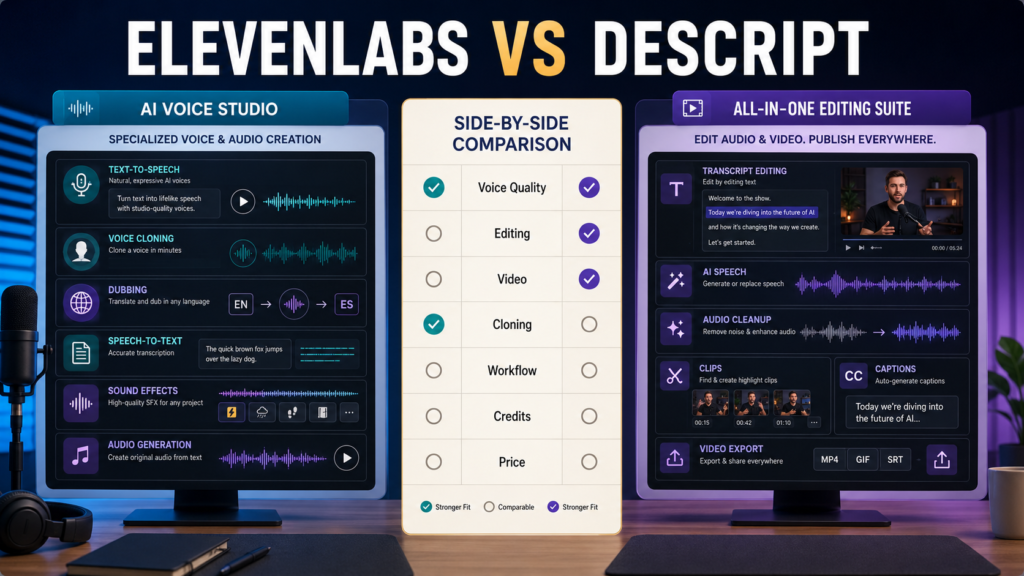
ElevenLabs and Descript both provide AI-generated speech, but they are not trying to solve exactly the same problem.
ElevenLabs is primarily a specialized voice-AI platform.
Descript is primarily a broader audio and video creation and editing platform that includes AI speech as part of the workflow.
That distinction makes the comparison easier.
If your primary need is:
Generate high-quality AI speech and work deeply with voices.
ElevenLabs deserves close attention.
If your primary need is:
Record, edit, clean up, generate, and assemble audio or video inside one creator workspace.
Descript may be the more complete workflow.
Neither should automatically be declared the winner.
Review Methodology: This comparison is based on official product information, current pricing pages, available documentation, and publicly available details reviewed August 14, 2026. No firsthand product testing or personal experience is claimed.
Key Takeaways
- ElevenLabs is more specialized around voice AI.
- Descript combines AI speech with transcript-based audio and video editing.
- Both currently offer free entry options.
- ElevenLabs uses a shared credit model across multiple voice and audio products.
- Descript combines media-hour limits with AI credits on its current plans.
- Creators who already have a separate video editor may prefer a specialized voice platform.
- Creators wanting fewer separate production applications may prefer Descript’s broader workflow.
- Compare the complete workflow rather than voice generation alone.
Affiliate Disclosure: This article contains affiliate links. If you purchase through one of these links, I may earn a commission at no additional cost to you. Affiliate compensation does not determine the conclusions or recommendations presented in this article.
What Is ElevenLabs?
ElevenLabs is a voice-AI platform whose current product lineup includes text-to-speech, speech-to-text, voice changing, voice isolation, sound effects, music, voice tools, dubbing, Studio, and additional generative media capabilities.
Its appeal for many creators is specialization.
If you need narration for:
- YouTube videos.
- Courses.
- Audiobooks.
- Tutorials.
- Marketing videos.
- Product demonstrations.
- Podcasts.
- Multilingual content.
voice generation may be the main job rather than one small feature inside another application.
You can review ElevenLabs through Michael’s approved affiliate link if dedicated AI voice generation is central to your workflow.
MichaelELeeReviews also has a detailed ElevenLabs review for creators focused on voiceovers and audiobooks.
What Is Descript?
Descript is a broader audio and video creation platform built around the idea of editing media through text.
Its current plans include tools such as:
- Transcript-based editing.
- AI video assistance.
- Studio Sound.
- Filler-word removal.
- Clip creation.
- AI Speech.
- Custom voice clones.
- Video export.
- Generative media features on applicable plans.
Descript’s pricing page describes its AI Speech feature as text-to-speech capable of using stock voices or custom voice clones.
That makes Descript less of a pure voice generator and more of an integrated creator workspace.
The Biggest Difference
Ask this question:
Where does the voiceover fit into my complete production process?
ElevenLabs Approach
Script → Generate Speech → Export Audio → Continue Production Elsewhere
This can be ideal if you already use:
- Video editor.
- Avatar platform.
- Course builder.
- Podcast editor.
- Presentation software.
Descript Approach
Record or Import → Edit Transcript → Generate or Repair Speech → Clean Audio → Edit Video → Export
That can reduce platform switching.
The difference is workflow architecture.
Voice Generation
ElevenLabs puts voice technology at the center of the platform.
Its pricing page currently lists multiple voice-related products drawing from one shared monthly credit pool.
For a creator whose output depends heavily on synthetic narration, that specialization matters.
Descript also provides AI Speech and voice cloning, but those capabilities exist inside a larger editing system rather than defining the entire product.
If voice generation is 80% of what you need, evaluate the dedicated platform carefully.
If voice generation is 20% of your production process, the all-in-one environment may be more attractive.
Editing Is Where Descript Becomes More Distinct
Suppose you have a 12-minute video.
You want to:
- Remove mistakes.
- Delete filler words.
- Improve poor audio.
- Shorten sections.
- Create clips.
- Correct narration.
- Add captions.
- Export the finished video.
Descript is designed around that kind of end-to-end editing workflow.
Its current plans include Studio Sound, Remove Filler Words, Create Clips, and access to its Underlord AI editing environment, with capabilities increasing across plans.
ElevenLabs is not primarily positioned as a traditional timeline or transcript-based full video editor.
That difference can eliminate much of the confusion between the products.
What If You Use a Talking Avatar?
Suppose your workflow is:
- Write a script.
- Generate narration.
- Create a talking-avatar video.
- Export.
- Upload to YouTube.
A dedicated voice platform may fit naturally if your avatar system accepts external audio.
But some avatar platforms already provide voice cloning internally.
In that case, adding ElevenLabs may be unnecessary unless its voice features produce a specific benefit you need.
MichaelELeeReviews previously compared ElevenLabs and HeyGen for voiceovers and talking-avatar videos, which addresses that different workflow decision.
ElevenLabs Pricing
As reviewed August 14, 2026, ElevenLabs lists several monthly tiers, including:
- Free: $0.
- Starter: $6.
- Creator: $22.
- Pro: $99.
- Higher Scale and Business tiers.
The platform currently uses credits shared across its products, and different activities consume credits at different rates. Annual billing is also available.
Pricing and credit consumption can change, so verify ElevenLabs’ current official pricing before purchasing.
Do not compare the monthly subscription price alone.
Estimate the amount of audio you actually intend to create.
Descript Pricing
Descript currently offers a free option and paid tiers.
Its official pricing page displays the Hobbyist plan at an annual-billing equivalent of $16 per person per month, compared with $24 on monthly billing, and the Creator plan at an annual-billing equivalent of $24 compared with $35 monthly. Current plans combine media hours with AI credits.
The included amounts differ by plan.
For example, the current pricing page lists:
- Hobbyist: 10 media hours and 400 AI credits monthly.
- Creator: 30 media hours and 800 AI credits monthly.
- Business: larger allowances and additional collaboration capabilities.
Verify Descript’s current official pricing before making the final decision.
Credits Make Direct Price Comparisons Difficult
A $22 voice platform and a $24 editing platform are not necessarily comparable simply because the prices are close.
The resources being purchased are different.
Estimate:
ElevenLabs
- How many narrated minutes?
- Which voice model?
- Dubbing?
- Speech-to-text?
- Other credit-consuming tools?
Descript
- How many media hours?
- How many AI edits?
- How much generated speech?
- How much video editing?
- How many exports?
Your workflow determines the real value.
Which Is Better for YouTube Voiceovers?
If you already have a video-production environment and mainly need narration, ElevenLabs may be the cleaner fit.
Your process could remain:
ChatGPT script → ElevenLabs narration → video editor → YouTube
You are not paying for another broad editor unless you need one.
If you want to edit the entire video by manipulating its transcript and use AI speech to repair or generate sections, Descript may consolidate more of the workflow.
Which Is Better for Podcasts?
Descript becomes particularly interesting when the recording itself needs editing.
You can work from transcripts, remove unwanted material, clean up audio, and create derivative content in the same environment.
ElevenLabs becomes more interesting when you are creating synthetic narration, voiceovers, translated audio, or other voice-first assets.
Again:
Editing versus generation.
Which Is Better for Courses?
Both can play a role.
ElevenLabs
Useful when you need narration for:
- Lessons.
- Slides.
- Audio modules.
- Course introductions.
- Audiobook versions.
Descript
Useful when you need:
- Lesson recording.
- Editing.
- Audio cleanup.
- Narration corrections.
- Captions.
- Video export.
If you record yourself teaching and need to clean up the recording, Descript’s broader editor deserves attention.
If lessons are generated from scripts using an AI voice, ElevenLabs deserves attention.
Voice Cloning
Both products currently provide voice-cloning capabilities in some form.
Do not choose based merely on seeing “voice cloning” on both feature lists.
Compare:
- Setup requirements.
- Available plan.
- Consent requirements.
- Editing workflow.
- Voice controls.
- Output use.
- Language requirements.
- Amount of generated speech required.
Always use voice cloning responsibly and only with voices you have permission to reproduce.
What About Existing Software?
This may determine the answer faster than the feature list.
If you already own and like:
- Clipchamp.
- Adobe Premiere.
- Final Cut.
- Camtasia.
- HeyGen.
- Canva video.
- Another editor.
you may not need Descript simply to obtain another editing environment.
A dedicated ElevenLabs subscription may fill the missing voice function.
But if you dislike your existing editing process, Descript could replace more than one step.
Who Should Consider ElevenLabs?
Consider ElevenLabs when:
- AI voice quality and options are central.
- You create substantial narration.
- You need a specialized voice platform.
- Your video-editing workflow already works.
- You want dubbing or broader voice capabilities.
- You need an API or voice infrastructure for a more advanced use case.
- You prefer generating audio and moving it into another tool.
Who Should Consider Descript?
Consider Descript when:
- You record podcasts or videos.
- Transcript-based editing appeals to you.
- You need audio cleanup.
- You want AI speech inside the editor.
- You frequently correct recorded narration.
- You create clips from longer recordings.
- You want fewer separate creator applications.
Run a Real Workflow Test
Before paying for either tool, choose one real project.
Example:
Project: Five-minute educational YouTube video.
Test:
- Import or create the script.
- Generate or record narration.
- Correct mistakes.
- Edit the finished content.
- Export.
- Record the time required.
- Record credits used.
- Note where another application was necessary.
A workflow test reveals more than a feature checklist.
MichaelELeeReviews has a guide to evaluating a software free trial before you pay that can help structure this type of comparison.
Final Verdict
Choose ElevenLabs when your main requirement is specialized AI voice generation and you are comfortable handling the remaining video or audio production in other software.
Choose Descript when you want AI speech inside a broader transcript-based audio and video editing environment.
For a creator already satisfied with an existing video editor, adding a specialized voice service may create the cleaner system.
For a creator trying to reduce the number of separate production steps, Descript’s integrated workflow may be more valuable.
Conclusion
ElevenLabs and Descript overlap in AI speech, but their strongest use cases remain different.
ElevenLabs begins with the voice.
Descript begins with the production and editing workflow.
Before choosing, map your process from script → narration → editing → final export.
Then circle the step that currently causes the most work.
Choose the platform that solves that bottleneck rather than the one with the longest AI feature list