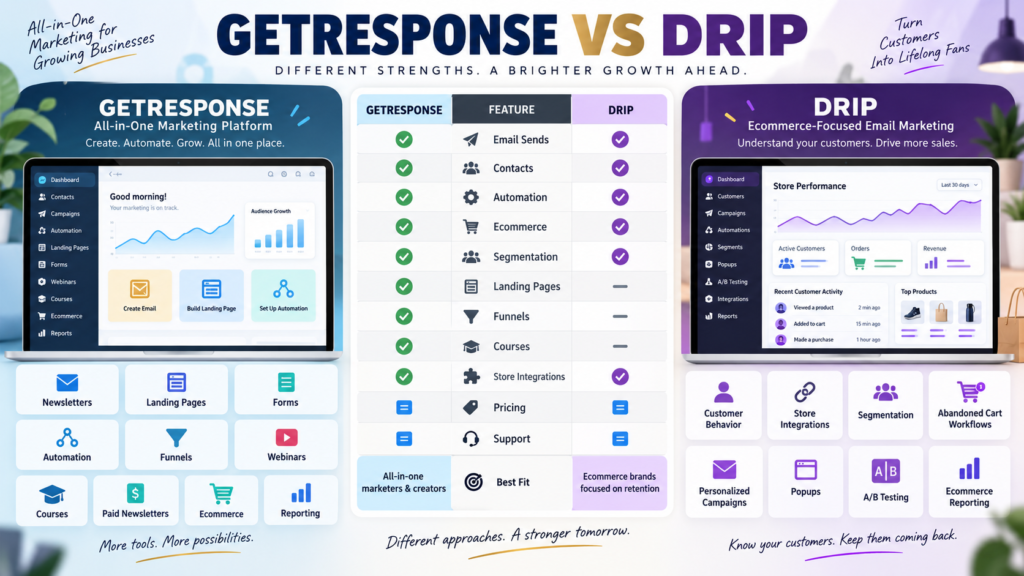
GetResponse and Drip both offer email marketing and automation.
But their current positioning is increasingly different.
GetResponse is a broad marketing platform serving email marketers, creators, ecommerce businesses, and companies that may also need landing pages, funnels, webinars, courses, paid newsletters, and related marketing functions.
Drip is much more specifically positioned around B2C ecommerce email marketing, behavioral segmentation, store integrations, personalized automation, and customer retention.
That means this comparison is not simply:
“Which autoresponder is better?”
The more useful question is:
Do you want email inside a broader marketing platform, or do you want email automation centered heavily on ecommerce customer behavior?
Review Methodology: This comparison is based on official GetResponse and Drip information reviewed on September 6, 2026. No firsthand product testing or personal-use claim is made. Pricing, features, limits, promotions, and support arrangements may change, so verify the current checkout before purchasing.
GetResponse’s Current Positioning
GetResponse currently offers three standard paid packages:
- Starter.
- Marketer.
- Creator.
It also offers an Enterprise tier.
At the 1,000-contact level, GetResponse currently displays monthly prices starting at:
Starter: $19/month
Marketer: $59/month
Creator: $69/month
Its annual option currently displays an 18% discount, bringing those shown equivalents to approximately $15.58, $48.38, and $56.58 per month respectively.
Review the current structure on GetResponse’s official pricing page.
Drip’s Current Positioning
Drip explicitly describes itself as an ecommerce email and automation platform for B2C businesses selling online.
Its current public information emphasizes:
- Ecommerce email.
- Behavioral segmentation.
- Customer personalization.
- Automated workflows.
- Store integrations.
- Onsite popups.
- A/B testing.
- Reporting.
- Customer-lifecycle marketing.
Drip currently lists pricing starting at $39 per month for 1–2,500 people on one of its official ecommerce pages, with unlimited email sends at that displayed tier. Drip also states that pricing scales based on active people and email volume.
You can review current pricing on Drip’s official pricing page.
GetResponse Is the Broader Platform
GetResponse Starter currently includes:
- Email marketing.
- Unlimited sends.
- Landing pages.
- Forms and popups.
- Welcome series.
- One automation workflow.
- Basic analytics.
Marketer adds more advanced automation and ecommerce-oriented features, including:
- Unlimited automation workflows.
- Advanced segmentation.
- Abandoned-cart recovery.
- Sales funnels.
- Promo codes.
- Revenue reports.
Creator expands further with:
- Webinars.
- Website builder.
- Course creator.
- Premium newsletter subscriptions.
That breadth is GetResponse’s clearest advantage.
Drip Is More Ecommerce-Specialized
Drip focuses much more narrowly on businesses selling directly to consumers.
Its official information currently says the platform is best suited to B2C businesses that sell online and is not designed around B2B sales cycles.
Current ecommerce positioning includes integrations with platforms such as:
- Shopify.
- WooCommerce.
- BigCommerce.
Drip says it offers more than 50 integrations overall.
This makes Drip especially relevant if the email list is connected directly to ecommerce purchase behavior.
Email Sending
GetResponse currently offers unlimited monthly sends across its standard paid plans.
Drip’s current entry pricing example also includes unlimited sends for the displayed 1–2,500-person tier, although its broader pricing model scales using active contacts and email volume.
If you send frequently, calculate your actual contact and sending needs rather than assuming two uses of the word “unlimited” represent identical billing structures.
Automation
Both platforms offer serious automation capability.
GetResponse
GetResponse Starter currently includes one basic automation workflow, while Marketer and Creator provide broader automation capability.
Potential workflows include:
Signup → Welcome → Engagement → Product Offer
and ecommerce automations on appropriate plans.
Drip
Automation is a central part of Drip’s ecommerce strategy.
Its current positioning emphasizes:
- Prebuilt playbooks.
- Welcome series.
- Abandoned cart.
- Behavioral targeting.
- Customer segmentation.
If your automation depends heavily on:
What did this customer buy?
What did they view?
What did they abandon?
Drip becomes particularly relevant.
Segmentation
Drip places strong emphasis on deep behavioral customer segmentation.
The platform’s current marketing emphasizes targeting people based on:
- Interests.
- Behavior.
- Purchase history.
That can help ecommerce businesses create:
- Customer-specific offers.
- Post-purchase sequences.
- Win-back campaigns.
- Repeat-buyer campaigns.
GetResponse also provides segmentation, with advanced audience segmentation available in Marketer and above.
The difference is emphasis.
Drip’s entire platform revolves more heavily around ecommerce behavioral data.
Landing Pages and Funnels
GetResponse has the clear broader-tool advantage here.
Landing pages are included across current standard plans.
Marketer includes sales-funnel functionality.
Creator adds still more business-building tools.
If your workflow is:
Ad → Landing Page → Lead → Email Sequence → Sales Funnel
GetResponse may reduce the number of separate platforms required.
Drip is not primarily trying to become your complete funnel-building suite.
Courses and Knowledge Products
GetResponse Creator currently includes course-creation functionality, student capacity, premium newsletters, webinars, and a website builder.
That can appeal to:
- Coaches.
- Educators.
- Course creators.
- Experts.
Drip’s official information says it can serve online educators and creators selling paid memberships or products, but its product identity remains centered on ecommerce email automation rather than being an all-in-one course platform.
Ecommerce Integration
This is Drip’s strongest area of specialization.
If your business runs on:
- Shopify.
- WooCommerce.
- BigCommerce.
Drip deserves serious consideration.
The platform is designed around using store data to drive segmentation and automation.
GetResponse also supports ecommerce integrations and ecommerce marketing tools, especially in Marketer and higher plans.
The question is whether ecommerce is:
One part of the business
or:
The center of the business.
Support
Drip currently states that all paying customers receive email support Monday through Friday, while customers on plans of $99 per month or more receive live chat support.
GetResponse’s current plan materials promote support access across its standard plans, with Enterprise providing additional priority and dedicated service options.
If live support is important, verify your exact tier.
GetResponse May Fit Better If…
Consider GetResponse when:
- Email is only one part of your marketing.
- You want landing pages.
- You want funnels.
- You may use webinars.
- You create courses.
- You want paid newsletters.
- You want broad automation.
- You want fewer separate marketing tools.
My GetResponse review for beginners provides a closer look at GetResponse itself.
Affiliate Disclosure: This article contains affiliate links. If you purchase through one of these links, I may earn a commission at no additional cost to you. Affiliate compensation does not determine the conclusions or recommendations presented in this article.
If GetResponse matches the broader marketing system you need, you can review the current GetResponse offer through this approved partner link.
Drip May Fit Better If…
Consider Drip when:
- You run a B2C ecommerce business.
- Store behavior should drive email.
- Purchase history matters heavily.
- Abandoned-cart automation matters.
- Deep behavioral segmentation is important.
- Shopify, WooCommerce, or BigCommerce is central.
- You want specialized ecommerce email rather than a large all-in-one marketing suite.
Compare GetResponse With ActiveCampaign Too
If Drip’s behavioral automation appeals to you but your business is not primarily ecommerce, ActiveCampaign may be another relevant comparison.
My GetResponse vs ActiveCampaign comparison examines GetResponse against a deeper automation and segmentation platform.
Compare GetResponse With Brevo
If multichannel communication and a different pricing structure matter, see GetResponse vs Brevo.
The Ecommerce Question Comes First
Before comparing editors or templates, answer:
Do I operate an ecommerce store where customer purchase behavior should drive most email automation?
If yes:
Drip becomes significantly more compelling.
If no:
GetResponse’s broader collection of marketing tools may provide more practical value.
Compare Total Tool Count
Suppose GetResponse replaces:
- Email software.
- Landing-page builder.
- Funnel builder.
- Webinar software.
- Simple course software.
Its subscription may save money elsewhere.
Suppose Drip produces better ecommerce automation but you still need:
- Landing pages.
- Courses.
- Webinar platform.
That is not necessarily bad.
It simply means you should calculate the complete stack.
A Simple Buying Scorecard
Score each platform for:
- Email campaigns.
- Automation.
- Behavioral segmentation.
- Ecommerce integration.
- Abandoned cart.
- Landing pages.
- Funnels.
- Courses.
- Webinars.
- Reporting.
- Support.
- Total monthly cost.
Give the most weight to the categories that directly affect the business.
Conclusion
GetResponse and Drip are both capable email-automation platforms, but they are built around different priorities.
GetResponse provides a broader marketing environment with email, automation, forms, landing pages, funnels, ecommerce tools, webinars, courses, websites, and paid newsletters depending on plan.
Drip concentrates more heavily on B2C ecommerce email, behavioral segmentation, store integrations, customer personalization, and purchase-driven automation.
For a creator, educator, affiliate marketer, or small online business wanting a broader all-in-one marketing platform, GetResponse may provide the stronger overall fit.
For a business where ecommerce customer behavior is the center of the email strategy, Drip may provide the more specialized system.
Choose based on the workflow.
Not the feature count.