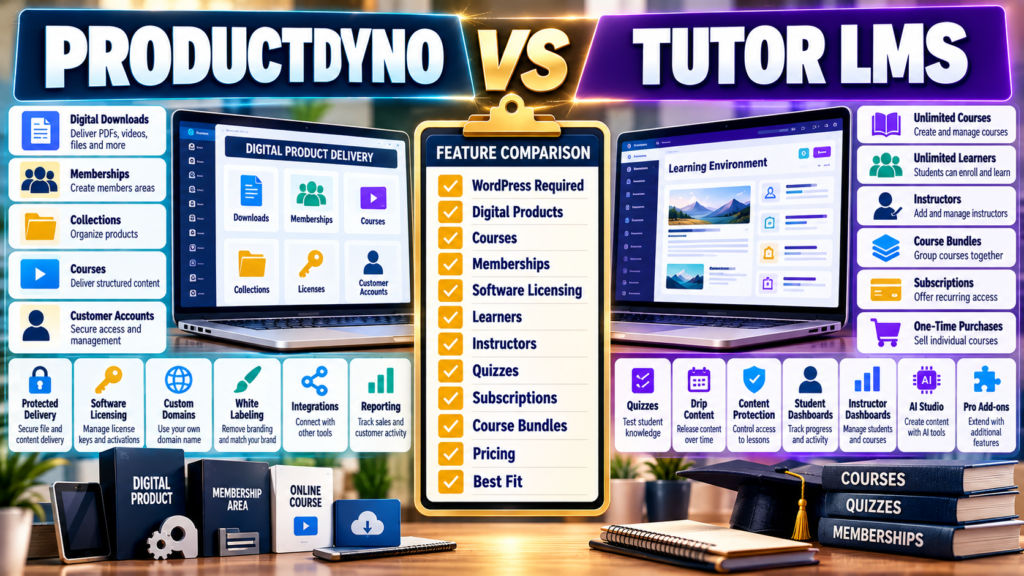
ProductDyno and Tutor LMS can both help deliver online courses.
But they are built around very different assumptions.
ProductDyno is a hosted digital-product platform.
It supports:
- Digital products.
- Memberships.
- Collections.
- Courses.
- Customer accounts.
- Software licensing.
Tutor LMS is a WordPress learning-management system.
Its current platform is strongly centered on:
- Courses.
- Learners.
- Instructors.
- Quizzes.
- Bundles.
- Subscriptions.
- Learning experience.
That means the central decision is:
Do you need a broader hosted digital-product environment—or a WordPress site dedicated to learning?
Review Methodology: This comparison is based on official ProductDyno and Tutor LMS information reviewed on September 25, 2026. No firsthand product testing or personal experience is claimed. ProductDyno currently displays more than one official offer, and Tutor LMS offers both annual and lifetime pricing. Prices and features may change, so verify current checkout terms before purchasing.
ProductDyno Current Principal Pricing
ProductDyno’s current principal pricing page lists:
Starter
$49/month billed annually
Growth Plus+
$69/month billed annually
Teach Pro+
$99/month billed annually.
ProductDyno Core Features
The same principal offer currently includes:
- Unlimited digital products.
- Unlimited memberships.
- Unlimited collections.
- Unlimited members/customers.
- Software/SaaS licensing.
- Unlimited custom domains.
- White-label branding removal.
- SSL.
- Integrations.
- Reporting.
- 0% ProductDyno transaction fee.
Teach Pro+ adds the LMS-oriented component.
ProductDyno Has Another Official Offer
ProductDyno also maintains a separate official offer advertising:
14-day test drive followed by $199/month.
Because multiple ProductDyno offers are currently live:
Verify the exact checkout attached to the promotion you intend to purchase.
Tutor LMS Has a Free Version
Tutor LMS currently offers:
Free — $0/year
with core course-building capability.
Its current free/pro comparison includes unlimited:
- Courses.
- Learners.
- Instructors.
That makes Tutor LMS attractive for testing a WordPress LMS before paying for Pro.
Tutor LMS Individual
Tutor LMS currently lists its annual Individual plan at:
$199/year
for:
1 site.
It includes:
- All Pro add-ons and features.
- Unlimited courses and users.
- Pro themes.
- AI Studio.
- Priority support.
- One year of updates.
AI Studio requires the user’s own OpenAI API key under the current offer.
Tutor LMS Business
The current Business plan is:
$399/year
for:
Up to 10 sites.
It includes the same overall Pro feature access with broader licensing.
Tutor LMS Agency
Agency currently costs:
$799/year
and the current pricing display says it is intended for agencies managing multiple projects.
The current annual plan display includes:
- Pro features.
- Unlimited courses/users.
- Pro themes.
- AI Studio.
- Priority support.
Tutor LMS Also Has Lifetime Pricing
Tutor LMS currently lists:
Individual Lifetime
$499 one-time
Business Lifetime
$999 one-time
Agency Lifetime
$1,999 one-time under the current public offer.
This is a major pricing-model difference from ProductDyno’s recurring hosted subscription.
WordPress Is the Biggest Difference
Tutor LMS runs inside WordPress.
That means your learning system depends on:
- Hosting.
- WordPress.
- Tutor LMS.
- Theme.
- Backups.
- Security.
- Plugin compatibility.
ProductDyno hosts the protected customer environment separately.
Tutor LMS Is Course-First
Tutor LMS is designed around learning.
Its current feature set includes areas such as:
- Course builder.
- Unlimited courses.
- Learner dashboard.
- Instructor dashboard.
- Multi-instructor support.
- Quizzes.
- Course attachments.
- Course prerequisites.
- Course bundles.
- Drip content.
- Content protection.
If courses are the main business:
That focus matters.
ProductDyno Is Product-First
ProductDyno treats courses as one product category within a broader digital-product platform.
You can also manage:
- Downloads.
- Memberships.
- Collections.
- Software licenses.
This can fit a business selling several different product types.
Course Bundles
Tutor LMS currently supports course bundles.
Its official documentation says bundles can use:
- One-time purchase.
- Subscription.
- Both subscription and one-time purchase.
That can support:
Three courses sold together
or:
Recurring access to a collection of training.
Subscriptions
Tutor LMS now supports more sophisticated course and bundle monetization under its current ecosystem.
Its bundle documentation includes recurring subscription options, billing cycles, enrollment-related settings, and one-time alternatives.
For a course business:
That can reduce dependence on separate membership logic.
Quizzes
Tutor LMS includes:
- Basic quiz building in its broader feature set.
- More advanced quiz functionality in Pro.
Its current Pro comparison mentions multiple advanced and interactive quiz types.
If assessment matters:
Tutor LMS deserves additional weight.
Multiple Instructors
Tutor LMS is designed to support multiple instructors.
Its current pricing comparison includes multi-instructor functionality within the learning-management feature set.
That can matter if:
- Experts teach different courses.
- You run a marketplace-style academy.
- Several team members create training.
ProductDyno is more oriented toward product ownership and delivery.
Learner Experience
Tutor LMS currently promotes:
- Modern learning interfaces.
- Learner dashboards.
- Notes and discussions.
- Resource downloads.
- Instructor/student views.
Those are LMS-centered capabilities.
If student progression is core to the value proposition:
Give this category substantial weight.
Software Licensing
This remains a major ProductDyno difference.
ProductDyno’s current principal plans include:
Software/SaaS Licensing Module.
If your catalog includes:
- WordPress plugins.
- SaaS.
- Desktop software.
- License-controlled applications.
ProductDyno is more directly designed for that use case.
Tutor LMS is not primarily a software-license-management platform.
Digital Downloads
Suppose your catalog contains:
- Ebook.
- Checklist.
- Templates.
- Course.
- Software.
ProductDyno’s broader digital-product architecture may fit naturally.
Tutor LMS can deliver course resources and attachments, but the entire platform is much more strongly organized around learning.
Hosting Responsibility
Tutor LMS
You control the WordPress environment.
Benefits:
- Ownership.
- Customization.
- Plugin ecosystem.
Responsibilities:
- Updates.
- Hosting.
- Security.
- Performance.
- Backups.
ProductDyno
The protected product environment is hosted by the service.
That reduces some WordPress-specific maintenance.
Tutor LMS May Fit Better If…
Consider Tutor LMS when:
- Courses are your main products.
- WordPress ownership matters.
- You want a free LMS starting point.
- Multiple instructors matter.
- Quizzes matter.
- Learner dashboards matter.
- Bundles and course subscriptions matter.
- You are comfortable maintaining WordPress.
ProductDyno May Fit Better If…
Consider ProductDyno when:
- You sell mixed digital products.
- Hosted delivery matters.
- Software licensing matters.
- Collections matter.
- You want customer access outside WordPress.
- You want fewer LMS-specific WordPress dependencies.
My ProductDyno Review for Beginners provides additional background.
Affiliate Disclosure: This article contains affiliate links. If you purchase through one of these links, I may earn a commission at no additional cost to you. Affiliate compensation does not determine the conclusions or recommendations presented in this article.
If ProductDyno matches your product-delivery requirements, you can review the current ProductDyno offer through this approved partner link.
Compare With ProductDyno vs LearnDash
Your verified ProductDyno vs LearnDash comparison provides another WordPress-LMS comparison.
That can help if your real decision is:
Hosted Digital-Product Platform
versus:
WordPress LMS
rather than one exact plugin.
Compare With ProductDyno vs LifterLMS
Your verified ProductDyno vs LifterLMS comparison provides another course-centered WordPress alternative.
Tutor LMS differs through its particular combination of:
- Free core.
- Annual Pro.
- Lifetime licenses.
- Multi-instructor features.
- AI Studio.
- Course bundles.
The Product-Mix Test
List your next five products.
Example A
- Ebook.
- Prompt pack.
- Membership.
- Course.
- Software.
ProductDyno may fit the mixed catalog more naturally.
Example B
- Beginner course.
- Advanced course.
- Instructor-led academy.
- Course bundle.
- Subscription learning library.
Tutor LMS may fit the course-centered model more naturally.
The WordPress Test
Ask:
Do I want learners accessing their courses inside my WordPress site?
If yes:
Tutor LMS deserves serious consideration.
If no:
Hosted delivery may be simpler.
The Pricing Test
Tutor LMS gives you several pricing models:
Free
Annual
Lifetime.
ProductDyno uses hosted recurring pricing under its principal offer.
Do not compare only first-year software cost.
Also include:
Tutor LMS
- Hosting.
- Security.
- Backup.
- Other WordPress plugins.
- Payment tools if required.
ProductDyno
- ProductDyno subscription.
- Website.
- Email.
- Checkout/payment tools in your actual workflow.
The Maintenance Test
If your goal is:
Maximum ownership and control
Tutor LMS gains weight.
If your goal is:
Lower WordPress maintenance
ProductDyno gains weight.
Neither is universally correct.
A Simple Buying Scorecard
Score each 1–5:
Digital Downloads
Courses
Memberships
Learner Experience
Multiple Instructors
Quizzes
Course Bundles
Subscriptions
Software Licensing
WordPress Ownership
Hosted Delivery
Maintenance
Annual Cost
Lifetime Option
Double-weight your three most important requirements.
Conclusion
ProductDyno and Tutor LMS overlap in courses and memberships, but their center of gravity is different.
ProductDyno emphasizes:
Digital Products → Hosted Delivery → Memberships → Collections → Courses → Software Licensing
Tutor LMS emphasizes:
WordPress → Courses → Learners → Instructors → Quizzes → Bundles → Learning Experience
ProductDyno may fit better when the business sells several types of digital products and wants hosted delivery.
Tutor LMS may fit better when the business is primarily an online academy and you want WordPress to own the learning environment.
Your Next Action
Write down your next five paid offers.
Mark each:
Download | Course | Membership | Course Bundle | Subscription | Software
Then answer:
Need multiple instructors? Yes / No
Need advanced quizzes? Yes / No
Need software licensing? Yes / No
Want WordPress to control the learner experience? Yes / No
Prefer annual or lifetime LMS pricing? _____
Want to minimize WordPress maintenance? Yes / No
Next, calculate the complete first-year and three-year cost for both setups.
Finally, map one real customer journey:
Sales Page → Payment → Account → Enrollment → Course/Product Access → Progress → Support
Choose the platform that best fits the products you actually plan to sell and the maintenance model you are willing to manage.