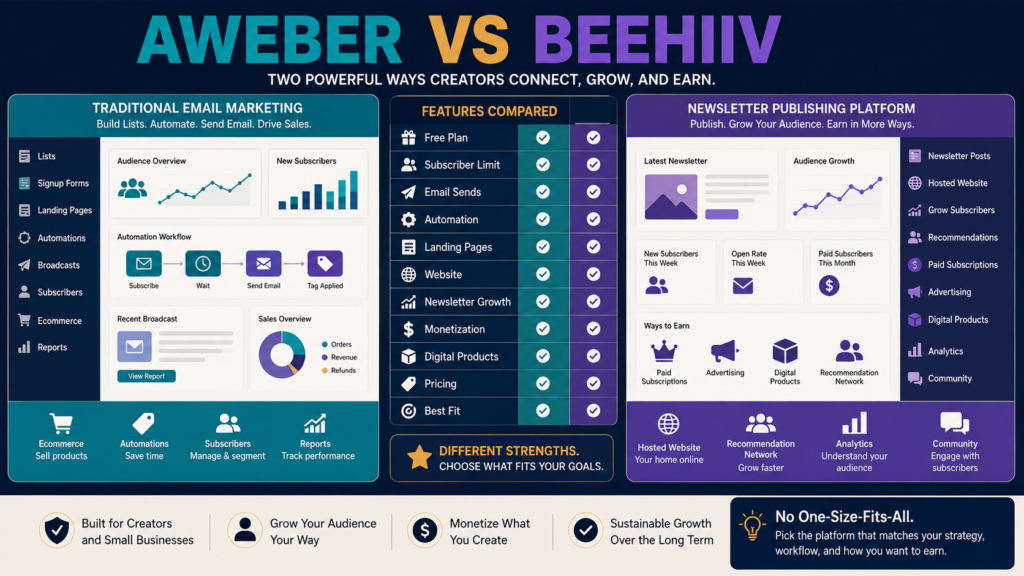
AWeber and beehiiv can both help a creator build an email audience.
But they start from different ideas about what the business is trying to build.
AWeber is primarily an email-marketing platform.
Its traditional strengths revolve around subscriber management, signup forms, landing pages, broadcasts, automations, segmentation, ecommerce, and integrations.
beehiiv is primarily a newsletter publishing and growth platform.
Its current offering combines newsletters with a hosted website, recommendation tools, audience growth, paid subscriptions, advertising opportunities, digital products, analytics, and other publisher-focused features.
For a beginner, the easiest decision framework is:
Choose AWeber when email marketing supports the business.
Give beehiiv stronger consideration when the newsletter itself is a major part of the business.
Neither platform automatically wins every category.
Review Methodology: This comparison is based on official AWeber and beehiiv information reviewed on September 3, 2026. No firsthand product testing or personal product-use claim is made. Pricing, promotions, plan limits, and features may change, so verify the current offer before purchasing.
Start With the Business You Want to Build
Imagine two creators.
Creator A
Wants:
- Lead magnet.
- Signup page.
- Welcome sequence.
- Weekly emails.
- Affiliate promotions.
- Occasional digital-product sales.
Email supports a broader online business.
Creator B
Wants:
- Newsletter publication.
- Public newsletter website.
- Audience growth network.
- Paid newsletter option.
- Advertising opportunities.
- Referral or recommendation tools.
- Newsletter-centered monetization.
The newsletter is closer to the product.
Both need email.
Their platform priorities are different.
AWeber’s Current Plan Structure
AWeber’s official documentation currently lists four main plans:
- AWeber Free.
- AWeber Lite.
- AWeber Plus.
- AWeber Unlimited.
The current Free plan supports up to 500 subscribers and 3,000 emails per month, with one list profile and one workflow automation.
At 500 subscribers, AWeber’s official help documentation currently lists:
- Lite: $15 per month monthly, or $150 annually, equivalent to $12.50 per month when billed annually.
- Plus: $30 per month monthly, or $240 annually, equivalent to $20 per month when billed annually.
Sending allowances and prices increase with subscriber count.
You can review the latest details in AWeber’s official pricing documentation.
beehiiv’s Current Plan Structure
beehiiv’s current pricing page displays:
Launch
$0 per month, supporting up to 2,500 subscribers at the current listed level.
Current Launch features include:
- Newsletters.
- Website.
- Podcast.
- Campaign analytics.
- Unlimited email sends.
- Recommendation Network.
- Custom domains.
- Other publishing features.
Scale
The current page displays $43 per month when billed annually, or $517 per year in its displayed configuration.
Scale adds features including:
- Ad Network.
- Recommendations.
- 0% beehiiv take rate on paid subscriptions.
- Digital products.
- Email automations.
- Surveys and polls.
- Advanced website analytics.
- Webhooks.
- Human support.
Max
The current page displays $96 per month when billed annually, or $1,151 per year in its displayed configuration, adding features such as branding removal, sponsorship tools, audio newsletters, additional publication capacity, priority support, dynamic content, and other advanced capabilities.
Because pricing presentations and subscriber tiers can change, verify your actual list size and checkout before purchasing.
You can see the current plans on beehiiv’s official pricing page.
Free Plan: beehiiv Currently Offers More Subscriber Headroom
For a beginner comparing free entry points, this is a noticeable difference.
AWeber’s official documentation currently caps its Free plan at:
500 subscribers
and:
3,000 monthly emails.
beehiiv’s current Launch plan lists:
Up to 2,500 subscribers
with:
Unlimited email sends.
That makes beehiiv’s free tier attractive for someone whose immediate priority is building a newsletter audience without paying as quickly.
But subscriber allowance should not decide the entire platform choice.
Ask what features you will need after the list grows.
Traditional Email Marketing: AWeber Has the More Familiar Structure
AWeber’s design is closer to what many online marketers expect from an autoresponder.
The typical workflow is:
Signup Form → Subscriber → Tag/List → Automation → Broadcast → Offer
That is useful for:
- Lead magnets.
- Affiliate marketing.
- Digital-product funnels.
- Customer onboarding.
- Promotional sequences.
- Newsletter-style broadcasts.
If your email list is one component inside a broader funnel, AWeber’s traditional email-marketing orientation may feel natural.
My AWeber review for beginners provides a closer look at AWeber by itself.
Newsletter Publishing: beehiiv Has the Clearer Publisher Orientation
beehiiv approaches the email audience more like a publication.
The platform combines:
- Email newsletters.
- Web publication.
- Audience growth.
- Recommendations.
- Analytics.
- Monetization.
- Paid subscriptions.
- Advertising tools.
That can reduce the need to assemble a separate newsletter website and several growth tools.
If you want readers to think of your email as:
“Michael’s weekly newsletter publication”
rather than:
“Michael’s email list”
beehiiv’s positioning may fit that model better.
Automation
Automation deserves careful comparison.
AWeber’s Free plan currently includes one workflow automation.
Its paid tiers increase automation capacity, with Plus positioned for broader feature access.
beehiiv includes more substantial email automations on its Scale plan rather than treating advanced automation as a core free-plan capability.
That means:
AWeber may be more familiar for traditional:
Trigger → Sequence → Tag → Follow-Up
workflows.
beehiiv may be better when automations support the newsletter publishing and monetization system.
Do not compare the word “automation.”
Compare the actual sequence you need.
Landing Pages and Signup Forms
AWeber includes signup forms and landing-page tools as central parts of its list-building environment.
That is useful for businesses using:
Blog Post → Lead Magnet Page → Signup Form → Email Sequence
beehiiv also provides website and subscriber-capture capabilities, but its broader website is designed around the publication itself.
Ask:
Do I want a landing page attached to my marketing funnel, or a hosted publication site attached to my newsletter?
That distinction may be more important than the number of templates.
Website Capability
beehiiv’s free Launch plan currently includes website hosting as part of the publication platform.
For a newsletter-first creator, that can be significant.
You can build a public home for:
- Newsletter posts.
- Archives.
- Subscriber signup.
- Publication content.
AWeber provides landing pages rather than positioning itself as a full newsletter publishing website.
If you already have WordPress, this difference may matter less.
You may prefer your main public content to remain on your own website and use AWeber primarily for email.
Newsletter Growth Tools
beehiiv places substantial emphasis on growth mechanisms.
Its current free plan includes its Recommendation Network, while higher plans include additional recommendation and growth capabilities.
This is one of beehiiv’s strongest distinctions.
A newsletter publisher may value platform-native audience discovery.
An online marketer whose main traffic comes from:
- Google.
- YouTube.
- Affiliate content.
- Paid ads.
- Existing website visitors.
may care less.
Choose based on where you expect subscriber growth to come from.
Paid Newsletter Monetization
beehiiv strongly emphasizes direct newsletter monetization.
Current Scale features include:
- Paid subscriptions.
- 0% beehiiv platform take rate on paid subscriptions, with payment processing still handled separately.
- Advertising network access.
- Digital products.
That is attractive when the newsletter itself is expected to produce revenue.
AWeber’s ecommerce features are more aligned with using email to sell products, services, subscriptions, and offers.
The difference is subtle but important:
AWeber: Email helps sell the business’s offers.
beehiiv: The newsletter can itself become one of the offers.
Digital Products
Both ecosystems can participate in digital-product selling, but differently.
AWeber supports ecommerce-related capabilities inside its email and landing-page environment.
beehiiv currently includes digital products on Scale.
If digital products are your main business, however, you may still prefer a dedicated checkout and delivery system rather than asking the email platform to do everything.
Do not select an email platform based only on whether a digital-product checkbox appears in the features list.
Evaluate the entire purchase and delivery workflow.
Sending Limits Matter
AWeber’s paid Lite and Plus plans currently tie email-send allowances to subscriber count.
Lite allows approximately ten times the subscriber count per month under its current documentation.
Plus allows approximately twelve times the subscriber count.
beehiiv’s listed plans currently advertise unlimited sends.
This could matter for high-frequency newsletter publishers.
Suppose you have 10,000 subscribers and send daily.
Calculate the actual monthly send volume before choosing.
A weekly sender and daily publisher have very different requirements.
List Management vs Publication Management
AWeber’s mental model is largely:
Subscribers and marketing campaigns.
beehiiv’s mental model is more:
Audience and publication.
Neither model is superior.
The right one should resemble how you think about your business.
AWeber May Fit Better If…
Consider AWeber when:
- You want a traditional autoresponder.
- Your list supports affiliate or product funnels.
- Signup forms and landing pages matter.
- You want familiar subscriber automation.
- Your main content lives on WordPress or another website.
- Newsletter publishing is not the entire business.
The existing AWeber vs MailerLite comparison can also help if your priority is a simpler conventional email-platform decision.
Affiliate Disclosure: This article contains affiliate links. If you purchase through one of these links, I may earn a commission at no additional cost to you. Affiliate compensation does not determine the conclusions or recommendations presented in this article.
If AWeber fits the workflow you need, you can review the current AWeber offer through this approved partner link.
beehiiv May Fit Better If…
Consider beehiiv when:
- You are building a newsletter-first business.
- A hosted publication website matters.
- The free subscriber allowance is attractive.
- Newsletter recommendation tools matter.
- Paid subscriptions are important.
- Newsletter advertising is part of the plan.
- Publication growth is central to the business.
Consider GetResponse if You Need a Broader Marketing Stack
There is also a third type of decision.
Some creators want:
- Email.
- Automation.
- Funnels.
- Webinars.
- Courses.
- Broader marketing tools.
My GetResponse vs beehiiv comparison examines that broader-marketing-platform alternative.
Use a Five-Question Buying Test
Before choosing, answer:
1. Is my newsletter the product or a marketing channel?
This may be the most important question.
2. Where will my main public content live?
WordPress?
Or the newsletter platform?
3. Do I need traditional autoresponder workflows?
Write the actual automation.
4. How often will I email?
Estimate monthly sending volume.
5. How do I expect the list to make money?
Affiliate offers?
Digital products?
Paid subscriptions?
Advertising?
The answer changes the platform fit.
Conclusion
AWeber and beehiiv overlap because both can build and email an audience.
But they are optimized around different business models.
AWeber is the more traditional email-marketing choice for creators who want subscriber management, signup forms, landing pages, broadcasts, automations, and ecommerce capabilities supporting a broader online business.
beehiiv is the more publication-centered option for creators who want newsletters, a hosted website, platform-native growth tools, paid subscriptions, advertising, and newsletter monetization in one environment.
For a beginner running a conventional online business, AWeber may feel more familiar.
For a creator intentionally building a newsletter company, beehiiv may offer the more natural system.
Do not decide from the free subscriber limit alone.
Choose the platform whose structure resembles the business you actually intend to operate.