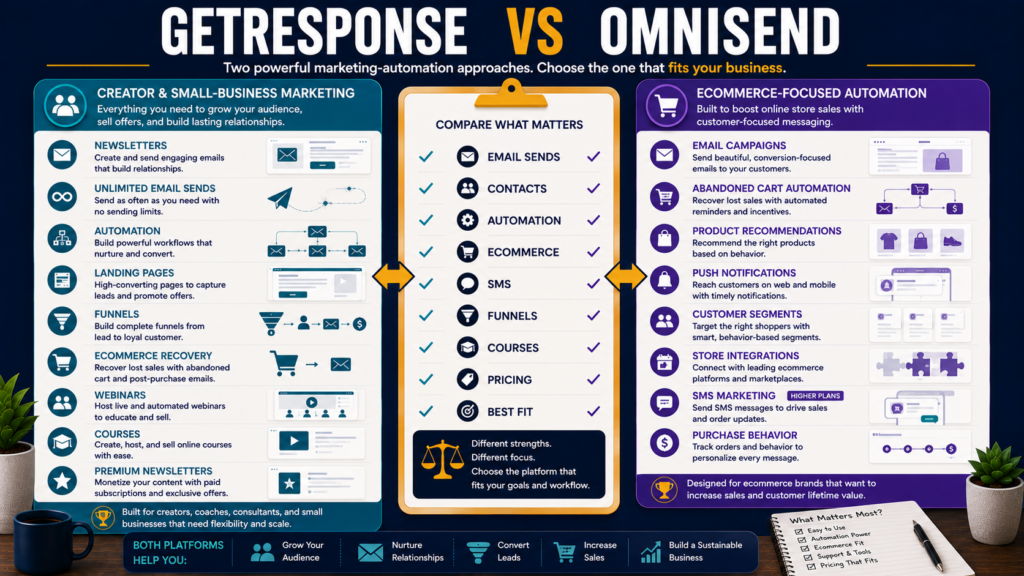
GetResponse and Omnisend both provide email marketing, automation, segmentation, ecommerce integrations, and customer communication.
That makes them legitimate alternatives for an online business.
But their priorities are different.
GetResponse is a broader marketing platform that combines email with landing pages, sales funnels, ecommerce automation, webinars, courses, premium newsletters, and creator monetization.
Omnisend focuses more tightly on ecommerce communication, with email campaigns, store-driven automation, segmentation, push notifications, and SMS capabilities concentrated around online retail workflows.
The practical question is:
Is ecommerce the center of your business—or do you need a broader creator and digital-marketing system?
Review Methodology: This review is based on official product information, available documentation, and publicly available details reviewed on August 30, 2026. No firsthand product testing or personal experience is claimed.
Affiliate Disclosure: This article contains affiliate links. If you purchase through one of these links, I may earn a commission at no additional cost to you. Affiliate compensation does not determine the conclusions or recommendations presented in this article.
If GetResponse’s broader marketing approach fits your needs, you can review GetResponse through my affiliate link.
Quick Verdict
GetResponse may be better if you want email marketing combined with unlimited monthly sends on its standard paid plans, sales funnels, webinars, courses, premium newsletters, and broader creator tools.
Omnisend may be better if your business centers on an ecommerce store and you want email automation, customer behavior, store integrations, web push, and—on the appropriate current plan—SMS designed around ecommerce workflows.
For a course creator or digital-product publisher, GetResponse has the broader native toolset.
For a conventional ecommerce store, Omnisend deserves stronger consideration.
GetResponse Pricing
At the current 1,000-contact starting level, GetResponse lists:
Starter
$19/month on monthly billing.
$15.58/month equivalent when paid annually.
Marketer
$59/month.
$48.38/month equivalent annually.
Creator
$69/month.
$56.58/month equivalent annually.
All three standard paid plans currently include unlimited monthly email sends.
Pricing scales with list size.
Omnisend Pricing
Omnisend currently offers:
Free
$0/month.
Up to 500 emails per month to a maximum of 250 unique contacts.
Standard
Starts at $16/month.
Email allowance equals the billable-contact count multiplied by 12 during the billing cycle.
Pro
Starts at $59/month.
Includes unlimited email sending and web push notifications, with SMS available using volume-based pricing for newer subscribers.
This creates a substantial difference in how sending volume is handled.
Unlimited Sends vs Email Credits
GetResponse’s standard paid plans currently advertise unlimited monthly sends.
Omnisend Standard uses:
Billable contacts × 12
for monthly email credits.
For example, Omnisend’s documentation gives 3,000 contacts as an example producing 36,000 monthly email credits.
Omnisend Pro removes that email limit.
If you send frequent broadcasts plus many automations, calculate expected volume.
How Contacts Are Counted
Omnisend currently says billable contacts include both subscribers and non-subscribers used within its marketing database, with pricing tiers adjusting as the billable list grows.
GetResponse pricing also scales with contact/list size and can increase as the active subscriber count reaches higher tiers.
Do not compare only:
$16 vs $19.
Compare the price at your actual database size.
Free Plan
Omnisend currently provides a permanent Free plan that lets a user test its feature set with limited sending: up to 500 emails monthly to 250 unique contacts.
GetResponse currently provides a 14-day premium-feature trial with plan-specific limitations before the regular paid-plan decision.
For a very small ecommerce store testing email automation, Omnisend’s permanent free tier can be useful.
Email Marketing
Both can manage:
- Campaigns.
- Subscribers.
- Segmentation.
- Automated emails.
- Reporting.
- Ecommerce integrations.
For simple:
signup → welcome emails → newsletter
either can perform the basic job.
The difference becomes clearer when ecommerce behavior becomes central.
Ecommerce Automation
GetResponse Marketer includes features such as:
- Abandoned-cart recovery.
- Promo codes.
- Product recommendations.
- Revenue tracking.
- Advanced segmentation.
- Sales funnels.
This makes GetResponse a capable ecommerce marketing option.
Omnisend, however, is designed primarily around ecommerce marketing and customer behavior.
For a store whose customer lifecycle is dominated by:
- Browsing.
- Cart activity.
- Purchases.
- Repeat orders.
- Product recommendations.
Omnisend’s specialization deserves attention.
SMS Changed for New Omnisend Customers in 2026
This is a current detail older reviews may miss.
Omnisend says that for customers subscribing to paid plans on or after May 4, 2026:
- Free: SMS unavailable.
- Standard: SMS unavailable.
- Pro: SMS available through volume-based pricing beginning at $0.007 per message for eligible U.S./Canada usage.
Older customers may have legacy arrangements.
A current buyer should use the current plan rules rather than an old review.
Web Push
Omnisend Standard and Pro include unlimited push notifications according to its current pricing documentation.
GetResponse Marketer and Creator currently include unlimited web push notifications as well.
If push notifications matter, both deserve evaluation.
Automation
GetResponse Starter provides one custom automation workflow.
Marketer and Creator provide unlimited automation workflows and broader behavioral/ecommerce elements.
Omnisend gives Free users access to its feature set within the plan’s communication limits, while Standard and Pro increase sending and scale.
For ecommerce, compare the exact triggers your store needs.
Sales Funnels
GetResponse has a clear advantage if you specifically want built-in sales funnels.
Marketer and Creator currently include funnel functionality alongside email and ecommerce automation.
Omnisend is more centered around messaging and store behavior than operating as a broad sales-funnel builder.
If you already use a separate storefront and checkout system, that distinction may not matter.
Courses and Knowledge Products
GetResponse Creator includes:
- Course creator.
- Up to 500 students.
- Webinars.
- Premium newsletter subscriptions.
- Website builder.
This makes GetResponse noticeably broader for:
- Educators.
- Coaches.
- Course sellers.
- Paid-newsletter creators.
Omnisend is not primarily positioned as a course-hosting platform.
Who Is Omnisend Best Suited For?
Omnisend becomes especially attractive when the business is built around a store.
Examples:
- Apparel.
- Beauty.
- Home goods.
- Physical-product ecommerce.
- Repeat-purchase retail.
- Store catalogs.
- Product-based ecommerce.
The value comes from aligning messaging with store behavior.
Who Is GetResponse Better Suited For?
GetResponse may align more naturally with:
- Lead magnets.
- Email newsletters.
- Digital products.
- Webinars.
- Courses.
- Paid newsletters.
- Sales funnels.
- Creator businesses.
- Ecommerce businesses that also need broader marketing tools.
Compare GetResponse With Other Platforms
If ecommerce is not your main concern, the verified GetResponse vs Brevo comparison examines a broader multichannel platform.
For creator-centered email and commerce, the verified GetResponse vs Flodesk comparison provides another angle.
And the GetResponse review for beginners looks at GetResponse itself rather than comparing it with another platform.
Calculate the Actual Workflow
Before buying, write down:
- Number of contacts.
- Emails sent each month.
- Store platform.
- Abandoned-cart needs.
- Product recommendations.
- SMS needs.
- Web push needs.
- Sales funnels.
- Courses.
- Webinars.
- Digital products.
Then choose based on required functions.
GetResponse May Be Better If You Need
- Unlimited sending on standard paid plans.
- Lead generation.
- Landing pages.
- Advanced marketing automation.
- Sales funnels.
- Ecommerce recovery.
- Webinars.
- Online courses.
- Premium newsletters.
- Broader creator tools.
Omnisend May Be Better If You Need
- Ecommerce-first automation.
- Store-driven customer messaging.
- A permanent Free starting tier.
- Email plus push.
- SMS through the current Pro structure.
- Messaging built closely around shopping behavior.
- A platform whose primary use case is ecommerce.
Migration Cost Matters
If you already have a functioning email system, switching means rebuilding:
- Subscriber segments.
- Automations.
- Forms.
- Authentication.
- Templates.
- Ecommerce integrations.
- Campaign history.
- Tracking.
A new platform should solve a real problem.
Do not switch simply because another product has a lower starting price.
Final Verdict
GetResponse vs Omnisend is primarily a question of business model.
GetResponse is the stronger candidate for a creator or diversified online business that needs email, funnels, ecommerce automation, webinars, courses, and premium newsletters in one broader platform.
Omnisend is the stronger candidate when ecommerce behavior and store-driven messaging are the center of the marketing strategy.
Both can handle email automation.
The better choice depends on what happens after the subscriber joins your list.
Conclusion
If your customer journey looks like:
Lead magnet → email sequence → webinar → digital product or course
GetResponse may fit more naturally.
If the journey looks like:
Store visitor → product view → cart → purchase → repeat order
Omnisend may fit more naturally.
Calculate your contact count and sending volume, review the current plan rules, and test the specific ecommerce or creator workflow you actually need.