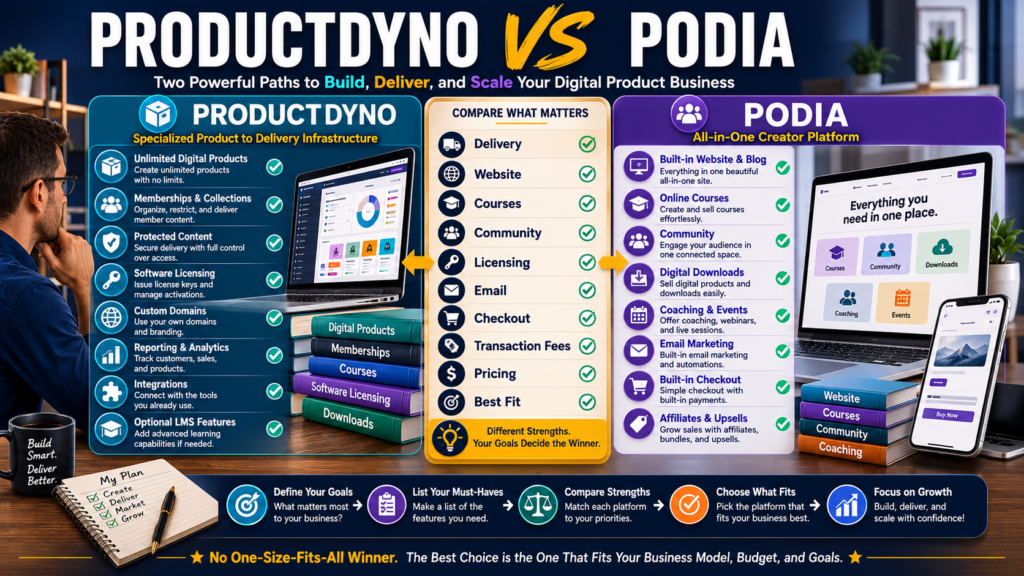
ProductDyno and Podia can both help run a digital-product business.
Both can support products and customer access.
Both can play a role in courses.
Both can serve creators.
But their product philosophies are different.
ProductDyno emphasizes specialized digital-product infrastructure: protected delivery, memberships, collections, customers, software licensing, custom domains, integrations, and optional LMS capabilities.
Podia emphasizes an all-in-one creator-business environment combining a website, blog, courses, downloads, community, coaching, events, landing pages, email marketing, checkout, and related selling tools.
That means the central question is:
Do you want a specialized delivery layer that works with an existing business stack—or a broader creator platform that can replace several tools?
Review Methodology: This review is based on official product information, available documentation, and publicly available details reviewed on August 29, 2026. No firsthand product testing or personal experience is claimed.
Affiliate Disclosure: This article contains affiliate links. If you purchase through one of these links, I may earn a commission at no additional cost to you. Affiliate compensation does not determine the conclusions or recommendations presented in this article.
Quick Verdict
ProductDyno may be the better fit if you already have WordPress, email marketing, checkout, and funnels and primarily need secure product delivery, memberships, collections, customer access, domains, and software licensing.
Podia may be the better fit if you want your website, blog, courses, downloads, community, email, checkout, and selling tools inside one creator platform.
For software licensing, ProductDyno has a clearer specialization.
For replacing multiple creator tools with one platform, Podia has the stronger case.
What Is ProductDyno?
ProductDyno’s current pricing pages emphasize:
- Unlimited digital products.
- Unlimited memberships.
- Unlimited collections.
- Unlimited members/customers.
- Software/SaaS licensing.
- Unlimited custom domains.
- White-label options.
- Integrations.
- Reporting.
- Optional LMS capability on higher configurations.
You can review ProductDyno through my affiliate link.
The verified ProductDyno review for beginners provides a broader introduction.
What Is Podia?
Podia’s current platform includes:
- Online courses.
- Digital downloads.
- Coaching.
- Community.
- Events.
- Website.
- Custom-domain support.
- Blog.
- Landing pages.
- Built-in checkout.
- Email marketing.
- Integrations.
- Migration assistance.
Higher plans add features such as:
- Affiliate marketing.
- Upsells.
- PayPal.
- Zapier.
- Higher product/community limits.
Podia Pricing
Podia currently offers:
Mover
$49/month on monthly billing or $42/month equivalent when paid annually.
The annual plan is currently $504.
Mover includes:
- 50 products.
- 500 videos.
- 25 community spaces.
- Up to 100 included email subscribers.
- Unlimited customers.
It charges a 5% Podia transaction fee.
Shaker
$99/month or $84/month equivalent annually.
Includes:
- 150 products.
- 1,000 videos.
- 100 community spaces.
- Up to 500 email subscribers.
- Affiliate marketing.
- Upsells.
- PayPal.
- Zapier.
Podia charges no platform transaction fee on this plan.
Earthquaker
$179/month or $150/month equivalent annually.
Includes:
- Unlimited products.
- Unlimited videos.
- Unlimited spaces.
- Unlimited assistants.
- Up to 1,000 included email subscribers.
There is no Podia transaction fee on this plan.
Payment processors can still charge their normal processing fees.
Podia Trial
Podia currently offers a 30-day free trial without requiring a credit card at signup.
That provides enough time to test:
- Product setup.
- Course structure.
- Website builder.
- Community.
- Checkout.
- Email.
Use the trial to build a real test workflow, not simply browse menus.
ProductDyno Pricing Requires Careful Verification
This is one area where buyers should slow down.
ProductDyno currently has more than one official pricing page showing materially different public offers.
One current page promotes a 14-day test drive followed by $199/month.
Another current official pricing page promotes a “Summer Special” with annual billing at monthly equivalents of:
- Starter: $49/month.
- Growth Plus+: $69/month.
- Teach Pro+: $99/month.
That page also advertises unlimited digital products, memberships, customers, custom domains, software licensing, and 0% ProductDyno transaction fees.
Because both official pages are live, verify the actual checkout, renewal price, included add-ons, and billing term immediately before purchase.
The Core Business Difference
A useful simplification is:
ProductDyno
Delivery infrastructure.
Podia
Creator-business platform.
ProductDyno is designed to work as a specialized layer around products and customer access.
Podia wants to handle more of the entire creator operation.
Website
Podia includes a website builder and blog in every current paid plan.
That can replace a separate WordPress site for some creators.
ProductDyno supports custom domains and product/member experiences but is not primarily a traditional content-site or blogging platform.
If you already have a WordPress site you like, Podia’s website feature may duplicate something you already own.
Courses
Both can support course businesses.
Podia includes online courses across its current plans.
ProductDyno offers course and LMS capabilities, with its Teach Pro+ pricing page specifically adding an LMS module.
Compare:
- Lesson structure.
- Quizzes.
- Student progress.
- Certificates.
- Community integration.
- Video hosting.
- Customer access.
Do not assume every platform’s course experience is identical.
Digital Downloads
Both can handle downloadable products.
Examples:
- Ebooks.
- Worksheets.
- Templates.
- ZIP bundles.
- PDFs.
- Audio.
- Videos.
Podia integrates those directly with its website and checkout.
ProductDyno is particularly oriented toward protecting and delivering purchased access.
Community
Podia has a significant advantage if community is central.
Current plans include community spaces, with the number increasing by tier.
Podia also supports paid community plans with recurring monthly or annual access.
ProductDyno can manage memberships, but Podia positions community as a core creator-platform feature.
Memberships
ProductDyno explicitly supports unlimited memberships on its currently promoted pricing plans.
Podia can create community plans and recurring product access.
Ask whether your membership is primarily:
protected content delivery
or:
community participation plus products and content.
That distinction may determine the better platform.
Software Licensing
This is a strong ProductDyno differentiator.
Its current plans advertise a Software/SaaS Licensing Module.
That can matter for:
- Plugins.
- Software downloads.
- Web applications.
- Licensed tools.
Podia is not primarily marketed as specialized software-license infrastructure.
If licensing is central to the product, ProductDyno should receive more weight.
Checkout
Podia includes built-in checkout across its current platform.
This can simplify the stack.
ProductDyno can integrate with external payment systems and sales tools.
That modular structure may appeal to creators already using a dedicated checkout platform.
Email Marketing
Podia includes email functionality within the platform.
Each plan includes a base number of email subscribers:
- Mover: 100.
- Shaker: 500.
- Earthquaker: 1,000.
Additional subscriber capacity can be purchased as needed.
ProductDyno relies more heavily on integrations with external email platforms.
If you already use GetResponse or AWeber, this may not be a disadvantage.
Affiliate Marketing
Podia includes affiliate marketing beginning with Shaker.
ProductDyno can connect with other sales and affiliate systems rather than replacing them.
This is another example of:
all-in-one vs modular.
Upsells
Podia Shaker and Earthquaker currently include upsells.
ProductDyno’s value proposition is more focused on what happens after entitlement and purchase are established through the surrounding stack.
If upselling is central, determine which checkout platform you intend to use before comparing.
Transaction Fees
This comparison is important.
ProductDyno Promotional Pricing Page
Advertises 0% ProductDyno transaction fee.
Podia Mover
5% Podia fee per sale.
Podia Shaker and Earthquaker
0% Podia transaction fee.
Payment-processor charges can still apply.
Calculate the Mover Break-Even Question
Suppose a creator sells $1,000 per month through Podia Mover.
The 5% Podia fee would be:
$50
in addition to the subscription and payment-processing cost.
At higher revenue, Shaker’s higher monthly subscription but 0% Podia transaction fee may become more attractive.
Do the calculation with your own expected sales.
Product Limits
ProductDyno currently advertises unlimited products across the promoted Starter, Growth Plus+, and Teach Pro+ plans.
Podia currently limits products by tier:
- Mover: 50.
- Shaker: 150.
- Earthquaker: Unlimited.
For many solo creators, 50 products may already be far more than necessary.
Do not pay for “unlimited” simply because it sounds better.
ProductDyno May Be Better If You Want
- Specialized secure delivery.
- Unlimited digital products.
- Unlimited memberships.
- Collections.
- Customer access management.
- Custom domains.
- Software/SaaS licensing.
- Integrations with your existing stack.
- Optional LMS functionality.
- No ProductDyno transaction percentage under the current promotional plans.
The verified ProductDyno vs Payhip comparison is useful if you are also considering a storefront-centered alternative.
Podia May Be Better If You Want
- Website.
- Blog.
- Digital downloads.
- Courses.
- Coaching.
- Events.
- Community.
- Landing pages.
- Email marketing.
- Built-in checkout.
- Affiliate marketing on higher plans.
- Upsells.
- Fewer separate platforms.
The verified ProductDyno vs LearnWorlds comparison provides another useful perspective if course delivery is the main decision.
Existing Tools May Decide the Winner
Imagine you already own:
- WordPress.
- GetResponse.
- ThriveCart.
- Product pages.
- Affiliate tracking.
Podia could duplicate several working systems.
ProductDyno may fit neatly as the product-delivery layer.
Now imagine you are starting from zero and need:
website → blog → email → checkout → course → community.
Podia may eliminate substantial setup.
The same platform can therefore be a great fit for one business and unnecessary duplication for another.
Migration Matters
If you switch later, consider:
- Customer records.
- Recurring subscriptions.
- Course enrollments.
- Membership access.
- Email subscribers.
- Product files.
- Checkout links.
- Affiliate links.
- Website URLs.
An all-in-one system can be simpler day to day while making future migration broader.
A modular system can involve more tools but allow one component to be replaced independently.
Final Verdict
ProductDyno and Podia are not merely two course platforms.
ProductDyno is best understood as specialized product-access, membership, delivery, and licensing infrastructure designed to connect with other marketing tools.
Podia is best understood as a broader creator-business platform that combines website, blog, products, courses, community, email, checkout, and selling tools.
Choose ProductDyno if you already have a strong marketing stack and need the delivery layer.
Choose Podia if replacing several separate creator tools with one platform is the larger goal.
Conclusion
The ProductDyno vs Podia decision becomes easier when you list what your business already has.
If you already have:
website + email + checkout + funnels
ask whether you really need another all-in-one platform.
If you are still assembling:
website + products + courses + community + email + checkout
Podia may simplify the setup.
If specialized memberships, software licensing, protected delivery, and integration with an existing stack matter more, ProductDyno may provide the better fit.
Verify the current checkout pricing—especially ProductDyno’s currently differing public offers—and choose the platform that removes the most real work without unnecessarily replacing tools that already function well.