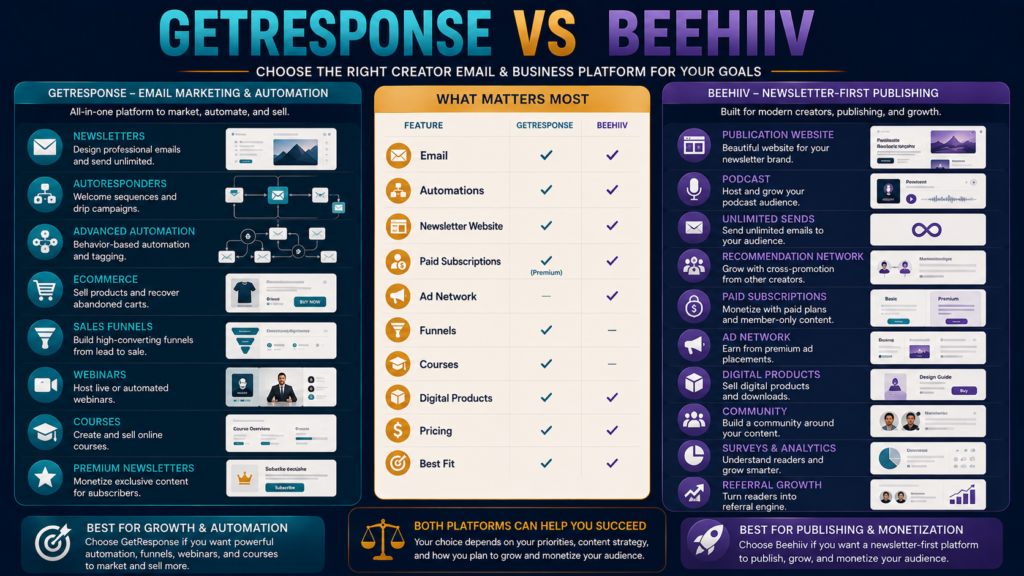
GetResponse and beehiiv both let creators build email audiences.
That makes them look like direct competitors.
But the platforms approach email from different directions.
GetResponse is a broad email-marketing and marketing-automation platform. Its current lineup includes email campaigns, autoresponders, landing pages, automation, segmentation, ecommerce tools, sales funnels, webinars, courses, premium newsletters, and other creator tools depending on plan.
beehiiv is much more newsletter-first. Its current plans combine newsletters with a hosted publication website, recommendation network, unlimited email sending, newsletter analytics, paid subscriptions, advertising, digital products, community features, surveys, and other newsletter-growth functionality.
The better choice depends on whether your business starts with:
email marketing
or:
a newsletter publication.
Review Methodology: This review is based on official product information, available documentation, and publicly available details reviewed on August 23, 2026. No firsthand product testing or personal experience is claimed.
Key Takeaways
GetResponse’s current U.S. pricing presentation lists Starter at $19/month, Marketer at $59/month, and Creator at $69/month for the entry contact level shown, with annual discounts available. Its standard paid plans include unlimited monthly email sends.
beehiiv currently offers a free Launch plan for up to 2,500 subscribers with unlimited email sends. Its Scale plan is currently shown at $43/month when billed annually at $517/year, while Max is shown at $96/month when billed annually at $1,151/year.
beehiiv Scale adds newsletter monetization and growth features including its Ad Network, recommendation functionality, 0% platform take rate on paid subscriptions, digital products, community, automations, surveys and polls, advanced website analytics, and team access.
GetResponse becomes more attractive when the creator needs email marketing to connect with funnels, ecommerce automation, webinars, courses, and broader lifecycle marketing.
Affiliate Disclosure: This article contains affiliate links. If you purchase through one of these links, I may earn a commission at no additional cost to you. Affiliate compensation does not determine the conclusions or recommendations presented in this article.
What Is GetResponse?
GetResponse is an email-marketing and automation platform.
Its current standard plans are:
- Starter.
- Marketer.
- Creator.
- Enterprise.
Its feature set extends beyond sending newsletters into:
- Landing pages.
- Marketing automation.
- Ecommerce.
- Funnels.
- Webinars.
- Course creation.
- Premium newsletters.
Explore GetResponse through Michael’s approved affiliate link
MichaelELeeReviews also has a complete standalone review:
GetResponse Review for Beginners
What Is beehiiv?
beehiiv is built around operating a newsletter publication.
Even the free Launch plan currently includes:
- Newsletters.
- Website.
- Podcast.
- Campaign analytics.
- Unlimited email sends.
- Recommendation network.
- Custom domains.
- AI website builder.
- API access.
That makes it less like a traditional email-service provider and more like a newsletter publishing system.
The Core Difference
A useful simplification:
GetResponse
Marketing system with email at the center.
beehiiv
Newsletter business with publishing at the center.
This distinction explains much of the feature difference.
Free Plan
beehiiv has a significant beginner advantage here.
beehiiv Launch
Current price:
$0/month
Current subscriber limit:
Up to 2,500 subscribers
Current sending:
Unlimited email sends.
That is a generous starting point for someone building a newsletter.
GetResponse currently emphasizes a 14-day premium trial and then its paid plan structure for its main marketing suite.
GetResponse Starter
The current U.S. pricing presentation shows:
$19/month
or:
$15.58/month equivalent with annual billing for the entry list size displayed.
Starter includes:
- Unlimited monthly sends.
- AI content generators.
- Welcome series.
- One custom automation workflow.
- Landing-page builder.
- Signup forms.
- Popups.
This is a more traditional email-marketing starting point.
beehiiv Scale
beehiiv’s current Scale plan is shown at:
$43/month equivalent
when billed annually at:
$517/year.
Scale supports up to 100,000 subscribers according to the current feature comparison and includes unlimited sends.
It adds:
- Ad Network.
- Recommendations.
- 0% beehiiv take rate on paid subscriptions.
- Digital products.
- Community.
- Email automations.
- Surveys and polls.
- Advanced website analytics.
- Webhooks.
- Three team seats.
That is a very newsletter-specific value proposition.
GetResponse Marketer
The current U.S. price shown is:
$59/month
or:
$48.38/month equivalent annually at the entry tier.
It adds:
- Unlimited automation workflows.
- Advanced segmentation.
- Abandoned-cart recovery.
- Sales funnels.
- Promo codes.
- Revenue reports.
- Unlimited web push.
This is where GetResponse becomes much more of a complete marketing-automation platform.
beehiiv Max
beehiiv currently shows Max at:
$96/month equivalent
with:
$1,151 billed annually.
It adds features such as:
- beehiiv branding removal.
- Sponsorship storefront.
- Audio newsletters.
- More digital-product capability.
- RSS to Send.
- Up to 10 publications.
- Unlimited team seats.
- Priority human support.
- Dynamic content.
- Click-triggered automations.
This is clearly oriented toward a serious newsletter/media operation.
Newsletter Website
beehiiv includes web hosting for publications across the current plans shown.
That means the newsletter can have:
- Archive.
- Website.
- Signup experience.
- Content publication.
inside the same ecosystem.
GetResponse includes landing pages and a website builder on applicable plans, but the platform’s center of gravity is marketing automation rather than operating a publication archive.
Paid Newsletters
Both platforms now support monetized newsletter models.
But beehiiv builds paid subscriptions deeply into its newsletter-first platform.
Scale currently advertises a 0% beehiiv take rate on paid subscriptions. Payment-processing costs can still be separate.
GetResponse Creator includes premium newsletter subscriptions alongside course creation, webinars, and other knowledge-monetization tools.
Advertising
This is an important beehiiv distinction.
Scale includes access to beehiiv’s Ad Network.
That is useful for newsletter publishers who specifically want sponsorship and advertising opportunities integrated with their publication business.
GetResponse is not primarily an advertising marketplace for newsletters.
Recommendation Network
beehiiv’s Launch plan currently includes its Recommendation Network, while Scale expands monetization/growth functionality around recommendations.
This can help newsletters cross-promote within the platform’s ecosystem.
GetResponse’s audience growth works more through:
- Forms.
- Landing pages.
- Funnels.
- Marketing campaigns.
Marketing Automation
GetResponse is stronger when you need detailed lifecycle marketing.
Starter gives one custom workflow.
Marketer and Creator provide unlimited workflows along with more advanced segmentation and ecommerce automation.
beehiiv Scale includes email automations, and Max adds click-triggered automations.
For a publication, that may be plenty.
For a broader ecommerce/digital-product funnel, GetResponse has the stronger automation orientation.
Sales Funnels
GetResponse Marketer and Creator currently include sales funnels.
This matters when your business journey looks like:
Lead magnet → automation → sales page → purchase → follow-up
beehiiv is more focused on:
Newsletter → audience growth → readership → sponsorship/subscription monetization
Both models can sell.
The architecture differs.
Courses
GetResponse Creator currently includes:
- Course creator.
- Up to 500 students at the displayed tier.
- Webinars.
- Premium newsletters.
- Website builder.
That makes it particularly relevant to knowledge-product businesses.
beehiiv can sell digital products, but it is not fundamentally a learning-management platform.
Digital Products
beehiiv Scale now includes Digital Products, making the platform broader than a newsletter-only tool.
This could be useful for selling:
- Guides.
- Templates.
- Downloads.
GetResponse also supports ecommerce and digital-product-oriented marketing, but may still be paired with a specialized delivery system.
Subscriber Capacity
beehiiv currently allows:
Launch
Up to 2,500 subscribers.
Scale
Up to 100,000.
Max
Up to 100,000.
Enterprise goes beyond that through custom arrangements.
GetResponse pricing scales through contact tiers and currently charges based on contact usage/list size rather than email volume.
Unlimited Sending
Both platforms currently advertise unlimited sending in the relevant main plans.
GetResponse says standard plans do not impose a monthly message-send limit.
beehiiv lists unlimited email sends on Launch, Scale, Max, and Enterprise.
That means this comparison is less about raw send limits and more about the surrounding business system.
Analytics
beehiiv focuses on newsletter/publication analytics, with Advanced Website Analytics appearing on Scale.
GetResponse reporting focuses on:
- Email.
- Automation.
- Funnels.
- Ecommerce.
- Revenue-related activity.
Choose the reporting that matches the business.
Which Is Better for a Newsletter-First Creator?
beehiiv deserves the stronger consideration when the primary product is:
the newsletter itself.
Especially if you want:
- Free starting tier.
- Publication website.
- Recommendation network.
- Paid subscriptions.
- Advertising.
- Newsletter community.
- Surveys.
- Referral/growth ecosystem.
Which Is Better for a Digital-Product Business?
GetResponse may fit better when email is part of a broader business that includes:
- Lead magnets.
- Sales funnels.
- Courses.
- Webinars.
- Ecommerce.
- Product launches.
- Customer automations.
The email platform becomes the marketing engine rather than the publication itself.
Existing GetResponse Comparison Coverage
MichaelELeeReviews already compares GetResponse with several other email platforms.
For example:
and:
GetResponse vs AWeber for Beginners
Those comparisons are useful if your goal is more traditional email marketing.
beehiiv represents a different choice because it is much more publication-centric.
Run a Real Test
Build one newsletter workflow in both platforms:
- Signup page.
- Welcome email.
- Newsletter issue.
- Automation.
- Public archive.
- Subscriber segmentation.
- Paid or digital-product offer if relevant.
- Analytics review.
Then score:
Setup
Writing
Automation
Website
Growth
Monetization
Reporting
Pricing
Overall workflow
Who Should Consider GetResponse?
GetResponse may fit better when:
- Email marketing is part of a broader funnel.
- Automation depth matters.
- Ecommerce matters.
- Sales funnels matter.
- Webinars matter.
- Courses matter.
- Premium newsletters are only one part of the business.
Who Should Consider beehiiv?
beehiiv may fit better when:
- The newsletter is central.
- A hosted publication website matters.
- You want a strong free entry tier.
- Paid subscriptions matter.
- Newsletter advertising matters.
- Recommendation/network growth matters.
- Newsletter analytics and community are important.
Final Verdict
Choose GetResponse when you are building a broader online-marketing system and need email to connect with funnels, ecommerce, automation, webinars, and digital knowledge products.
Choose beehiiv when you are building a newsletter-centered media or creator business and want publishing, audience growth, paid subscriptions, recommendations, advertising, and newsletter monetization to live in the same ecosystem.
For a creator whose newsletter is primarily a marketing channel for products, GetResponse may fit better.
For a creator whose newsletter is increasingly becoming the product, beehiiv deserves serious consideration.
Conclusion
GetResponse and beehiiv both send email.
That is where the simple comparison ends.
GetResponse is fundamentally an email-marketing and automation platform that has expanded into creator monetization.
beehiiv is fundamentally a newsletter publishing and growth platform that has expanded into digital products, community, and monetization.
Decide which statement better describes your business:
I use email to market my products.
or:
I am building a newsletter publication.
That answer will usually make the platform decision much easier.