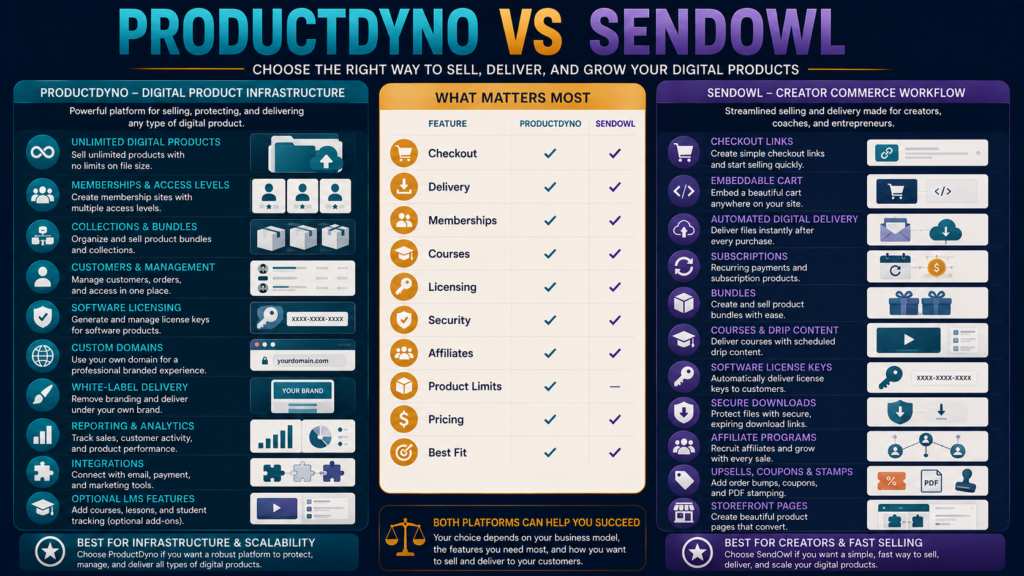
ProductDyno and SendOwl can both participate in the same basic business:
Someone buys a digital product and receives access to it.
But the platforms approach that business differently.
ProductDyno currently emphasizes a broader product-delivery infrastructure including digital products, memberships, collections, customers, custom domains, software/SaaS licensing, white-label delivery, integrations, reporting, and optional learning-management capabilities depending on plan.
SendOwl combines checkout and digital fulfillment more tightly. Its current feature set includes payment links, embeddable carts, automated product delivery, downloads, subscriptions, bundles, courses and drip content, license keys, streaming, storefronts, upsells, affiliate programs, coupons, PDF stamping, security controls, and reporting.
The better fit depends on whether you primarily want:
a product-access infrastructure
or:
a checkout-plus-delivery commerce system.
Review Methodology: This review is based on official product information, available documentation, and publicly available details reviewed on August 23, 2026. No firsthand product testing or personal experience is claimed.
Key Takeaways
ProductDyno’s current promotional annual-pricing page shows Starter at $49/month equivalent, Growth Plus+ at $69/month equivalent, and Teach Pro+ at $99/month equivalent, all billed annually.
Those ProductDyno tiers currently advertise unlimited digital products, memberships, collections, customers/members, custom domains, software/SaaS licensing, integrations, white-label functionality, and 0% ProductDyno transaction fees.
SendOwl’s current monthly pricing shows Launch at $39/month, Grow at $87/month, and Scale at $159/month. Annual billing currently reduces the equivalents to $32.50, $72.50, and $132.50 per month respectively.
SendOwl says every plan includes the full feature set, while the tiers scale mainly through business-volume limits such as orders, annual sales, and bandwidth.
Affiliate Disclosure: This article contains affiliate links. If you purchase through one of these links, I may earn a commission at no additional cost to you. Affiliate compensation does not determine the conclusions or recommendations presented in this article.
What Is ProductDyno?
ProductDyno is a digital-product delivery and membership platform.
Its current promotional pricing structure includes:
- Starter.
- Growth Plus+.
- Teach Pro+.
Across those plans, the company currently emphasizes:
- Unlimited digital products.
- Unlimited memberships.
- Unlimited collections.
- Unlimited customers.
- Software/SaaS licensing.
- Custom domains.
- White labeling.
- Reporting.
- Integrations.
- 0% ProductDyno transaction fees.
Explore ProductDyno through Michael’s approved affiliate link
There is also a standalone ProductDyno review:
ProductDyno Review: Is It a Practical Way to Deliver Digital Products?
What Is SendOwl?
SendOwl is a creator-commerce platform built around selling and automatically delivering products.
Its current plans all include the same overall feature set, with pricing determined more heavily by business volume.
Current features include:
- Checkout.
- Payment links.
- Embeddable cart.
- Automated delivery.
- Digital downloads.
- Subscriptions.
- Bundles.
- Courses.
- Drip content.
- License keys.
- Streaming.
- Storefronts.
- Upsells.
- Affiliates.
- Coupons.
- Security.
- Reporting.
The Main Difference
A useful simplification:
ProductDyno
Manage product access, memberships, collections, customers, and licensing.
SendOwl
Sell and fulfill digital products through a built-in commerce workflow.
There is meaningful overlap.
But the architecture differs.
Checkout
SendOwl has a clear checkout-oriented focus.
It currently includes:
- Three mobile-friendly checkout flows.
- Payment links.
- Custom checkout fields.
- Embeddable shopping cart.
- Modal checkout.
- Custom checkout CSS and JavaScript.
That means a creator can sell from:
- Existing website.
- Blog.
- Social link.
- Product page.
and use SendOwl as both transaction layer and delivery layer.
ProductDyno and External Checkout
ProductDyno is often more naturally understood as the protected product/member-delivery environment that can integrate with other marketing and checkout systems.
That can be useful if you already have:
- WordPress.
- Dedicated checkout.
- Email platform.
- Funnel software.
You do not necessarily need your delivery platform to replace those tools.
Automated Delivery
SendOwl currently advertises instant automated digital fulfillment after purchase.
That is central to the platform.
The buyer pays.
SendOwl handles access to the purchased digital item through its delivery process.
ProductDyno similarly manages customer/member access, but with stronger emphasis on the longer-term protected content environment.
Digital Downloads
SendOwl supports:
- PDFs.
- Video.
- Images.
- Music.
- Other downloadable file types.
ProductDyno supports digital-product delivery across its current plans.
If your business sells straightforward downloads, both can perform the core job.
The workflow surrounding the product becomes the deciding factor.
Unlimited Products
This comparison is interesting because both currently emphasize broad product capacity.
ProductDyno’s current promotional page says its listed plans allow unlimited digital products.
SendOwl’s Launch, Grow, and Scale plans currently list unlimited products and unlimited storage.
So raw product count may not decide the purchase.
SendOwl Volume Limits
SendOwl instead scales plans using operating volume.
Launch
$39/month monthly.
Limits currently include:
- 5,000 orders/year.
- $10,000 sales/year.
- 10GB bandwidth/month.
- Unlimited products.
- Unlimited storage.
Grow
$87/month.
Current limits:
- 25,000 orders/year.
- $36,000 sales/year.
- 20GB bandwidth/month.
Scale
$159/month.
Current limits:
- 50,000 orders/year.
- $100,000 sales/year.
- 50GB bandwidth/month.
SendOwl says accounts exceeding plan limits are notified and upgraded.
ProductDyno Pricing
ProductDyno’s current promotional Pricing New page states that all shown pricing is billed annually.
Starter
$49/month equivalent.
Growth Plus+
$69/month equivalent.
Teach Pro+
$99/month equivalent.
The promotional page describes discounted renewal pricing, so buyers should verify the exact current checkout before purchasing.
SendOwl Annual Pricing
Current annual equivalents:
Launch
$32.50/month.
Grow
$72.50/month.
Scale
$132.50/month.
SendOwl currently describes annual billing as providing two months free.
Again, verify checkout when you are ready to purchase.
Transaction Fees
ProductDyno’s current promotional pricing explicitly says:
0% transaction fee.
SendOwl’s current page is positioned as “No Revenue Cuts” and instead uses subscription tiers tied to sales/order volume.
Normal payment-processing costs from Stripe, PayPal, or other processors can still apply depending on the setup.
Memberships
ProductDyno has a stronger explicit membership orientation.
It currently advertises:
Unlimited memberships
across its promotional main plans.
If your business includes:
- Member portals.
- Resource libraries.
- Ongoing access.
- Multiple product collections.
ProductDyno deserves strong consideration.
Subscriptions
SendOwl currently includes subscriptions and recurring billing management as part of every plan’s feature set.
This can support:
- Recurring digital content.
- Subscription access.
- Ongoing product billing.
The difference is whether you want a dedicated member-area architecture or a commerce-oriented subscription workflow.
Courses
SendOwl supports:
- Courses.
- Drip content.
ProductDyno supports course delivery and its Teach Pro+ plan currently adds an LMS Learning Management add-on.
For a basic course, either may work.
For more education-specific functionality, compare the actual learning experience.
Software Licensing
Both platforms have meaningful licensing capabilities.
ProductDyno
Its core plans currently include a Software/SaaS Licensing Module.
SendOwl
Its current feature set includes software and license keys with automatic generation and management.
If licensing is central to your business, this is one area that deserves a hands-on trial.
Secure Delivery
SendOwl currently includes security-related tools such as:
- Secure download pages.
- PDF stamping.
- PDF and Office document locking.
- Download/time limits.
- Fraud filters.
- Two-factor authentication.
These are meaningful features for creators concerned about casual sharing.
ProductDyno also focuses on protected customer access and product-delivery environments.
PDF Stamping
SendOwl’s current PDF stamping can place unique buyer information into downloads.
This can discourage casual sharing.
It does not make digital files impossible to copy.
No technical protection should be marketed as absolute piracy prevention.
Storefront
SendOwl currently includes:
- Personalized storefront.
- Product sales pages.
- Custom URLs.
- SEO-oriented pages.
That allows a creator to sell without building every public product page elsewhere.
ProductDyno can use custom domains and member/product environments but fits naturally behind an existing WordPress business too.
Upsells and Cross-Sells
SendOwl currently includes:
- Upsells.
- Cross-sells.
- Cart abandonment recovery.
- Coupon codes.
- Pay-what-you-want pricing.
- Gifting.
This gives it a stronger built-in commerce-tool orientation.
ProductDyno may rely more heavily on integrations with the rest of your selling stack for some of those jobs.
Affiliate Programs
SendOwl currently includes affiliate-program functionality for tracking referrals and commissions.
If you want affiliates directly inside the same system that sells/delivers products, that may reduce the need for another service.
If your existing checkout already manages affiliates, it may be redundant.
Email Integrations
SendOwl currently lists integrations with platforms including Mailchimp and Kit.
ProductDyno also emphasizes integrations across its current plans.
Before subscribing, verify the exact connection to your email platform.
Reporting
SendOwl currently includes:
- Income analysis.
- Order reports.
- Subscription reports.
- Upsell analytics.
- Abandoned-cart reporting.
- Affiliate reporting.
- Tax reports.
- GA4 integration.
ProductDyno currently advertises an Advanced Reporting/Analysis Dashboard.
Again, the reporting focus differs:
SendOwl: commerce.
ProductDyno: product/member operation.
Existing ProductDyno Comparisons
MichaelELeeReviews already compares ProductDyno with simpler creator selling:
and with a deeper course platform:
SendOwl sits somewhere different because it combines lightweight creator commerce with surprisingly broad digital-delivery features.
Which Is Better for a Simple Ebook Business?
SendOwl may be attractive if the workflow is:
Product page → checkout → automatic PDF delivery
You get selling and fulfillment together.
ProductDyno may be more infrastructure than necessary if you only sell three standalone PDFs.
Which Is Better for a Product Library?
ProductDyno may fit better if you expect:
- Many products.
- Memberships.
- Product collections.
- Customer portals.
- Custom member domains.
- Software licensing.
Its broader member/product structure becomes more relevant.
Which Is Better for WordPress?
Both can coexist with WordPress.
ProductDyno Model
WordPress handles public content.
ProductDyno handles protected access.
SendOwl Model
WordPress handles public content.
SendOwl buttons/cart/payment links handle selling and delivery.
The difference is where checkout lives.
Which Is Better for Courses?
If your course is simple:
- Videos.
- Downloads.
- Drip schedule.
SendOwl’s course functionality may be sufficient.
If you want a more dedicated product/member environment and stronger LMS functionality under Teach Pro+, ProductDyno may fit better.
Test the actual student view before deciding.
Run One Complete Test Product
Create the same $10 test product in both.
Test:
- Public sales link.
- Checkout.
- Payment.
- Delivery email.
- Customer access.
- Download protection.
- Refund.
- Customer record.
- Affiliate/coupon if relevant.
- Reporting.
Record:
Time
Complexity
Customer experience
Selling tools
Access control
Price
Maintenance
Who Should Consider ProductDyno?
ProductDyno may fit better when:
- You already have a preferred checkout.
- You need memberships.
- You need collections.
- You want strong customer/member areas.
- You sell software licenses.
- You use multiple custom domains.
- You want a modular online-business stack.
Who Should Consider SendOwl?
SendOwl may fit better when:
- You want checkout and fulfillment together.
- You sell downloads.
- You want payment links.
- You want embedded checkout.
- Subscriptions matter.
- Courses/drip content matter.
- Affiliate functionality matters.
- PDF stamping/security matters.
- You want the same feature set across plans and are comfortable with volume-based limits.
Final Verdict
Choose ProductDyno when your primary requirement is a flexible protected digital-product and membership infrastructure that can plug into a broader marketing and checkout stack.
Choose SendOwl when you want a creator-commerce system that combines checkout, payment links, automatic delivery, subscriptions, selling tools, affiliates, and digital-file security in one platform.
ProductDyno is the stronger product infrastructure choice.
SendOwl is the stronger checkout-plus-fulfillment choice.
Conclusion
ProductDyno and SendOwl can both sell and deliver digital products.
The difference becomes clear when you map your customer journey.
If you already have:
Website → Email → Checkout
and mainly need:
secure product access
ProductDyno deserves close attention.
If you want:
Website → SendOwl checkout → SendOwl delivery
with commerce features built into the same platform, SendOwl may simplify the system.
Before choosing, test one complete purchase from the buyer’s perspective.
The better platform is the one that makes selling, delivery, access, and ongoing maintenance easier—not the one with the longest feature list.