Spin Rewriter AI may be worth considering for publishers who regularly refresh, repurpose, localize, or create alternative versions of content they own.
It should not be treated as a tool for copying someone else’s article and attempting to disguise the source.
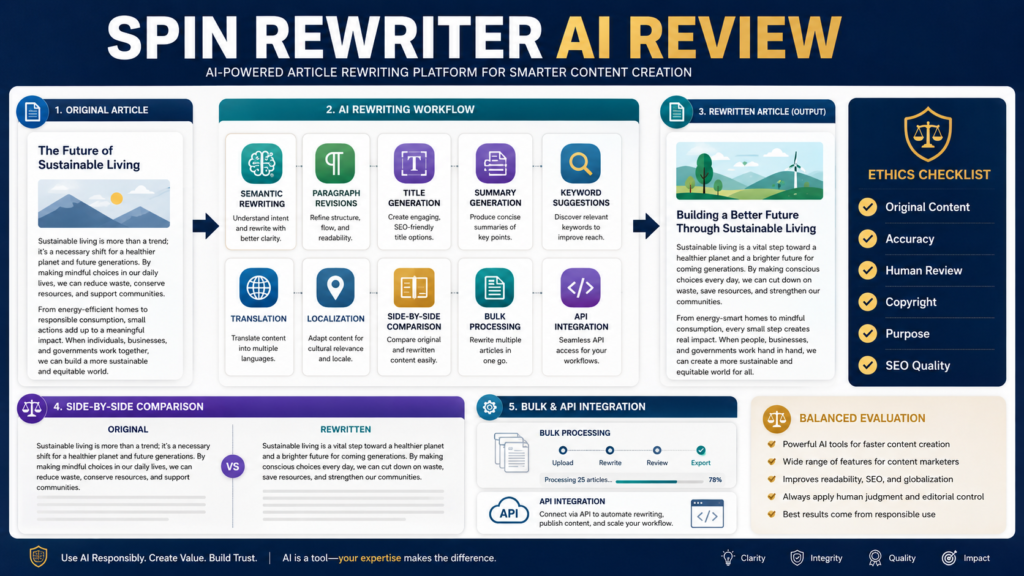
Spin Rewriter’s current 2026 platform promotes semantic rewriting, automated paragraph rewriting, title and summary generation, SEO-keyword generation, translation, localization, bulk article processing, mass export, stock-image integration, and an API.
The platform currently provides 1,000,000 AI credits per month with paid access and says those credits support specific AI-assisted features.
The most important buying question is whether you actually have enough original content to justify a specialized rewriting platform.
Review Methodology: This review is based on Spin Rewriter’s current official website, pricing page, FAQ, API documentation, and publicly available product details reviewed on August 7, 2026. No firsthand rewrite testing, plagiarism testing, SEO-result testing, API implementation, customer-support experience, or ranking result is claimed.
Key Takeaways
- Spin Rewriter currently focuses on AI-assisted article rewriting and repurposing.
- Its plans advertise unlimited article rewriting.
- Current plans include a monthly AI-credit allocation.
- Advanced AI functions use credits.
- An API is available for integrations.
- The platform supports bulk and mass-processing workflows.
- A five-day free trial is currently advertised on qualifying plans.
- The software does not remove the need for factual verification and human editing.
- Rewriting another person’s content does not automatically make it ethical or lawful.
What Is Spin Rewriter?
Spin Rewriter is a cloud-based rewriting platform.
The company describes its rewriting technology as ENL Semantic Rewriting, intended to analyze the meaning of content rather than simply replacing individual words.
Current functions include:
- Article rewriting.
- Paragraph rewriting.
- Alternative titles.
- Descriptions.
- Summaries.
- Keyword suggestions.
- Translation.
- Localization.
- Bulk rewriting.
- Mass export.
- Stock image integration.
- API access.
Who May Benefit From Spin Rewriter?
The tool may suit:
- Bloggers refreshing older articles.
- Publishers repurposing original content.
- Affiliate marketers.
- Agencies managing licensed content.
- PLR publishers.
- Website owners creating regional versions.
- Content teams handling large original archives.
- Developers who need rewriting through an API.
It may be particularly useful when rewriting is a repeated operational task rather than an occasional need.
Who May Not Need It?
Spin Rewriter may be unnecessary if:
- You publish only a few articles.
- You prefer manual editing.
- A general AI tool already meets your needs.
- You do not maintain an original-content archive.
- You expect software to publish automatically without review.
- You want to rewrite competitors’ work.
- Your content requires highly specialized expert accuracy.
- You are buying it because you believe “unique wording” guarantees search rankings.
Google’s current guidance emphasizes useful, original, non-commodity content rather than special tricks designed specifically for generative AI search.
A rewriting tool should support useful publishing—not replace it.
What Does Semantic Rewriting Mean?
Traditional spinning often replaced words with synonyms.
That can produce sentences such as:
“Build an email list.”
becoming:
“Construct an electronic mail register.”
The words changed.
The sentence became worse.
Spin Rewriter markets its ENL system as meaning-aware rewriting rather than simple word substitution.
Whether the result meets your quality standard should be tested with your own material.
Do not rely solely on the vendor’s characterization.
Current 2026 Version
Spin Rewriter’s main website currently promotes its 2026 version and identifies AI rewriting and a “Text Humanizer” among current capabilities.
Because “humanizer” can mean different things across AI products, buyers should test what the feature actually changes.
The goal should be natural, accurate writing—not defeating AI-detection tools.
Automated Paragraph Rewriting
Spin Rewriter’s current FAQ says AI credits are used for fully automated paragraph rewriting.
This could be useful when:
- Refreshing an old section.
- Creating a shorter version.
- Updating a product description.
- Repurposing original training material.
- Developing a new draft from your own article.
Review each rewritten paragraph against the source.
Check whether:
- Meaning changed.
- Facts changed.
- Important qualifiers disappeared.
- Tone changed.
- Examples remain accurate.
Title Generation
The current AI-credit system includes automated article-title generation.
This may help brainstorm alternatives.
Do not automatically publish the generated title.
Review whether it:
- Matches search intent.
- Reflects the article.
- Avoids clickbait.
- Avoids guarantees.
- Differentiates the page.
- Fits the website.
Description and Summary Generation
Current AI features include automated article descriptions and summaries.
These can help create:
- Article summaries.
- Excerpts.
- Internal editorial notes.
- Starting points for metadata.
Review them for accuracy.
A summary can accidentally overstate the article’s conclusion.
SEO Keyword Generation
Spin Rewriter’s current FAQ lists AI-generated SEO keywords as another credit-supported feature.
Treat keyword suggestions as ideas.
Do not assume:
- The phrase has high volume.
- The phrase has low competition.
- The page will rank.
- The phrase matches search intent.
Verify important search phrases separately.
Translation
The current platform says AI credits can support translation into more than 30 languages.
Translation can help create a starting version.
For commercial or important public content, have a qualified speaker review:
- Meaning.
- Grammar.
- Tone.
- Terminology.
- Cultural appropriateness.
- Legal wording.
Automated translation does not guarantee publication-ready localization.
Localization
Spin Rewriter also lists localization for English-speaking markets among its AI functions.
This may include adapting language for different regions.
Examples can involve:
- American versus British spelling.
- Regional phrasing.
- Terminology.
- Units.
Again, human review matters.
Bulk Rewriting
The current pricing page advertises bulk article rewriting and mass-export capabilities.
This may appeal to high-volume publishers.
It is also where quality control becomes more important.
If you rewrite fifty articles in one batch, you still need a process for checking:
- Meaning.
- Accuracy.
- Links.
- Images.
- Headings.
- Formatting.
- Calls to action.
Automation can multiply mistakes as efficiently as it multiplies good work.
Mass Export
Spin Rewriter currently advertises the ability to generate many variations from source material.
This capability should be used carefully.
Producing hundreds of variations does not create hundreds of useful pages.
Google recommends avoiding repetitive content and building logical site structures.
A variation should have a legitimate publishing purpose.
Side-by-Side Comparison
Spin Rewriter’s pricing page describes a side-by-side comparison feature for reviewing source and rewritten material.
This is one of the more practically useful concepts because it supports human review.
Compare:
- Meaning.
- Tone.
- Sentence quality.
- Facts.
- Examples.
- Length.
Do not focus only on whether the words are different.
Stock Photo Integration
The platform currently advertises stock-photo integration for adding relevant images.
Review:
- Image relevance.
- License.
- Accessibility.
- ALT text.
- File size.
- Mobile display.
Do not add images simply because the software can.
API Access
Spin Rewriter provides an API for users and developers.
Its current documentation states that the API can be used inside compatible software, online services, WordPress plugins, and custom applications.
The API documentation lists actions for:
- Checking quota.
- Processing text.
- Creating variations.
- Working with spintax.
This may be valuable for agencies and developers.
A typical beginner may never need the API.
API Limits
The current API help page states a limit of up to 500 API requests per day.
Developers should verify:
- Current quotas.
- Authentication.
- Security.
- Error handling.
- Rate limits.
- Costs.
before building the API into a production system.
Current Pricing
As reviewed August 7, 2026, the official pricing page displays:
Monthly
$47 per month.
Yearly
A current promotional offer showing a five-day trial followed by $77 per year, with $197 shown as the regular yearly price.
Lifetime
$497 single payment.
The promotional yearly price may change.
Verify the actual checkout before purchasing.
Free Trial
Spin Rewriter currently advertises a five-day free trial on its yearly promotional offer and states that users who cancel during the trial will not be billed.
Use the trial to test your actual workflow.
Do not test only a short generic paragraph.
Try:
- Long article.
- Technical section.
- List.
- Example.
- Product description.
- Conclusion.
Review whether the tool saves enough editing time.
Money-Back Guarantee
The current pricing page also advertises a 30-day money-back guarantee after the five-day trial.
Review the current terms before purchasing because promotional conditions may change.
AI Credits
The official FAQ says users currently receive 1,000,000 AI credits per month.
The monthly refill does not roll over, while separately purchased additional credits are described as non-expiring.
AI credits are used for:
- Automated paragraph rewrites.
- Titles.
- Descriptions.
- Summaries.
- SEO keywords.
- Translation.
- Localization.
If your use is light, the included amount may be more than sufficient.
If you plan very high-volume processing, test actual usage.
Responsible Use
A rewriting tool should be used on:
- Your original articles.
- Licensed PLR.
- Material you have permission to modify.
- Internal drafts.
- Product descriptions you own.
- Old content being refreshed.
Do not assume rewriting removes copyright obligations.
If another author created the original content and you do not have permission to reproduce or adapt it, changing the wording does not automatically make the use appropriate.
A Good Content-Refresh Workflow
Step 1
Choose an article you own.
Step 2
Check Search Console performance.
Step 3
Identify outdated sections.
Step 4
Verify current facts.
Step 5
Rewrite only where improvement is needed.
Step 6
Use Spin Rewriter where it saves time.
Step 7
Compare old and new text.
Step 8
Add new original information.
Step 9
Proofread manually.
Step 10
Update images and links.
Step 11
Record the revision date.
Step 12
Monitor performance.
This is more responsible than automatically rewriting the entire website.
Use It for Repurposing
A strong original article can be adapted into:
- Email lesson.
- Shorter summary.
- Social post.
- Video script.
- Lead-magnet section.
- Course lesson.
- Newsletter.
Different formats require more than synonym replacement.
The explanation should be adapted to the audience and platform.
A Practical Example
Suppose you own a 2,000-word article:
How to Build an Email List for Beginners
You want a 700-word newsletter guide.
A rewriting tool can help:
- Shorten sections.
- Rephrase explanations.
- Create alternative summaries.
You still need to decide:
- Which information belongs in email.
- What to remove.
- Which example to keep.
- What action the reader should take.
- Whether facts are current.
The software assists.
The creator edits.
Meaningful Advantages
Specialized rewriting workflow
The platform is designed specifically around rewriting.
Bulk processing
Useful for high-volume content teams.
AI-assisted features
Titles, summaries, keywords, translations, and localization expand the workflow.
API access
Developers can integrate rewriting into other systems.
Cloud access
No local installation is required for the main web platform.
Trial availability
Current offers allow testing.
Meaningful Limitations
Specialized use
A general AI platform may already handle occasional rewriting.
Human review remains necessary
Meaning can change.
SEO claims should be treated cautiously
No rewriting tool can guarantee rankings.
High-volume features can encourage low-value publishing
More versions do not automatically create better content.
Translation needs review
Automated language generation can contain errors.
Copyright responsibility remains with the publisher
Rewriting does not create rights you did not have.
Affiliate Recommendation
Affiliate Disclosure: This article contains affiliate links. If you purchase through one of these links, I may earn a commission at no additional cost to you. Affiliate compensation does not determine the conclusions or recommendations presented in this article.
You can review the current Spin Rewriter AI offer if you regularly refresh, repurpose, translate, localize, or rewrite content that you own or are licensed to modify.
Use the current trial period to test the software with real material before selecting a long-term plan.
Is Spin Rewriter Worth It?
Spin Rewriter may be worth considering when:
- You have a large original-content archive.
- Rewriting is a regular task.
- You manage multiple licensed-content projects.
- You need bulk processing.
- You want API access.
- Translation or localization supports your workflow.
- The software reduces manual rewriting time enough to justify the cost.
It may not be worth it when:
- You rewrite content rarely.
- A general AI tool already meets the need.
- You do not publish enough to justify another subscription.
- You expect automatic ranking gains.
- You do not want to review the output.
Final Verdict
Spin Rewriter AI remains a specialized content-rewriting platform with a broad set of rewriting, AI, bulk-processing, translation, localization, and API features.
Its value depends heavily on the publisher.
For a high-volume content creator working with original or properly licensed material, the structured rewriting workflow may save time.
For a small publisher who occasionally rewrites one paragraph, another paid platform may be unnecessary.
The software should be treated as an editing and repurposing assistant, not a shortcut for copying competitors or producing hundreds of nearly identical search pages.
You can examine Spin Rewriter’s current trial and pricing options before deciding.
Conclusion
Spin Rewriter AI may be worth using when article rewriting and content repurposing are recurring parts of your business.
Its current 2026 offer includes semantic rewriting, AI-assisted paragraph changes, title and summary creation, keyword generation, translation, localization, bulk processing, mass export, and API access.
The tool does not remove your responsibility to protect copyright, verify facts, create useful original value, and review the finished content.
Use the free trial on one complete article you own, measure how much editing remains afterward, and decide whether the workflow genuinely saves enough time to justify the subscription.