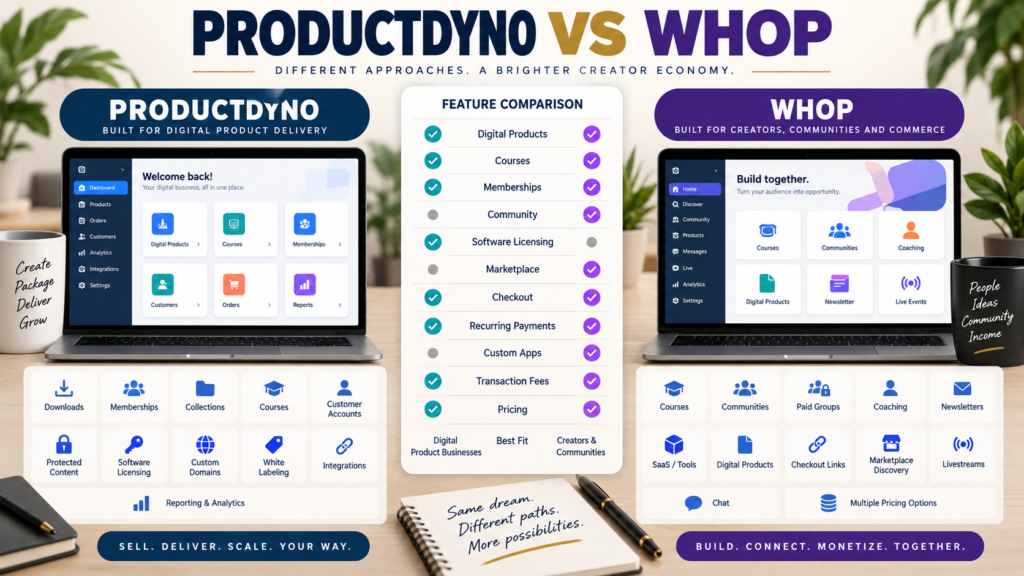
ProductDyno and Whop can both power digital-product businesses.
But they represent different models.
ProductDyno is primarily dedicated digital-product infrastructure.
It focuses on:
- Secure delivery.
- Customer accounts.
- Memberships.
- Collections.
- Courses.
- Software licensing.
- Custom domains.
Whop is a broader app-based internet-business platform and marketplace ecosystem.
Whop’s current documentation supports business models including:
- Educational programs.
- Coaching.
- Newsletters.
- Paid groups.
- SaaS.
- Events.
- Physical ecommerce.
Whop also allows sellers to build and host digital products directly or use Whop primarily for payment processing while delivering products elsewhere.
The core decision is:
Do you want specialized protected product infrastructure—or a broader creator/community commerce ecosystem?
Review Methodology: This comparison is based on official ProductDyno and Whop information reviewed on September 12, 2026. No firsthand product testing or personal experience is claimed. Fees, promotions, features, and payment costs may change. ProductDyno currently maintains more than one official pricing offer, and Whop uses transaction-based pricing, so verify the exact checkout and fee structure relevant to your business.
ProductDyno’s Current Pricing
ProductDyno’s principal current pricing page displays:
Starter
$49/month billed annually
Growth Plus+
$69/month billed annually
Teach Pro+
$99/month billed annually.
Review ProductDyno’s current pricing.
ProductDyno’s Core Offer
The current principal offer includes:
- Unlimited digital products.
- Unlimited memberships.
- Unlimited collections.
- Unlimited members/customers.
- Software/SaaS licensing.
- Unlimited custom domains.
- White-label capability.
- SSL.
- Integrations.
- Reporting.
- 0% ProductDyno transaction fee.
ProductDyno also maintains another official offer page with a 14-day trial followed by a different $199/month offer, so buyers should verify the checkout connected to the promotion they are considering.
Whop’s Current Pricing Model
Whop takes a very different approach.
Its current pricing page lists:
No setup fees
and:
No monthly platform cost
under its standard payments model, with domestic card processing currently shown at:
2.7% + $0.30 per successful transaction.
International cards, currency conversion, payouts, and optional services can carry additional fees.
This means Whop is much more transaction-oriented than ProductDyno’s fixed software subscription.
Do Not Compare $49 With $0 Too Quickly
Whop may have no monthly platform fee under its current standard payments pricing.
ProductDyno charges a recurring subscription.
But the economics change as sales volume increases.
Example:
A transaction-based platform can feel inexpensive at low volume.
At higher volume:
Percentage-based fees can become significant.
Calculate:
Monthly Revenue × Applicable Transaction Rate
plus:
- Fixed transaction charges.
- Payment-method differences.
- Optional services.
Then compare with ProductDyno’s subscription and payment-processing costs.
Whop Lets You Build and Sell Digital Products
Whop’s current setup documentation gives sellers two primary pathways:
- Build and sell digital products on Whop, including hosting and accepting payments.
- Use Whop for payment processing only and host/deliver the product elsewhere.
That flexibility can support both all-in-one and modular business models.
Courses
Whop includes a Courses app.
Its official educational-program documentation explains that sellers can host courses, add course modules, upload learning material, build community around the program, and accept payments.
Whop therefore goes beyond simple checkout links.
A course can live inside the Whop ecosystem.
ProductDyno Courses
ProductDyno’s Teach Pro+ adds LMS-oriented capability in addition to its broader delivery platform.
If courses are one part of a mixed digital-product catalog, ProductDyno may provide a natural structure.
If courses are tightly connected with community, chat, and marketplace discovery, Whop may deserve stronger consideration.
Paid Communities
Community is one of Whop’s clearest differences.
Whop’s paid-group offering currently supports:
- Courses.
- Chats.
- Livestreams.
- Community interaction.
- Store pages.
- Marketplace discovery.
Its paid-group documentation supports pricing such as:
- Free access.
- One-time payments.
- Weekly subscriptions.
- Monthly subscriptions.
- Annual subscriptions.
- Lifetime options.
For a community-centered membership business, this can be significant.
ProductDyno Memberships
ProductDyno supports unlimited memberships under its current principal pricing structure.
But its identity is more strongly centered on:
Product Access + Membership Delivery
rather than:
Community Interaction + Marketplace Ecosystem
That difference should shape the decision.
Marketplace Discovery
Whop’s marketplace/discovery environment can expose offers to users already browsing the Whop ecosystem.
Its paid-group page currently promotes marketplace listing as one route to discovery.
ProductDyno is more strongly designed as infrastructure behind your own business.
You generally bring the customer to your offer.
Control vs Ecosystem
This creates an important strategic distinction.
ProductDyno
You build the audience and marketing stack.
ProductDyno manages protected product access.
Whop
The offer can live within a broader commerce and community ecosystem with platform-native apps and discovery.
Some creators will prefer the ecosystem.
Others will prefer keeping their business centered on their own website and email list.
Software and SaaS
ProductDyno includes a dedicated Software/SaaS Licensing Module in its current principal plans.
Whop also explicitly supports SaaS as one of its current merchant business models and can provide payments and user-management infrastructure around applications.
The implementations are different.
If license-key management is central, ProductDyno deserves close inspection.
If SaaS is integrated into a broader Whop-based commerce ecosystem, Whop may be relevant.
Coaching
Whop explicitly supports coaching as a business model and provides infrastructure for selling programs, organizing clients, and receiving payments.
ProductDyno can deliver coaching-related content, but coaching-client organization is not its primary identity.
Newsletters
Whop also supports paid newsletters as a current business model.
Again, this illustrates Whop’s broader platform model.
ProductDyno is narrower and more infrastructure-focused.
Customizable Apps
Whop businesses can add apps such as:
- Courses.
- Chat.
- Community tools.
- Other specialized experiences.
Its setup documentation describes adding apps to customize what a Whop offers.
This can create flexibility without requiring the creator to build every capability externally.
ProductDyno Custom Domains
ProductDyno’s principal plans currently support unlimited custom domains and white-label branding removal.
That can be attractive when brand control is important.
ProductDyno May Fit Better If…
Consider ProductDyno when:
- You want dedicated digital-product infrastructure.
- Protected customer access matters.
- Membership delivery matters.
- Collections matter.
- Software licensing matters.
- Custom domains matter.
- White labeling matters.
- You already have your own website and marketing system.
- You prefer a fixed software subscription rather than platform transaction economics.
My ProductDyno review for beginners provides more background.
Affiliate Disclosure: This article contains affiliate links. If you purchase through one of these links, I may earn a commission at no additional cost to you. Affiliate compensation does not determine the conclusions or recommendations presented in this article.
If ProductDyno fits your digital-product infrastructure requirements, you can review the current ProductDyno offer through this approved partner link.
Whop May Fit Better If…
Consider Whop when:
- Community is central.
- Courses and chat belong together.
- You want marketplace discovery.
- You want transaction-based pricing.
- You run a paid group.
- Coaching matters.
- SaaS or digital services matter.
- You want flexible pricing options.
- You prefer an app-based creator/business ecosystem.
The Revenue Test
Because the pricing models differ, calculate both.
Example:
If monthly sales are:
$1,000
calculate Whop’s applicable transaction and payment charges.
Then repeat at:
$5,000
and:
$10,000
Compare those totals with:
- ProductDyno subscription.
- Payment-processing fees.
- Other tools required.
This reveals how the economics change as the business grows.
The Community Test
Ask:
Is the product itself the main value—or is ongoing interaction between members part of the value?
If the product itself is central:
ProductDyno may fit naturally.
If:
Course + Community + Chat + Live Interaction
is the real offer:
Whop becomes more compelling.
The Marketplace Test
Ask:
Do I want potential buyers discovering the offer inside someone else’s marketplace ecosystem?
If yes:
Whop provides that model.
If you want:
Your Website → Your Funnel → Your Email List → Your Product Environment
ProductDyno may fit your preferred architecture more closely.
The Software Test
If you sell software:
Compare exactly how each platform handles:
- User access.
- Licensing.
- Recurring billing.
- Application integration.
- Customer management.
Do not treat “supports SaaS” and “software licensing module” as identical features.
A Simple Buying Scorecard
Score each from 1–5 for:
Digital Downloads
Memberships
Courses
Community
Marketplace Discovery
Software/SaaS
Custom Domains
White Labeling
Recurring Payments
Transaction Cost
Customer Access
Ease of Management
Double-weight your top three requirements.
Conclusion
ProductDyno and Whop can both support digital-product businesses, but their operating models differ significantly.
ProductDyno is centered around:
Protected Digital Products → Customer Access → Memberships → Collections → Courses → Software Licensing
Whop is centered around:
Digital Products → Payments → Courses → Communities → Apps → Marketplace → Multiple Internet-Business Models
ProductDyno may fit better when you want dedicated backend digital-product infrastructure connected to your existing website and marketing systems.
Whop may fit better when the product benefits from community, platform-native apps, transaction-based commerce, and marketplace discovery.
Your Next Action
Write down the main thing customers are actually paying for:
Download | Course | Membership Access | Community | Coaching | Software/SaaS
Then answer:
Need marketplace discovery? Yes / No
Need software licensing? Yes / No
Need custom branded domains? Yes / No
Need built-in community/chat? Yes / No
Prefer fixed subscription cost or transaction-based cost? _____
Next, estimate monthly sales at:
$1,000 | $5,000 | $10,000
Calculate the approximate Whop transaction costs that would apply to your scenario and compare them with the ProductDyno subscription plus your normal payment-processing costs.
Finally, map one customer journey:
Discovery → Checkout → Payment → Product Access → Community/Support → Renewal
Choose the platform that handles the most important parts of that journey with the least unnecessary complexity.