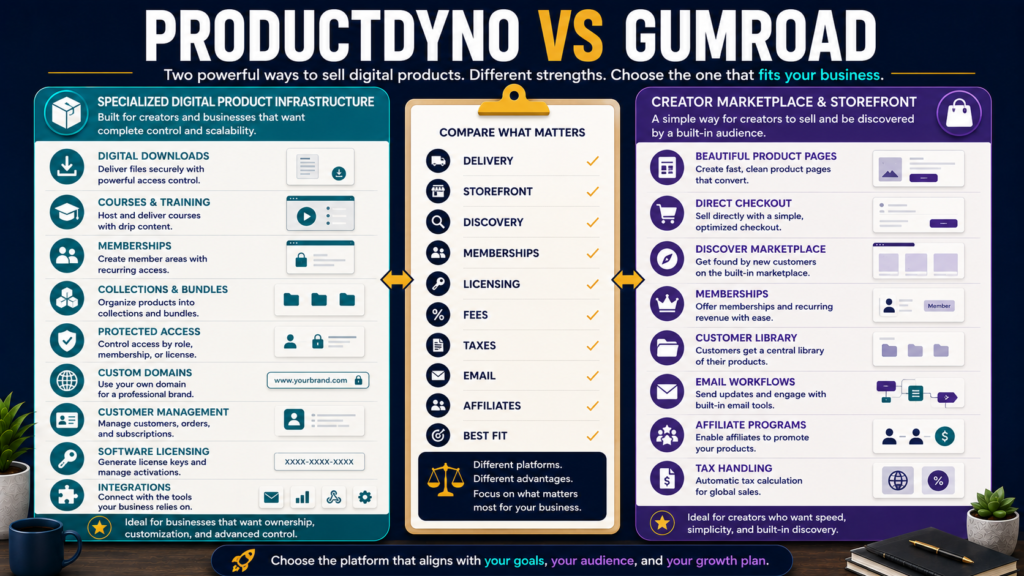
ProductDyno and Gumroad can both help someone sell digital products.
But they solve noticeably different business problems.
ProductDyno emphasizes digital-product infrastructure: delivery, protected content, memberships, courses, collections, customer access, domains, integrations, and software licensing.
Gumroad emphasizes creator commerce: product pages, direct checkout, customer delivery, memberships, built-in audience tools, affiliates, marketplace discovery, and transaction-based pricing without a standard monthly platform charge.
The better choice therefore depends on your starting point.
Do you already have marketing and checkout systems and need stronger delivery infrastructure?
Or:
Do you want a simple place to start selling without paying a monthly software fee first?
Review Methodology: This comparison is based on official ProductDyno and Gumroad pricing pages, help documentation, and publicly available product information reviewed on August 27, 2026. No firsthand product testing or personal experience is claimed.
Affiliate Disclosure: This article contains affiliate links. If you purchase through one of these links, I may earn a commission at no additional cost to you. Affiliate compensation does not determine the conclusions or recommendations presented in this article.
Quick Verdict
ProductDyno may be the better fit if you want specialized digital-product delivery, multiple memberships, collections, courses, protected access, custom domains, customer management, or software licensing and already have other marketing systems.
Gumroad may be the better fit if you want to begin selling quickly with no standard monthly platform fee and prefer a creator-oriented storefront, built-in checkout, memberships, customer library, email tools, affiliates, marketplace discovery, and merchant-of-record tax handling.
The pricing models are fundamentally different.
That difference should be part of the decision from the beginning.
What Is ProductDyno?
ProductDyno’s current public platform information emphasizes:
- Digital downloads.
- Online courses.
- Membership sites.
- Collections.
- Learning-management features.
- Custom domains.
- Restricted access.
- Software licensing.
- Business intelligence.
- Integrations.
- Customer management.
If those capabilities fit your business, you can review ProductDyno through my affiliate link.
What Is Gumroad?
Gumroad is a creator-commerce platform designed to make direct digital selling relatively simple.
Creators can publish products, accept payments, deliver content, manage customers, run memberships, send email updates, create automated workflows, and use affiliate features.
Gumroad also operates Discover, where customers can find products through Gumroad rather than only through the creator’s own traffic.
The Core Difference
Think of the platforms this way.
ProductDyno
“I have a digital-product business. I need infrastructure for managing what customers receive and how they access it.”
Gumroad
“I want a straightforward way to put a product online and sell it.”
That simplification is not perfect, but it captures the main buying difference.
Gumroad Pricing
Gumroad currently charges no standard monthly platform fee.
Its official pricing page lists:
Direct sales through your profile or direct links:
10% + $0.50 per transaction.
Gumroad’s fee documentation says card processing is additional at 2.9% + $0.30 for those direct sales, with PayPal fees handled separately where applicable.
Gumroad Discover marketplace sales:
30% per transaction, including processing.
That makes Gumroad inexpensive to start but potentially expensive as sales volume grows.
Gumroad High-Volume Discount
Gumroad’s current fee documentation also describes a high-volume discount.
When paid sales in a calendar month reach $20,000, new direct sales for the rest of that month can drop to 5% + $0.50 rather than 10% + $0.50, subject to the stated conditions.
That resets monthly.
Verify the latest terms before basing a large-volume business decision on it.
ProductDyno Pricing Needs Extra Verification
ProductDyno’s current official pricing information is unusual because multiple official pricing pages presently show different promotional structures.
One current ProductDyno pricing page promotes a 14-day test drive followed by $199/month.
Another official pricing page currently presents a “Summer Special” Starter offer of $49/month billed annually, with higher plans also listed and 0% ProductDyno transaction fees.
Because those official pages do not present one identical offer structure, verify the exact checkout, billing frequency, renewal terms, and included features immediately before purchasing.
That is more reliable than treating one promotional page as permanent pricing.
Fixed Software Cost vs Transaction Cost
This is one of the clearest differences.
Gumroad
Low fixed cost.
Higher cost per sale.
ProductDyno
Platform subscription.
Potentially lower platform cost per transaction depending on the current plan and payment integrations.
The better economics change with sales volume.
Simple Cost Illustration
Suppose Gumroad direct sales produce $1,000 in revenue through twenty $50 transactions.
Using the current published Gumroad platform fee:
10% of $1,000 = $100
Plus:
20 × $0.50 = $10
That is approximately $110 in Gumroad’s platform transaction fees before the additional card-processing fees described in Gumroad’s documentation.
At higher sales volume, a fixed-cost platform can become more attractive.
At very low volume, paying a large monthly software fee may make less sense.
Always calculate your actual expected order value and volume.
Marketplace Discovery
Gumroad has a distinctive advantage:
Discover.
A customer may find the product through Gumroad itself.
That potentially adds a discovery channel.
But Discover sales currently carry the much higher 30% marketplace fee.
Do not assume marketplace discovery will happen automatically.
Your own audience and marketing remain important.
Merchant of Record
Gumroad states that since January 1, 2025, it operates as Merchant of Record and handles sales-tax collection and remittance worldwide for sales processed through the platform.
That can simplify one complicated part of international creator commerce.
It does not mean the creator has no tax, accounting, or income-reporting responsibilities.
It specifically changes how transaction-related sales-tax obligations are handled through Gumroad.
Digital Downloads
Both platforms work for digital downloads.
Examples:
- Ebooks.
- Templates.
- Checklists.
- Audio.
- Video.
- Graphics.
- Digital bundles.
Gumroad combines the product page, checkout, receipt, customer library, and delivery.
ProductDyno provides a more specialized delivery environment that can connect with other parts of an existing marketing stack.
Memberships
Gumroad currently supports recurring membership products.
Creators can create tiers, offer payment frequencies, provide tier-specific content, offer certain free-trial options, and allow customer access through the Gumroad Library or receipts.
ProductDyno also places memberships at the center of its platform and supports broader product collections and access management.
The difference is less:
“Can either platform do memberships?”
and more:
“How sophisticated does my membership structure need to become?”
Courses
ProductDyno explicitly promotes online-course and learning-management features.
Gumroad can sell course-style content and memberships, but it is not positioned as a traditional feature-heavy learning-management system.
If a structured learning experience matters, compare:
- Lesson organization.
- Progress.
- Assessments.
- Dripping.
- Student management.
- Certificates.
- Membership integration.
Do not assume all course delivery is equivalent.
Software Licensing
ProductDyno explicitly lists licensing as part of its platform.
This can matter for:
- Plugins.
- SaaS.
- Software downloads.
- Licensed applications.
Gumroad memberships can support different product tiers, and its documentation discusses software-oriented license levels in membership examples, but its broader product identity remains creator commerce rather than specialized licensing infrastructure.
Software sellers should examine the exact licensing workflow carefully.
Email Communication
Gumroad has built-in email capabilities.
Creators can send emails to subscribers and customers, and Workflows support automated messages triggered by events such as:
- Purchase.
- New subscriber.
- Membership cancellation.
- New affiliate.
- Abandoned cart.
Gumroad currently notes that creators cannot send emails until they have earned $100 after fees and received a payout, a limitation intended to protect the platform from spam.
That is an important limitation for a brand-new creator expecting Gumroad to function immediately as a full email-marketing replacement.
Affiliate Programs
Gumroad includes affiliate functionality.
Creators can add their own affiliates with customized commission rates, and Gumroad also operates a broader optional Gumroad Affiliates program.
Its documentation currently describes a 30-day cookie for creator-added affiliates and a shorter 7-day cookie for Gumroad Affiliate Program links.
That can reduce the need for a separate affiliate platform for a simple creator business.
ProductDyno can integrate into broader marketing stacks where affiliate management may be handled elsewhere.
ProductDyno May Be Better If You Want
- More specialized product delivery.
- Multiple memberships.
- Collections.
- Courses.
- LMS functionality.
- Custom domains.
- Software licensing.
- Protected access.
- More control over the surrounding technology stack.
- Existing external checkout and email tools.
My recent ProductDyno vs Sellfy comparison examines another storefront-versus-specialized-infrastructure choice.
The ProductDyno vs Payhip comparison is also useful if you prefer a creator storefront with a lower fixed entry cost.
Gumroad May Be Better If You Want
- No standard monthly platform subscription.
- Quick product setup.
- Built-in product pages.
- Checkout.
- Customer delivery.
- Memberships.
- Customer library.
- Email updates and workflows.
- Affiliate tools.
- Discover marketplace.
- Merchant-of-record sales-tax handling.
It can be especially appealing for testing a first offer.
Gumroad May Become Expensive as Volume Grows
Transaction-based pricing is easy when sales are low.
It becomes more noticeable as sales increase.
Suppose direct sales produce:
$10,000 per month
At the standard 10% Gumroad platform percentage alone, that is $1,000 before adding the per-transaction component and applicable processing fees.
That does not automatically mean you should leave Gumroad.
You may value:
- Tax handling.
- Checkout.
- Customer management.
- Discovery.
- Ease of use.
But cost should be calculated rather than ignored.
ProductDyno May Require More of a Stack
ProductDyno’s specialization can be an advantage when you already use:
- WordPress.
- Email marketing.
- Checkout.
- Funnel software.
- Affiliate tracking.
But if you are starting from zero, assembling several systems can be more work than using Gumroad.
The correct answer depends on what you already own.
Compare Total Business Cost
Create a table:
| Function | ProductDyno Approach | Gumroad Approach |
|---|---|---|
| Storefront | Existing/other | Included |
| Checkout | Integration/other | Included |
| Digital delivery | ProductDyno | Included |
| Memberships | Included | Included |
| Courses | Stronger LMS focus | Content/membership approach |
| Licensing | Specialized feature | More limited use case |
| Existing/integrated tools | Built-in emails/workflows | |
| Affiliate tools | External/integrated as needed | Included |
| Tax handling | Depends on payment stack | Merchant of Record |
| Platform pricing | Subscription | Transaction based |
Now price your actual setup.
Do Not Switch Solely Because of Fees
Migration has costs too.
Consider:
- Customer records.
- Product files.
- Membership subscriptions.
- Purchase history.
- Emails.
- Links.
- Affiliate tracking.
- Support instructions.
- Existing customer access.
A platform change should solve a meaningful business problem.
Final Verdict
ProductDyno and Gumroad fit different stages and business structures.
Gumroad may be the better starting platform for someone who wants to publish an offer quickly without paying a standard monthly platform fee and values built-in checkout, delivery, marketplace discovery, memberships, email workflows, affiliate tools, and merchant-of-record tax handling.
ProductDyno may be the better fit for a business that already has marketing infrastructure and wants more specialized control over delivery, memberships, collections, courses, customer access, domains, and software licensing.
The economics also change with volume.
Gumroad’s transaction pricing can be very attractive at low sales levels and increasingly significant as revenue grows.
ProductDyno requires a recurring platform commitment but may provide better economics or infrastructure for an established catalog depending on the current plan.
Conclusion
The ProductDyno vs Gumroad decision should begin with your current business stack.
If your primary question is:
“How can I put a digital product online and start selling with minimal fixed cost?”
Gumroad deserves serious consideration.
If the question is:
“How can I manage a growing catalog of digital products, courses, memberships, protected content, and software access inside a more specialized delivery system?”
ProductDyno may fit better.
Calculate the total cost, verify the current checkout terms, and choose the platform that solves the business problem you actually have rather than the one with the longest feature list.