GetResponse and ActiveCampaign both provide email marketing and automation.
That makes them look like direct competitors.
But their broader product strategies are different.
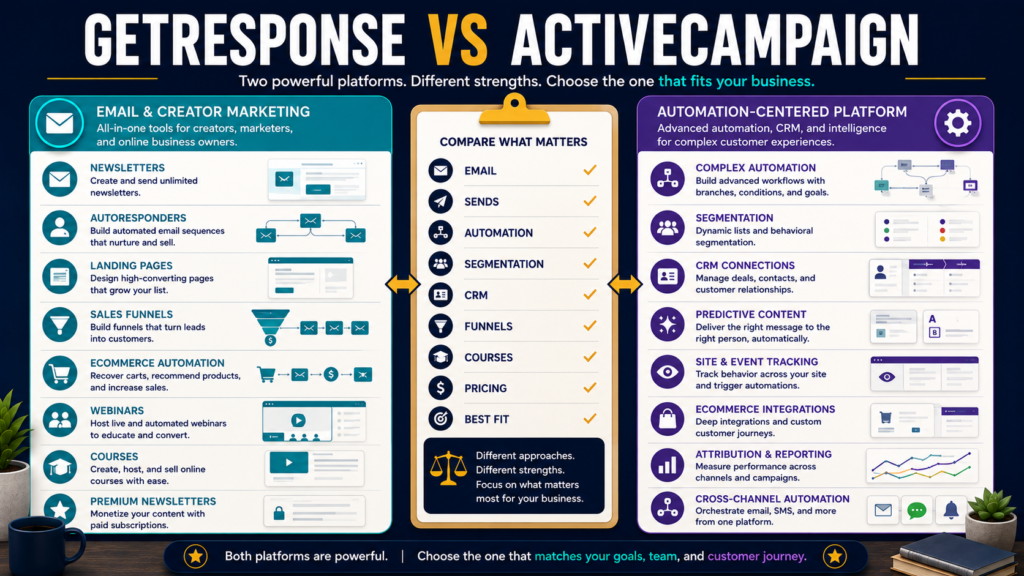
GetResponse combines email marketing with landing pages, funnels, ecommerce marketing, webinars, courses, paid newsletters, and creator-oriented tools.
ActiveCampaign places deeper marketing automation, segmentation, contact behavior, CRM integrations, predictive capabilities, and cross-channel orchestration closer to the center of its platform.
That creates a practical decision:
Do you want a broader marketing-and-creator platform, or is sophisticated automation itself the main requirement?
Review Methodology: This comparison is based on official GetResponse and ActiveCampaign pricing pages, help documentation, and publicly available product information reviewed on August 27, 2026. No firsthand product testing or personal experience is claimed.
Affiliate Disclosure: This article contains affiliate links. If you purchase through one of these links, I may earn a commission at no additional cost to you. Affiliate compensation does not determine the conclusions or recommendations presented in this article.
Quick Verdict
GetResponse may be the better fit if you want email marketing plus landing pages, funnels, ecommerce automation, webinars, courses, premium newsletters, and creator monetization without assembling those functions from several platforms.
ActiveCampaign may be the better fit if complex marketing automation, advanced segmentation, behavior-based campaigns, predictive features, CRM integrations, and cross-channel workflows are your priorities.
For a simple digital-product or creator business, GetResponse may be easier to keep focused.
For a business with sophisticated automation requirements, ActiveCampaign deserves serious consideration.
GetResponse Overview
GetResponse currently offers three standard paid plans:
- Starter.
- Marketer.
- Creator.
It also offers an Enterprise option.
At the entry list size, its current public pricing lists:
Starter: $19/month or $15.58/month equivalent on annual billing.
Marketer: $59/month or $48.38/month equivalent annually.
Creator: $69/month or $56.58/month equivalent annually.
All three standard paid plans currently advertise unlimited monthly email sends.
You can review GetResponse’s current plans through my affiliate link.
ActiveCampaign Overview
ActiveCampaign’s current base email-plan structure includes:
- Starter.
- Plus.
- Professional.
- Enterprise.
Its help documentation says Starter provides email marketing and basic automation, Plus expands automation and multichannel capabilities, Professional adds advanced automation, segmentation, reporting, predictive features, and attribution, while Enterprise adds higher-level security, reporting, integrations, and dedicated support.
ActiveCampaign also offers optional packages such as SMS, transactional email, custom reporting, and enhanced CRM capabilities depending on plan.
Pricing: ActiveCampaign
ActiveCampaign’s live pricing page is dynamic because pricing changes with contact count and configuration.
Its official FAQ currently states pricing begins at $15 for accounts with fewer than 1,000 contacts.
An official ActiveCampaign comparison page gives an example for 1,000 contacts:
- Starter: $15/month.
- Plus: $49/month.
- Pro: $79/month.
Because plan configuration, contact count, billing period, and current offers can affect pricing, verify the exact live checkout before purchasing.
Email Sending Limits Are Different
This is an important buying difference.
GetResponse currently advertises unlimited monthly email sends on Starter, Marketer, and Creator.
ActiveCampaign’s current pricing comparison describes email-send allowances as multiples of the account’s contact limit, with limits varying by plan.
That matters to businesses that email frequently.
Suppose you have 5,000 contacts and send:
- Weekly newsletter.
- Automated sequences.
- Launch campaigns.
- Re-engagement emails.
- Product follow-up.
Sending volume can become an important pricing consideration.
Basic Email Marketing
Both platforms can handle standard email-marketing functions such as:
- Campaigns.
- Contact management.
- Forms.
- Segmentation.
- Automated follow-up.
- Reporting.
A beginner building:
Lead magnet → welcome emails → newsletter → product promotion
could reasonably use either.
The differences become more important as the workflow expands.
Automation: Where ActiveCampaign Is Strong
Automation has long been central to ActiveCampaign’s positioning.
Current plan documentation describes:
Starter
Light automation with up to five actions per automation.
Plus
More advanced automation and unlimited automation actions.
Professional
Advanced automation triggers and actions, connected automations, campaign automation A/B testing, conditional content, predictive sending, attribution, and custom-event tracking.
Enterprise
Premium automation and segmentation plus additional enterprise features.
If automation is the reason you are buying the platform, this depth deserves close evaluation.
GetResponse Automation
GetResponse also has substantial automation.
Its Starter plan currently allows one automation workflow with basic limitations.
Marketer and Creator expand into unlimited automation workflows and advanced automation elements.
Current GetResponse automation options can include conditions such as:
- Link clicked.
- Message opened.
- Tag assigned.
- Purchase.
- Abandoned cart.
- URL visited.
- Custom-field change.
Available elements vary by plan.
For many small digital-product businesses, this may be more automation than they actually need.
Segmentation
ActiveCampaign differentiates its plans partly through segmentation depth.
Its current tiers range from limited segmentation on Starter to standard, advanced, and premium segmentation at higher levels.
GetResponse includes basic segmentation on Starter and more advanced segmentation in Marketer and Creator.
If your business needs intricate behavioral targeting, compare the exact segmentation rules you will use.
Do not choose based on the word “advanced” alone.
CRM
ActiveCampaign’s current platform connects email automation with standard CRM integrations and offers enhanced CRM add-ons for pipelines and sales engagement on applicable plans.
This becomes useful when marketing needs to coordinate with:
- Deal stages.
- Sales pipelines.
- Sales representatives.
- Lead ownership.
- Account information.
GetResponse is more marketing-centered.
A solo creator may not need a formal sales CRM.
Landing Pages
GetResponse currently includes a landing-page builder in its standard plans.
ActiveCampaign includes landing pages from Plus upward in its current plan descriptions.
If landing pages are required, compare the plan that actually contains them rather than the lowest advertised entry price.
Funnels
GetResponse’s Marketer and Creator plans include sales-funnel capabilities as part of the broader marketing platform.
This can be useful for businesses wanting:
landing page → email → sales page → checkout-related follow-up
inside a more connected environment.
ActiveCampaign is more focused on the automation layer and integration ecosystem rather than presenting itself primarily as an all-in-one sales-funnel platform.
Ecommerce
Both platforms integrate with ecommerce systems.
GetResponse’s Marketer and Creator tiers currently include features such as:
- Abandoned-cart recovery.
- Promo codes.
- Revenue reporting.
- Ecommerce-oriented automation.
ActiveCampaign’s current plans include ecommerce integrations, with broader capabilities and premium integrations at higher tiers.
For an ecommerce store, compare your exact platform integration before buying.
Courses and Creator Monetization
This is where GetResponse becomes quite different.
The current Creator plan includes:
- Course creator.
- Up to 500 students at the current published limit.
- Webinars.
- Premium newsletter subscriptions.
- Website builder.
- Creator monetization tools.
ActiveCampaign is not primarily a course-creation platform.
If your business sells knowledge products, those GetResponse features may reduce the need for additional tools.
Predictive Features
ActiveCampaign’s Professional and Enterprise levels currently include predictive and conditional capabilities such as predictive sending and conditional content.
These are useful only if your business will actually use them.
Do not pay for advanced automation because the feature name sounds impressive.
Free Trials
Both currently advertise 14-day trials.
GetResponse provides premium-feature trial access with certain limitations.
ActiveCampaign says its trial is based on Professional-level features and runs for 14 days.
A trial should test your real workflow.
Do not spend the entire trial exploring unrelated features.
GetResponse May Be Better If You Want
- Unlimited email sends on standard paid plans.
- Email marketing.
- Landing pages.
- Sales funnels.
- Ecommerce automation.
- Webinars.
- Courses.
- Premium newsletters.
- Creator monetization.
- A broader marketing platform.
The recent GetResponse vs Brevo comparison is useful if you also want to compare GetResponse with a multichannel platform emphasizing CRM, transactional communication, SMS, and WhatsApp.
The verified GetResponse vs Kit comparison provides another creator-focused comparison.
ActiveCampaign May Be Better If You Want
- Automation as the main priority.
- Advanced segmentation.
- Predictive sending.
- Conditional content.
- Attribution.
- Custom-event tracking.
- CRM integrations.
- Sophisticated customer journeys.
- Cross-channel automation.
Those needs usually become more important as customer journeys become more complex.
Do Not Buy Complexity Before You Need It
Consider a business that needs:
- Lead capture.
- Welcome sequence.
- Weekly newsletter.
- Product promotion.
- Customer follow-up.
A highly sophisticated automation platform may be unnecessary.
Now consider:
- Multiple lead sources.
- Behavioral segmentation.
- Lead scoring.
- Product-specific automations.
- Ecommerce behavior.
- Sales pipeline.
- Conditional messaging.
- Cross-channel campaigns.
ActiveCampaign’s deeper automation becomes much more relevant.
Migration Cost Matters
Switching platforms can require rebuilding:
- Lists.
- Tags.
- Automations.
- Forms.
- Landing pages.
- Integrations.
- Email templates.
- Authentication.
- Historical reporting.
- Customer segments.
Do not switch solely to save a few dollars unless the ongoing benefit outweighs the migration work.
Final Verdict
GetResponse and ActiveCampaign are both capable email-automation platforms, but they fit different operating priorities.
Choose GetResponse when you want email automation combined with a broader creator and marketing toolkit including funnels, ecommerce, webinars, courses, paid newsletters, and unlimited email sends on standard paid plans.
Choose ActiveCampaign when sophisticated automation, advanced segmentation, predictive capabilities, CRM integrations, and complex multichannel customer journeys matter more than built-in creator-product tools.
For a simple creator or digital-product business, GetResponse may provide the more manageable system.
For a business built around complex automated customer journeys, ActiveCampaign may provide greater depth.
Conclusion
Do not decide GetResponse vs ActiveCampaign by counting features.
Map your actual workflow.
Then determine:
- Number of contacts.
- Monthly sending volume.
- Number of automations.
- Segmentation complexity.
- CRM requirements.
- Ecommerce requirements.
- Landing-page needs.
- Course or webinar needs.
Choose the lowest-complexity platform that can reliably perform those jobs.
That is usually a better long-term decision than paying for sophisticated automation you never use.