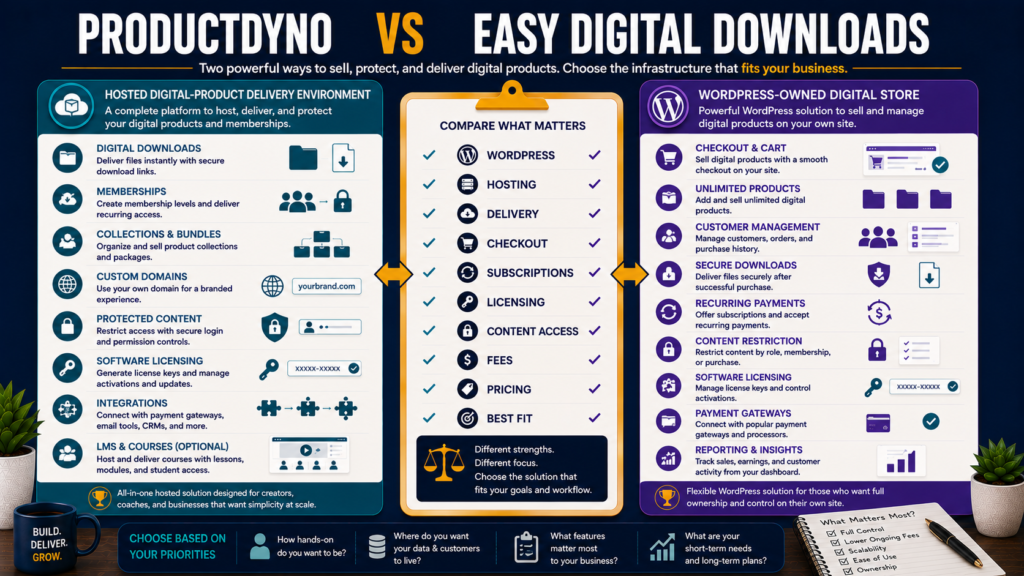
ProductDyno and Easy Digital Downloads can both support a serious digital-product business.
Both can work with:
- Downloads.
- Customers.
- Protected access.
- Subscriptions or memberships.
- Software licensing.
- Payment systems.
But they are built around two fundamentally different architectures.
ProductDyno is a hosted digital-product platform designed around delivery, memberships, collections, licensing, customer access, integrations, and optional LMS functionality.
Easy Digital Downloads, usually called EDD, is a WordPress ecommerce system that turns your own self-hosted WordPress site into a digital-product store.
So the most important question is not:
“Which one has more features?”
It is:
“Do I want product infrastructure provided by a hosted platform, or do I want the digital store built directly into WordPress?”
Review Methodology: This review is based on official product information, available documentation, and publicly available details reviewed on August 31, 2026. No firsthand product testing or personal experience is claimed.
Affiliate Disclosure: This article contains affiliate links. If you purchase through one of these links, I may earn a commission at no additional cost to you. Affiliate compensation does not determine the conclusions or recommendations presented in this article.
You can review ProductDyno through my affiliate link if its hosted delivery model fits your business.
Quick Verdict
ProductDyno may be better if you want a dedicated product-delivery and membership platform without making your WordPress installation responsible for the entire commerce and access system.
Easy Digital Downloads may be better if WordPress is already the center of your business and you want the store, checkout, customer data, product pages, and digital-commerce infrastructure directly inside that WordPress environment.
For software sellers, both deserve serious attention because both support licensing.
For someone who does not want to maintain a WordPress ecommerce stack, ProductDyno may be simpler operationally.
What Is ProductDyno?
ProductDyno’s current public pricing page promotes plans with features including:
- Unlimited digital products.
- Unlimited memberships.
- Unlimited collections.
- Unlimited members/customers.
- Software/SaaS licensing.
- Custom domains.
- White labeling.
- Integrations.
- Reporting.
- 0% ProductDyno transaction fees.
- LMS functionality on the Teach Pro+ configuration.
The platform also supports secure delivery of PDFs, ebooks, audio, video, ZIP files, software, and other digital formats.
What Is Easy Digital Downloads?
Easy Digital Downloads is built specifically for WordPress ecommerce involving digital products.
Its current feature set includes:
- Unlimited products.
- Unlimited transactions.
- Customer management.
- Secure file delivery.
- Payment gateways.
- Reporting.
- Subscriptions through premium functionality.
- Content restriction.
- Software licensing.
- Ecommerce integrations.
EDD is installed on a WordPress site rather than operating as a completely separate hosted product environment.
The Core Difference
Think of it this way.
ProductDyno
“I want a specialized platform responsible for product access and delivery.”
Easy Digital Downloads
“I want my WordPress website itself to be the digital-product store.”
That architecture affects:
- Maintenance.
- Control.
- Hosting.
- Security.
- Integrations.
- Migration.
- Technical responsibility.
ProductDyno Current Pricing
ProductDyno’s current promotional pricing page lists:
Starter
$49/month equivalent, billed annually.
Growth Plus+
$69/month equivalent, billed annually.
Teach Pro+
$99/month equivalent, billed annually.
The same page currently advertises unlimited products, memberships, customers, collections, licensing, domains, integrations, and 0% ProductDyno transaction fees across those promotional plans, with additional LMS functionality in Teach Pro+.
Promotions can change.
Verify the checkout, renewal terms, and included modules before purchasing.
Easy Digital Downloads Pricing
EDD currently offers:
Lite
Free.
Personal
$99.50/year at the current advertised price.
Extended
$199.50/year.
Professional
$299.50/year.
All Access
$499.50/year.
The pricing page presents these as annual licenses with different feature access and supported-site counts.
Verify current renewal pricing before purchase because introductory offers can change.
WordPress Hosting Changes the Cost Comparison
EDD’s plugin price is not the complete cost.
You also need:
- WordPress hosting.
- Domain.
- Site maintenance.
- Backups.
- Security.
- Theme.
- Other plugins where needed.
ProductDyno may still be used with a WordPress marketing site, but the protected product-delivery system is handled through ProductDyno rather than requiring the ecommerce operation to live entirely inside WordPress.
Compare the whole stack.
EDD Lite Has a Transaction-Fee Consideration
EDD’s current Stripe and PayPal documentation says the free Lite setup can add a 3% EDD pay-as-you-go application fee on transactions in addition to the normal payment processor’s fees. Paid licensing can remove that platform fee, with current Stripe documentation specifically describing Extended or higher for removal in that configuration.
This is important because:
Free plugin
does not always mean:
zero platform cost per sale.
Check your gateway status and current plan terms.
ProductDyno Transaction Fees
ProductDyno’s current promotional pricing page advertises 0% platform transaction fees.
Payment processors can still charge their own fees.
ProductDyno is saying it does not take an additional percentage under the plan terms shown on that page.
Digital Downloads
Both platforms are strong here.
ProductDyno
Supports delivery of multiple digital file formats and protected customer access.
EDD
Was designed specifically around digital-product commerce and supports unlimited products, secure file delivery, customer management, and transaction records.
If all you sell is a PDF or template, both may be more capable than you need.
The broader architecture becomes the deciding factor.
Checkout
EDD includes ecommerce checkout directly on WordPress and supports payment gateways including Stripe, PayPal, Square, and others depending on setup. Its current documentation also includes a Store Gateway for free and test transactions.
ProductDyno can connect to payment and marketing systems as part of its product-delivery environment.
If you already have a dedicated checkout platform, ProductDyno may fit into that modular stack more naturally.
Subscriptions
EDD offers Recurring Payments as part of its premium ecosystem.
Its current functionality includes:
- Subscription management.
- Renewal reporting.
- Customer self-service.
- Recurring file access.
- Integration with licensing and content restriction.
ProductDyno supports memberships and access structures as a core part of its platform.
The question is whether you need:
recurring ecommerce inside WordPress
or:
membership/customer access inside ProductDyno.
Content Restriction
EDD’s Content Restriction functionality can protect:
- Full WordPress pages.
- Posts.
- Custom post types.
- Portions of content through shortcodes.
The current documentation says Content Restriction is available with Extended or higher and can integrate with both subscriptions and software licensing.
This is a major advantage when the protected content already lives in WordPress.
ProductDyno Protected Content
ProductDyno supports protected member and delivery areas without making WordPress content rules the center of the system.
That can reduce dependence on:
- Theme behavior.
- Plugin compatibility.
- WordPress access-rule configuration.
But it also means product delivery depends on another hosted service.
Neither approach removes dependency.
It changes where the dependency lives.
Software Licensing
This is an unusually strong comparison because both platforms support software sellers.
ProductDyno
The current pricing page includes Software/SaaS Licensing.
Easy Digital Downloads
EDD provides Software Licensing functionality for license keys, activations, renewals, upgrades, and related workflows. Its licensing system can also integrate with recurring subscriptions.
EDD’s current plan information places Software Licensing among premium functionality, with official EDD materials historically associating it with Professional-level access.
Software creators should compare the actual API and licensing workflow required by their product before choosing.
Memberships
ProductDyno advertises unlimited memberships and collections on its current promotional plans.
EDD can build membership-style access by combining tools such as:
- Recurring Payments.
- Content Restriction.
- All Access.
That highlights another architectural difference.
ProductDyno presents memberships as a core product type.
EDD builds membership behavior through WordPress ecommerce components.
Courses
ProductDyno’s Teach Pro+ plan currently includes its LMS add-on.
EDD can sell course access, but it is primarily an ecommerce system rather than a full course platform by itself.
If advanced course delivery is central, identify:
- Lessons.
- Quizzes.
- Progress.
- Certificates.
- Student communication.
Then determine what additional WordPress LMS software EDD might need.
Data Ownership and Control
EDD operates inside your WordPress environment.
That gives you considerable control over:
- Customer database.
- Site content.
- Product pages.
- Checkout.
- Hosting.
It also means you are responsible for the health of the site.
ProductDyno is more managed on the delivery side.
That can reduce WordPress responsibility but increases dependence on the hosted ProductDyno service.
Maintenance
With EDD, plan for:
- WordPress updates.
- Plugin updates.
- Theme compatibility.
- Hosting.
- Backups.
- Security.
- Extension compatibility.
With ProductDyno, plan for:
- ProductDyno subscription.
- Integrations.
- External website and checkout systems if you use them.
- Vendor-platform dependence.
The simpler choice depends on which type of maintenance you prefer.
Easy Digital Downloads May Be Better If You Want
- WordPress ownership.
- Store and checkout on your site.
- Unlimited digital products.
- Digital ecommerce built into WordPress.
- Recurring subscriptions.
- Content restriction.
- Software licensing.
- Detailed ecommerce reporting.
- Access to a large WordPress extension ecosystem.
ProductDyno May Be Better If You Want
- Hosted delivery infrastructure.
- Unlimited memberships and collections under current promotional plans.
- Product access outside the WordPress plugin stack.
- Built-in software licensing.
- Custom domains.
- White labeling.
- Integrations.
- LMS functionality on the applicable plan.
- 0% ProductDyno platform transaction fees under the current offer.
Compare ProductDyno With Other Approaches
The verified ProductDyno vs Payhip comparison explores a hosted creator-commerce alternative.
The ProductDyno vs Lemon Squeezy comparison is useful when Merchant-of-Record billing and software subscriptions matter.
The ProductDyno review for beginners provides a broader introduction to ProductDyno itself.
Example: WordPress Ebook Store
Suppose you already have:
- WordPress.
- Reliable hosting.
- Ten ebooks.
- Stripe.
- Product pages.
You want:
- Checkout directly on the website.
- Customer history.
- Download delivery.
- Coupon codes.
EDD may be a very natural fit.
Example: Modular Digital-Product Business
Suppose you already have:
- Main marketing website.
- Dedicated checkout.
- Email platform.
- Multiple products.
- Memberships.
- Course content.
- Software.
You want one specialized delivery layer connected to the rest.
ProductDyno may fit more naturally.
Example: Software Company
If you sell plugins or SaaS, test both licensing systems carefully.
Do not compare only:
“Both have license keys.”
Compare:
- API.
- Activation limits.
- Renewal handling.
- Upgrades.
- Subscription integration.
- Customer self-service.
- Developer documentation.
That is where meaningful differences appear.
Final Verdict
ProductDyno and Easy Digital Downloads can both support sophisticated digital-product businesses.
Their biggest difference is architecture.
Choose Easy Digital Downloads when you want WordPress itself to become the digital ecommerce system and you are comfortable maintaining the hosting, plugins, checkout, and product database.
Choose ProductDyno when you want a hosted product-delivery and membership layer that can work alongside the other tools in your business rather than putting the entire digital-commerce system inside WordPress.
For software licensing, both deserve careful testing.
For WordPress ownership, EDD has the stronger case.
For hosted delivery and membership infrastructure, ProductDyno has the stronger case.
Conclusion
Before choosing ProductDyno or Easy Digital Downloads, decide where you want the operational responsibility to live.
If the answer is:
“Inside my WordPress website.”
Easy Digital Downloads deserves serious consideration.
If the answer is:
“Inside a dedicated delivery platform connected to my existing marketing stack.”
ProductDyno may fit better.
Then compare total cost—not just the advertised subscription.
Include hosting, payment fees, premium extensions, licensing features, backups, maintenance, integrations, and the time required to manage the system.
The best platform is the one whose architecture makes your digital-product business easier to operate over the long term.