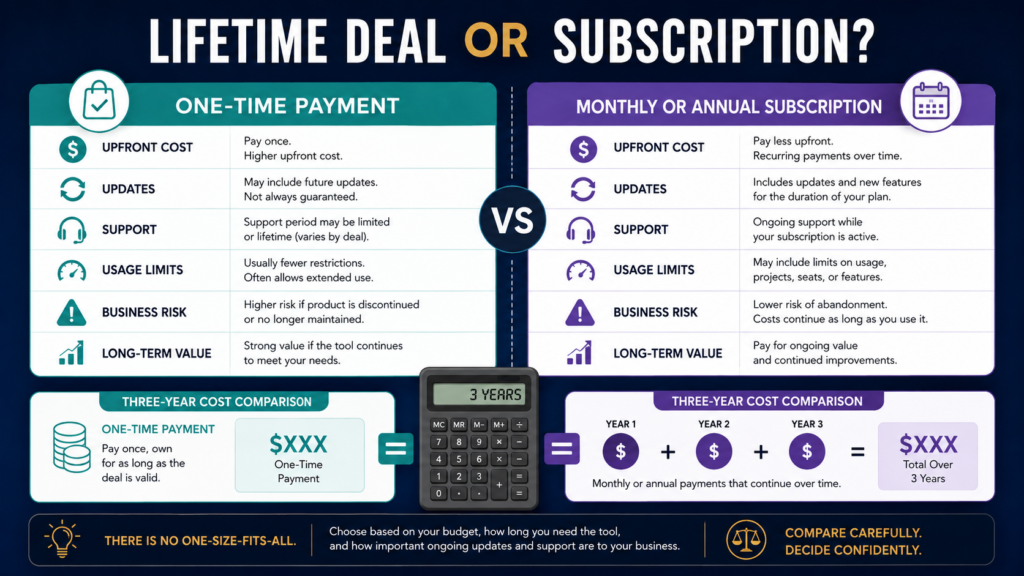
A lifetime software deal requires one larger payment in exchange for continued access under the seller’s stated terms.
Subscription software requires monthly or annual payments for continued access.
Neither option is automatically better.
A lifetime deal may save money when:
- The software remains available.
- The included features continue meeting your needs.
- Updates and support remain adequate.
- The license covers your intended use.
- You use the product for several years.
A subscription may provide better value when:
- The product requires constant development.
- Support is important.
- Your needs may change.
- You want the ability to leave.
- The business cannot justify a large upfront payment.
The correct decision requires more than comparing one payment with one monthly price.
The Main Difference
Lifetime Deal
You pay once for access described as lifetime, perpetual, or one-time.
Subscription
You continue paying monthly or annually while using the service.
The word “lifetime” may refer to:
- The life of the product
- The life of the company
- The life of the account
- A particular version
- Access under stated restrictions
Read the terms instead of relying only on the headline.
Question 1: How Long Will You Use It?
Estimate realistic use.
Do not assume you will use a tool for ten years merely because the lifetime price appears low.
Ask:
- Do I have a current project?
- How often will I use the tool?
- Does it replace another expense?
- Is it part of an approved workflow?
- Have I tested it?
- Will the task still matter next year?
A software tool you never use is expensive even when the price is low.
Question 2: What Does the Lifetime License Include?
Confirm:
- Current features
- Future updates
- Support
- Storage
- Credits
- Usage limits
- Commercial rights
- Client rights
- Team access
- Templates
- Integrations
- New modules
A lifetime offer may include only the current version.
Major future features may require another purchase.
Question 3: What Does the Subscription Include?
Subscriptions may support:
- Continuous updates
- Security maintenance
- Cloud hosting
- Customer support
- New integrations
- Ongoing AI usage
- Storage
- Backups
- Infrastructure
These services create continuing costs for the provider.
A subscription may be more sustainable for software requiring substantial hosting and development.
That does not mean every subscription offers good value. Compare the actual service.
Question 4: What Is the Break-Even Point?
Use this formula:
Lifetime Price ÷ Monthly Subscription Price = Approximate Break-Even Months
Example:
Lifetime price: $297
Monthly price: $29
$297 ÷ $29 = approximately 10.2 months.
The lifetime deal becomes cheaper after about eleven months when the products and features are otherwise equivalent.
They may not be equivalent.
One version may include different support, limits, or upgrades.
Question 5: What Is the Three-Year Cost?
Calculate:
Subscription
Monthly price × 36 months
Annual Plan
Annual price × 3 years
Lifetime
One-time price plus any add-ons, credits, or required upgrades
Example:
Monthly: $29 × 36 = $1,044
Annual: $249 × 3 = $747
Lifetime: $397
The lifetime option appears less expensive.
Now add:
- Additional credits
- Required hosting
- Optional upgrades
- Missing integrations
- Replacement software when development stops
The complete cost may differ.
Question 6: Is the Company Likely to Support the Product?
No buyer can guarantee a company’s future.
Look for reasonable signs, including:
- Product history
- Update record
- Documentation
- Support system
- Clear business model
- Public terms
- Active development
- Transparent limitations
Be cautious when the offer depends heavily on:
- Fake countdown timers
- Guaranteed income claims
- Unlimited everything
- No explanation of ongoing costs
- No support documentation
- Constantly changing product names
- Unclear ownership
A lifetime offer must generate enough revenue to support continued service.
Question 7: Can the Product Be Exported?
Ask:
- Can content be downloaded?
- Can contacts be exported?
- Can pages be moved?
- Can videos be saved?
- Can customer records be retrieved?
- Can you continue using exported files after closure?
Export options reduce the risk of depending entirely on one company.
Question 8: Does the Deal Include Commercial Rights?
Personal-use access may not permit:
- Client work
- Product resale
- Customer projects
- Agency use
- Commercial publishing
- Team access
Review:
- License
- Client limits
- Domain limits
- Account sharing
- Resale restrictions
- Commercial-output rights
Do not assume that a lifetime purchase includes every business right.
Question 9: Are Usage Credits Included?
AI and cloud tools may charge through:
- Credits
- Characters
- Images
- Video minutes
- Storage
- Exports
- Contacts
- Bandwidth
- Team members
A lifetime account may still require recurring credit purchases.
Calculate the expected usage cost.
Question 10: How Important Is Flexibility?
A subscription allows you to stop paying when:
- The project ends
- The tool is unused
- A better product appears
- The business changes
- The cost becomes too high
A lifetime purchase cannot usually be recovered after the refund period.
The lower long-term cost comes with a larger upfront commitment.
A Practical Beginner Example
Imagine a creator comparing two product-design tools.
Option A
$39 per month
Option B
$397 lifetime
The lifetime break-even point is slightly more than ten months.
The creator should still ask:
- Have I tested both?
- Are the features equivalent?
- Does the lifetime deal include updates?
- Are commercial rights included?
- How often will I create designs?
- Can files be exported?
- Do I already own another suitable tool?
When the creator needs only three graphics for one product, a one-month subscription may be more practical.
When the creator develops products weekly and has tested the lifetime tool, the one-time option may provide stronger value.
Evaluate Products You Already Own
Before buying another lifetime deal, create a software inventory.
Record:
- Product
- Purchase date
- Price
- Current use
- Last login
- Business task
- Alternatives
- Support status
A large collection of unused lifetime deals is not a money-saving system.
Use what you own before adding another platform.
Product-Specific Evaluation
When considering a one-time product-creation platform such as AI Product Engine, apply the same questions concerning usage, commercial rights, updates, support, exports, and workflow fit.
When considering an ongoing delivery platform such as ProductDyno, compare the long-term subscription cost with the value of hosting, customer access, support, and continuing infrastructure.
Do not select either payment model based solely on the headline price.
Advantages of Lifetime Deals
- One primary payment
- No routine renewal for the included access
- Lower long-term cost when used regularly
- Easier expense planning
- Potential value for repeated work
Limitations of Lifetime Deals
- Larger upfront payment
- Risk of product closure
- Limited future updates
- Possible paid upgrades
- Refund window may be short
- Support may decline
- “Lifetime” terms may be restricted
- Unused purchases cannot usually be recovered
Advantages of Subscriptions
- Lower initial cost
- Ability to cancel
- Continuing updates
- Ongoing support
- Infrastructure included
- Easier product switching
- Costs connected to active use
Limitations of Subscriptions
- Continuing expense
- Price increases
- Loss of access after cancellation
- Long-term cost may become high
- Data or content may remain inside the platform
- Businesses may forget renewals
Lifetime Deal vs. Subscription Checklist
Current Business Task:
[Task]
Expected Use:
[Weekly, monthly, or occasional]
Lifetime Price:
[Price]
Monthly Price:
[Price]
Annual Price:
[Price]
Break-Even Point:
[Months]
Three-Year Cost:
[Cost]
Usage Limits:
[Limits]
Commercial Rights:
[Rights]
Updates Included:
[Yes, no, or unclear]
Support Included:
[Support]
Export Available:
[Yes or no]
Refund Terms:
[Terms]
Existing Alternative:
[Tool]
Risk if Company Closes:
[Risk]
Final Decision:
[Buy, subscribe, delay, or reject]
Common Buying Mistakes
Buying Because the Deal Is Ending
Make the decision based on the workflow.
Ignoring Existing Tools
Compare what you already own.
Calculating Only the First Year
Review several years.
Assuming Lifetime Means Unlimited
Read the limits.
Buying Without Testing
Use a trial or demonstration when available.
Ignoring Export and Closure Risk
Know how to protect important work.
Final Verdict
A lifetime deal may provide better value for a tested tool that supports repeated work and includes clear commercial rights, updates, support, and exports.
A subscription may be safer when the software requires continuous development, the business need is temporary, or you want flexibility.
The best choice is the payment model that fits your actual use, risk tolerance, and long-term cost.
Conclusion
Lifetime and subscription software should be compared using more than the advertised price.
Calculate the break-even point, review the license, examine usage limits, test the workflow, check exports, and consider what happens if the product or business changes.
Complete the comparison checklist before purchasing the next lifetime deal or committing to another recurring subscription.