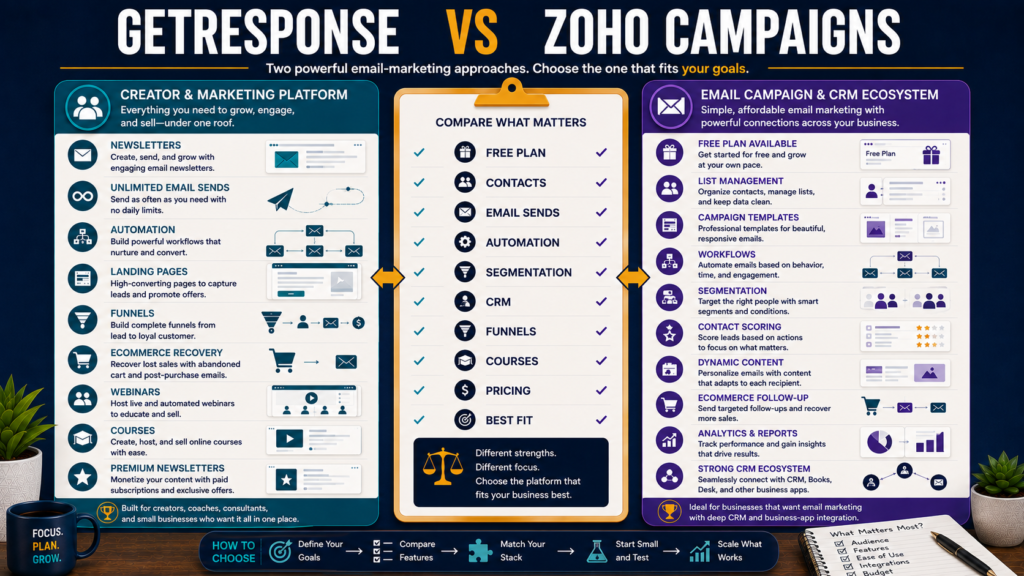
GetResponse and Zoho Campaigns both handle email marketing.
Both support subscriber management.
Both provide automation.
Both can help a small business build an email list and communicate with customers.
But their broader strategies are different.
GetResponse has expanded into a wider creator and marketing platform with landing pages, funnels, ecommerce automation, webinars, courses, and premium newsletters.
Zoho Campaigns remains more focused on email campaigns, contact management, segmentation, workflows, analytics, and integration with the broader Zoho business ecosystem.
That leads to the central buying question:
Do you want email to be part of a broader marketing-and-creator platform, or do you want an email system that fits naturally into a larger Zoho-based business stack?
Review Methodology: This review is based on official product information, available documentation, and publicly available details reviewed on August 31, 2026. No firsthand product testing or personal experience is claimed.
Affiliate Disclosure: This article contains affiliate links. If you purchase through one of these links, I may earn a commission at no additional cost to you. Affiliate compensation does not determine the conclusions or recommendations presented in this article.
You can review GetResponse through my affiliate link if its broader marketing approach fits your business.
Quick Verdict
GetResponse may be the better fit if you want email combined with landing pages, sales funnels, ecommerce recovery, webinars, online courses, and paid-newsletter tools.
Zoho Campaigns may be the better fit if you want a permanent free starting plan, contact-based email marketing, strong campaign functionality, and particularly close integration with the wider Zoho business ecosystem.
For a creator selling courses or digital knowledge products, GetResponse has a stronger built-in creator feature set.
For an existing Zoho CRM or Zoho-app user, Zoho Campaigns can have a natural ecosystem advantage.
GetResponse Plans
GetResponse currently lists three standard paid plans:
- Starter.
- Marketer.
- Creator.
At the 1,000-contact entry level, current public pricing is:
Starter: $19/month, or $15.58/month equivalent with annual billing.
Marketer: $59/month, or $48.38/month annually.
Creator: $69/month, or $56.58/month annually.
All three standard paid plans currently include unlimited monthly email sends.
GetResponse also offers an Enterprise tier with custom pricing.
Zoho Campaigns Plans
Zoho Campaigns currently offers:
- Forever Free.
- Standard.
- Professional.
It also provides pay-as-you-go options for some use cases.
The current public pricing page uses contact-based pricing selectors for paid plans, beginning at 500 contacts.
Because the displayed dollar amount can vary with contact count, currency, and billing period, verify the live selector for your exact list size before purchasing.
Zoho currently advertises a 25% annual-billing discount.
The Free Plan Is a Major Difference
Zoho Campaigns currently provides a substantial Forever Free plan:
- Up to 2,000 contacts.
- Up to 6,000 emails per month.
- Up to 5 users.
- List management.
- Templates.
- Drag-and-drop and HTML creation.
- Generative AI features.
- Basic reporting.
- Dozens of app integrations.
GetResponse’s current entry model emphasizes a 14-day premium-feature trial rather than an equivalent long-term free email-marketing plan.
For a beginner with a small list and minimal budget, that is a meaningful Zoho advantage.
But the Zoho Free Plan Has Restrictions
The Forever Free plan is not simply the paid platform with smaller limits.
Zoho’s current documentation lists restrictions involving features such as:
- Segmentation.
- Scheduling.
- Dynamic content.
- Marketing automation.
- Ecommerce email marketing.
- Webhooks.
- SMS campaigns.
The free tier is useful for learning and basic campaigns.
A growing business should compare the paid plan containing the features it actually needs.
Email Sending
GetResponse’s three standard paid plans currently provide unlimited monthly sending.
Zoho Campaigns Standard and Professional also advertise unlimited emails under their contact-based paid structure, while Free allows 6,000 messages per month.
If sending volume is high, both paid platforms can work.
The pricing comparison then depends more on:
- Contact count.
- Features.
- Automation.
- Ecosystem needs.
Automation
GetResponse Starter currently provides one custom automation workflow.
Marketer and Creator include unlimited automation workflows, and the higher tiers add stronger segmentation and ecommerce functionality.
Zoho Standard includes basic drag-and-drop workflows.
Professional expands automation-related capabilities with features such as:
- Advanced segmentation.
- Contact scoring.
- Dynamic content.
- Send-time optimization.
- Abandoned-cart workflows.
- Purchase follow-up.
- Webhooks.
For either platform, do not decide based on the word automation alone.
List the triggers and actions your business actually requires.
Segmentation
Zoho differentiates its plans clearly.
Free
Limited.
Standard
Basic segmentation.
Professional
Advanced segmentation, tags, and contact scoring.
GetResponse Starter includes more basic list-management capabilities, while Marketer and Creator add advanced audience segmentation.
Complex behavioral targeting pushes you toward higher plans on both platforms.
CRM Integration
This is one of Zoho Campaigns’ strongest strategic advantages.
Zoho operates a large business-software ecosystem, including Zoho CRM.
For a company already using Zoho for:
- CRM.
- Sales.
- Forms.
- Customer data.
- Business operations.
Zoho Campaigns can reduce the friction of connecting unrelated vendors.
This does not automatically make Zoho Campaigns the better email tool.
It makes the ecosystem part of the buying decision.
GetResponse’s Ecosystem Is More Marketing-Centered
GetResponse’s broader platform is centered around marketing and monetization rather than a general business-software suite.
Current Marketer features include:
- Advanced automation.
- Abandoned-cart recovery.
- Sales funnels.
- Promo codes.
- Revenue reports.
- Web push.
Creator adds:
- Webinars.
- Website builder.
- Course creator.
- Up to 500 students.
- Premium newsletter subscriptions.
That can reduce the number of separate creator tools required.
Landing Pages
GetResponse includes a landing-page builder across its current standard plans.
Zoho Campaigns provides signup forms and campaign-oriented audience tools, but if full landing-page and funnel creation are central to your system, compare the complete Zoho ecosystem rather than assuming Zoho Campaigns alone replaces a funnel platform.
This is one area where GetResponse’s integrated marketing approach is clearer.
Sales Funnels
GetResponse Marketer and Creator include dedicated sales-funnel capabilities.
Zoho Campaigns is primarily an email-campaign platform.
If your workflow is:
landing page → email → product promotion → funnel
GetResponse may consolidate more of the process.
Ecommerce
Both support ecommerce marketing.
GetResponse Marketer and Creator currently include:
- Abandoned-cart recovery.
- Product-related automation.
- Promo codes.
- Revenue reporting.
Zoho Campaigns Professional includes ecommerce-oriented functionality such as abandoned-cart and purchase-follow-up workflows.
If ecommerce is central, verify the exact store integration you use.
Courses
This is a major difference.
GetResponse Creator currently includes a built-in course creator with up to 500 students on the standard published Creator tier.
Zoho Campaigns is an email-marketing product, not a course-hosting LMS.
If you want email and courses inside the same platform, GetResponse has the advantage.
Webinars
GetResponse Creator includes webinars, and GetResponse’s platform has long treated webinars as part of its marketing stack.
Zoho as a company has other products that can address meetings and webinars, but Zoho Campaigns itself should not be evaluated as though it includes every separate Zoho application.
Be careful when comparing ecosystem features with features included directly in the subscription you are buying.
Team Size
Zoho Campaigns currently includes:
- Up to 5 users on Free.
- 10 users on Standard.
- 20+ users on Professional according to its current pricing information.
That can be attractive for teams.
A solo creator may not need it.
AI Features
Both platforms now advertise AI-assisted functionality.
GetResponse lists AI content generation and subject-line assistance.
Zoho Campaigns’ current plan comparison includes generative AI, AI subject-line recommendations, and additional AI-supported tools across its plan matrix.
Do not choose a platform merely because it contains the letters “AI.”
Test whether the feature improves your actual workflow.
GetResponse May Be Better If You Want
- Unlimited paid-plan email sending.
- Landing pages.
- Sales funnels.
- Ecommerce automation.
- Web push.
- Webinars.
- Courses.
- Premium newsletters.
- A broader creator-marketing environment.
For a closer look at GetResponse itself, see the GetResponse review for beginners.
Zoho Campaigns May Be Better If You Want
- Permanent Free plan.
- Up to 2,000 free contacts.
- 6,000 monthly free emails.
- Email-first campaign management.
- Contact-based paid plans.
- Large team allowances.
- Strong connection to Zoho CRM and the wider Zoho ecosystem.
- Professional-level segmentation and contact scoring.
Compare With Other Email Platforms
The verified GetResponse vs Brevo comparison is useful if multichannel messaging and CRM capabilities matter.
The GetResponse vs ActiveCampaign comparison focuses more heavily on automation depth.
Final Verdict
GetResponse and Zoho Campaigns are both capable email-marketing platforms.
Their strongest reasons to buy are different.
Choose GetResponse when email is part of a broader creator-marketing system involving funnels, ecommerce automation, webinars, courses, and premium newsletters.
Choose Zoho Campaigns when you want email-focused marketing, a generous permanent free tier, and especially when your business already uses the Zoho ecosystem.
For a creator starting an online knowledge business, GetResponse provides more native monetization tools.
For a CRM-centered small business already operating inside Zoho, Zoho Campaigns may fit the existing infrastructure more naturally.
Conclusion
Do not choose between GetResponse and Zoho Campaigns by comparing one entry price.
Write down:
- Contacts.
- Monthly sending volume.
- Number of users.
- Automation needs.
- CRM.
- Ecommerce.
- Landing pages.
- Sales funnels.
- Courses.
- Webinars.
Then compare the specific plans that contain those features.
A free plan can be valuable.
An all-in-one creator platform can also be valuable.
The better choice is the one that reduces the total complexity of the business you are actually operating.