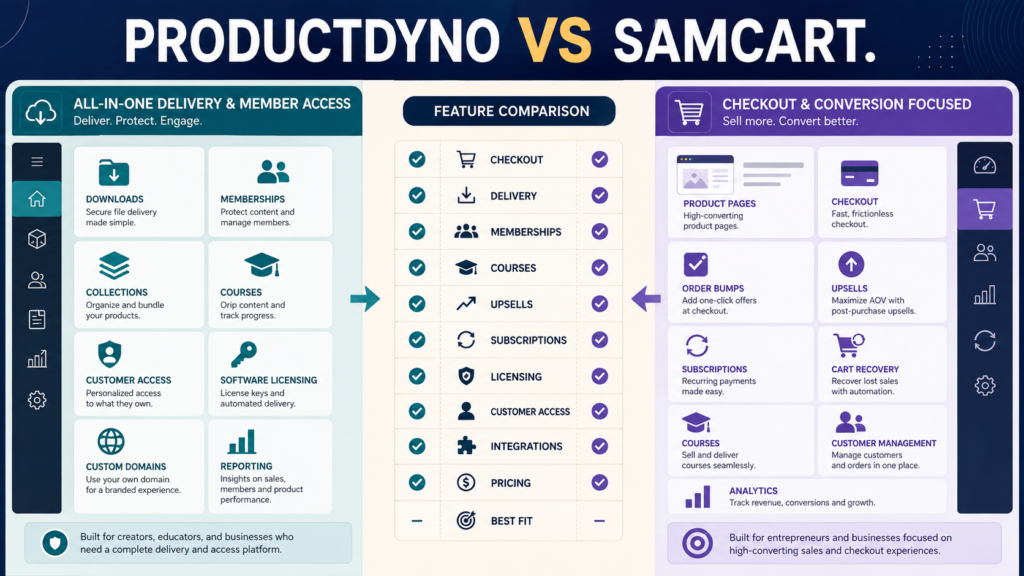
ProductDyno and SamCart can both participate in selling digital products.
But they approach the business from different directions.
ProductDyno emphasizes creating, protecting, organizing, and delivering digital products, memberships, collections, courses, and licensed software.
SamCart places greater emphasis on product pages, checkout, payments, conversion tools, subscriptions, order bumps, upsells, cart recovery, courses, and revenue management.
That makes this less about:
“Which platform is better?”
and more about:
Where does your business need the most help—after the purchase or around the purchase?
For many creators, that distinction makes the comparison much easier.
Review Methodology: This comparison is based on official ProductDyno and SamCart information reviewed on September 3, 2026. No firsthand product testing or personal product-use claim is made. Pricing, promotions, payment fees, limits, and features may change, so verify the current checkout and documentation before purchasing.
ProductDyno’s Main Strength: Digital-Product Infrastructure
ProductDyno’s current pricing and feature pages emphasize:
- Unlimited digital products.
- Memberships.
- Collections.
- Members/customers.
- Custom domains.
- White labeling.
- SSL.
- Integrations.
- Reporting.
- Software/SaaS licensing.
- Course/LMS options on higher plans.
The platform is designed to manage what customers receive and how they access it.
That makes ProductDyno especially relevant to creators selling combinations such as:
- Ebooks.
- Templates.
- Download libraries.
- Courses.
- Memberships.
- Software.
- Multiple related digital products.
You can review its current positioning on the ProductDyno features page.
SamCart’s Main Strength: Checkout and Commerce
SamCart’s current pricing page places strong emphasis on:
- Unlimited products.
- Product pages.
- Checkout.
- Payment processing.
- Cart abandonment.
- Courses.
- Customer management.
- Integrations.
- Reporting.
Its Pro plan adds sales-optimization tools such as:
- Order bumps.
- One-click upsells.
- A/B testing.
- Subscription Saver.
- Affiliate Center.
- Advanced analytics.
- Additional integration and processor flexibility.
You can review the current details on SamCart’s official pricing page.
The difference is clear:
ProductDyno begins with delivery and access.
SamCart begins more strongly with selling and checkout.
Current ProductDyno Pricing
ProductDyno’s current pricing-new page displays annual-billing promotional offers of:
Starter
$49 per month billed annually.
Current listed features include unlimited digital products, unlimited memberships, unlimited collections, unlimited members/customers, software/SaaS licensing, custom domains, white labeling, SSL, integrations, themes, reporting, and a stated 0% ProductDyno transaction fee.
Growth Plus+
$69 per month billed annually.
It includes the core features plus additional growth-related functionality.
Teach Pro+
$99 per month billed annually.
It adds ProductDyno’s LMS learning-management add-on and related higher-tier functionality.
Review the current offer on ProductDyno’s official pricing page.
One important caution: ProductDyno has displayed different offer structures on different official marketing pages. Because promotional pricing can vary, verify the actual checkout you are offered rather than assuming one page represents every available ProductDyno promotion.
Current SamCart Pricing
SamCart’s current pricing page displays:
Core
$79 per month under the monthly selection.
Core includes unlimited pages, products, and checkouts plus the platform’s core selling, course, business-management, payment, and customer capabilities.
Pro
$199 per month under the monthly selection.
Pro expands the system with more sophisticated selling and optimization tools.
SamCart currently also advertises 25% savings for yearly billing, so compare the actual annual checkout if you plan to pay yearly.
Pricing and processor fees can change, so review SamCart’s current pricing before making a purchase decision.
Which Platform Owns the Checkout?
This is one of the most important architectural questions.
SamCart is deliberately built around the sales transaction.
That includes:
- Checkout pages.
- Payment options.
- Order optimization.
- Upsells.
- Order bumps.
- Subscription management.
- Cart recovery.
If improving:
Visitor → Buyer
is your biggest priority, SamCart deserves serious attention.
ProductDyno also provides selling and checkout functionality, but much of its identity is built around:
Buyer → Correct Product Access
That is a different stage of the customer journey.
Product Delivery
For a simple ebook, either system may be more than you need.
But a digital-product business often becomes more complicated.
A customer may purchase:
Product A
then:
Product B
then:
Membership C
and eventually receive:
Course D
A delivery system must answer:
- What does this person own?
- What can they access?
- Where do they find it?
- What happens after a refund?
- How do several products appear together?
- How is access protected?
ProductDyno has been designed heavily around those questions.
If delivery organization is your main pain point, that matters.
Product Collections
ProductDyno supports collections, which can help organize multiple digital products under a shared customer-access structure.
Imagine selling:
AI Business Starter Collection
containing:
- Ebook.
- Prompt pack.
- Checklist.
- Course.
- Template library.
Instead of treating every file as an isolated download, you can organize access more intentionally.
This is consistent with the broader ProductDyno model: control and organize what the buyer receives.
Courses
Both platforms support course-related business models.
ProductDyno’s Teach Pro+ tier includes its LMS-related add-on.
SamCart currently includes its Courses App among its platform capabilities.
The important question is not:
“Does it have courses?”
Ask:
- How are lessons structured?
- What student experience do I want?
- Do I need quizzes?
- Do I need progress features?
- How important is video hosting?
- Are courses my primary product or a bonus?
- What plan includes the features I need?
If your business is primarily education-focused, compare the actual learning experience—not merely the presence of a course feature.
My ProductDyno vs Kajabi comparison provides another useful perspective if an all-in-one course and marketing environment is also under consideration.
Upsells and Order Bumps
This is an area where SamCart’s sales orientation becomes especially visible.
Current Pro features include:
- One-click upsells.
- Order bumps.
- A/B testing.
These tools are designed to improve the economics of the checkout.
Example:
Main Product: $27 ebook.
Order Bump: $9 workbook.
Upsell: $47 mini-course.
For a business using that type of funnel, checkout optimization can have meaningful value.
Do not add upsells simply because software makes them possible.
The additional offer should genuinely complement the main purchase.
Cart Abandonment
SamCart’s current Core offering includes cart-abandonment functionality.
That can be useful when a potential customer begins purchasing but does not complete the transaction.
Again, this reflects SamCart’s focus on the sales process.
ProductDyno’s strongest distinction is elsewhere: delivery, access, membership, collections, and licensing.
Subscription Products
Recurring revenue may come from:
- Memberships.
- Subscription products.
- Ongoing services.
- Paid communities.
- Course access.
SamCart’s selling environment supports recurring-payment business models and its Pro-level Subscription Saver is designed around recovering subscription-related revenue problems.
ProductDyno supports memberships and recurring-access business structures, with the focus more directly tied to customer access and content delivery.
Ask:
Is my main challenge collecting recurring payments, or delivering recurring access?
That question can point toward the stronger fit.
Software Licensing Is a Major ProductDyno Difference
ProductDyno’s current plans list a built-in Software/SaaS Licensing Module.
That can matter greatly if you sell:
- Software.
- WordPress plugins.
- Licensed tools.
- SaaS access.
- Digital applications requiring license controls.
This is more specialized than ordinary digital-file delivery.
If software licensing is a core requirement, ProductDyno moves higher on the shortlist.
Do not assume every checkout platform provides the same licensing infrastructure simply because it can sell a software product.
Affiliate Management
SamCart’s current Pro plan includes an Affiliate Center.
That may be important for businesses planning to recruit partners to promote products.
ProductDyno is more likely to be combined with external checkout, affiliate, or sales systems depending on the creator’s preferred stack.
If affiliates are central to the business, compare:
- Partner signup.
- Tracking.
- Commission rules.
- Payment workflow.
- Reporting.
- Link management.
Do not choose from the words “affiliate system” alone.
Payment Processing
SamCart’s current pricing page prominently details its payment capabilities and current SamPay processing rate information.
ProductDyno’s pricing page emphasizes a stated 0% ProductDyno transaction fee, but that does not mean payment processors themselves charge nothing.
Always separate:
Platform transaction fee
from:
Payment processor fee
from:
Subscription price.
Those are three different cost categories.
Integrations
Both platforms integrate with outside tools.
A digital-product business may still need connections to:
- Email marketing.
- Payment processing.
- CRM.
- Analytics.
- Webinar software.
- Automation tools.
Before subscribing, map the full stack.
Do not assume:
“Integrates with email marketing”
means:
“Integrates with my exact email platform on my exact plan in the exact way I need.”
Verify the specific integration.
ProductDyno May Fit Better If…
ProductDyno deserves stronger consideration when:
- Product delivery is the main requirement.
- You sell multiple digital products.
- Membership access matters.
- Collections are useful.
- Software licensing matters.
- You want custom-domain product delivery.
- You want a centralized product-access environment.
- Courses are part of the catalog.
- You already have a separate checkout strategy you like or prefer ProductDyno’s own selling options.
For a broader overview, see my ProductDyno review for beginners.
Affiliate Disclosure: This article contains affiliate links. If you purchase through one of these links, I may earn a commission at no additional cost to you. Affiliate compensation does not determine the conclusions or recommendations presented in this article.
If ProductDyno matches the delivery and access system you need, you can review the current ProductDyno offer through this approved partner link.
SamCart May Fit Better If…
SamCart deserves stronger consideration when:
- Checkout optimization is central.
- Order bumps matter.
- One-click upsells matter.
- Cart-abandonment tools matter.
- You want subscriptions managed close to checkout.
- A/B testing of sales elements matters.
- Affiliate management is important.
- You want a commerce system built heavily around turning visitors into buyers.
What if You Mainly Sell Simple Downloads?
If your business sells:
- One ebook.
- One checklist.
- One template pack.
both systems may provide more capability than you currently need.
Ask whether the extra complexity is justified.
A simpler alternative may be more appropriate during the earliest stage.
The ProductDyno vs SendOwl comparison examines a different creator-commerce approach.
Compare the Complete Cost
Do not compare only:
ProductDyno $49
versus:
SamCart $79
because the plans do different jobs.
Build a complete stack.
ProductDyno Stack
Include:
- ProductDyno.
- Checkout/payment system if separate.
- Email platform.
- Payment processing.
- Any integrations.
SamCart Stack
Include:
- SamCart.
- Email platform.
- Payment processing.
- Additional delivery or licensing tools if needed.
- Any other membership or automation services.
The cheaper subscription is not always the cheaper business system.
Use the Workflow Test
Write your desired customer journey:
Traffic → Sales Page → Checkout → Payment → Upsell → Product Access → Course/Membership → Support → Renewal
Now place each platform beside the steps.
Ask:
Which system handles my most important steps with the fewest unnecessary tools?
That question is more useful than counting features.
Could ProductDyno and SamCart Be Complementary?
Potentially.
Because the platforms emphasize different parts of the transaction and delivery process, some businesses may use a checkout-focused platform with a specialized product-delivery platform.
But that does not mean you should automatically buy both.
Every integration adds:
- Cost.
- Setup.
- Testing.
- Another potential failure point.
A beginner should first determine whether one platform adequately handles the required workflow.
Add a second platform only when the business has a clear reason.
Five Questions Before Choosing
1. What do I sell?
Downloads, courses, memberships, software, subscriptions, or a combination?
2. What is harder for me?
Selling the product or delivering it?
3. Do I need conversion tools?
Order bumps, upsells, A/B testing, cart recovery?
4. Do I need specialized access tools?
Collections, memberships, software licensing?
5. How many separate tools will the final system require?
Fewer tools often means easier maintenance.
Conclusion
ProductDyno and SamCart overlap, but their strengths sit at different points in the customer journey.
ProductDyno is especially compelling for businesses that need structured digital-product delivery, memberships, collections, customer access, courses, and software licensing.
SamCart is especially compelling when checkout, payment flow, cart recovery, subscriptions, order bumps, upsells, A/B testing, and sales optimization are the higher priorities.
Neither automatically replaces every other business tool.
Map your actual workflow before buying.
If the difficult part of your business begins after the customer pays, ProductDyno may provide the more relevant infrastructure.
If the difficult part is getting the customer through checkout and increasing the value of the sale, SamCart may provide the stronger fit.
Choose the system that solves your real bottleneck rather than the one with the longest feature list.