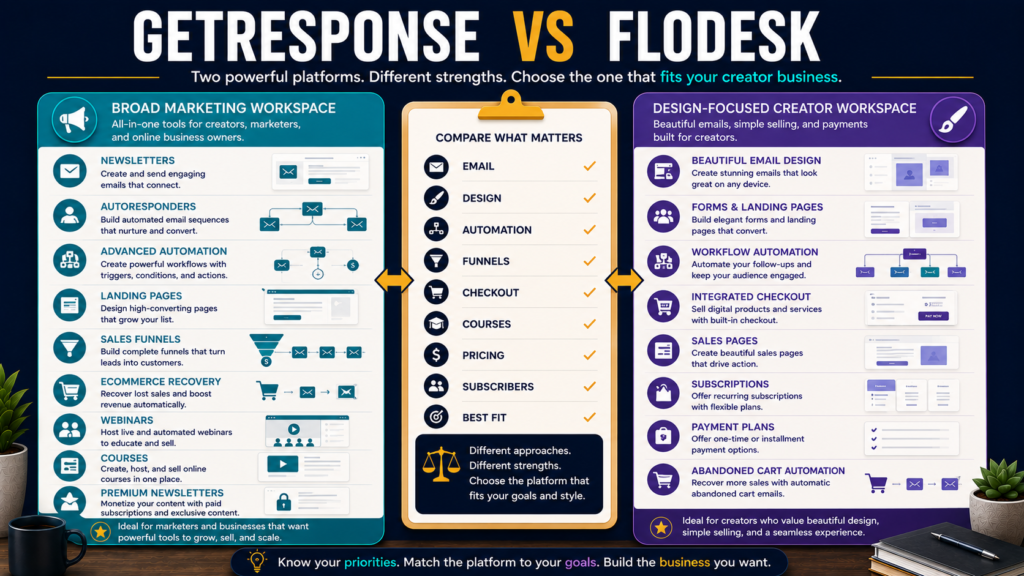
GetResponse and Flodesk can both help creators collect subscribers, send emails, build landing pages, segment audiences, and automate follow-up.
But they approach the creator market differently.
GetResponse emphasizes a broader marketing platform that combines email with automation, funnels, ecommerce marketing, webinars, courses, websites, and premium newsletters.
Flodesk emphasizes visually polished email creation, forms, landing pages, straightforward workflows, and—on higher plans—integrated checkout and creator-commerce tools.
Flodesk also changed its pricing model for new customers in late 2025. Current pricing now scales with active subscribers rather than using the old universal flat-rate model many older reviews still describe.
That makes a current GetResponse vs Flodesk comparison especially important.
Review Methodology: This comparison is based on official GetResponse and Flodesk pricing pages, feature information, and public documentation reviewed on August 28, 2026. No firsthand product testing or personal experience is claimed.
Affiliate Disclosure: This article contains affiliate links. If you purchase through one of these links, I may earn a commission at no additional cost to you. Affiliate compensation does not determine the conclusions or recommendations presented in this article.
Quick Verdict
GetResponse may be the stronger choice if you want email marketing to connect with deeper automation, sales funnels, ecommerce recovery, webinars, courses, premium newsletters, and a broader online-marketing system.
Flodesk may be the stronger choice if visual email design, creator-friendly forms, straightforward automation, and integrated selling are higher priorities than advanced marketing complexity.
For a very simple newsletter workflow, either may be more capable than necessary.
For a growing digital-product business, the differences in automation, selling tools, and pricing deserve closer attention.
What Is GetResponse?
GetResponse’s current standard plans are:
- Starter.
- Marketer.
- Creator.
It also offers Enterprise.
At the current entry list size, GetResponse publicly lists:
Starter: $19/month, or $15.58/month equivalent on annual billing.
Marketer: $59/month, or $48.38/month equivalent annually.
Creator: $69/month, or $56.58/month equivalent annually.
Standard paid plans currently include unlimited monthly email sending.
Higher tiers add broader automation, ecommerce, funnel, webinar, and creator features.
You can review GetResponse through my affiliate link.
What Is Flodesk?
Flodesk is a creator-focused email and commerce platform that places heavy emphasis on design.
Its current plan structure is:
- Free.
- Lite.
- Pro.
- Everything.
At up to 1,000 subscribers, current published prices are:
Lite: $25/month, or $19/month with annual billing.
Pro: $28/month, or $25/month annually.
Everything: $54/month, or $49/month annually.
Pricing scales as the active subscriber count grows.
Important: Flodesk No Longer Uses the Old Flat-Rate Model for New Customers
Many older reviews still say:
“Flodesk charges one flat price no matter how many subscribers you have.”
That is no longer accurate for new subscriptions.
Flodesk says its subscriber-based pricing began December 2, 2025. Existing legacy customers who subscribed before the change may retain older pricing while their qualifying subscription remains active.
For a new buyer in 2026, use the current active-subscriber pricing.
How Flodesk Counts Subscribers
Flodesk says pricing is based on active subscribers.
Unsubscribed, bounced, or cleaned contacts do not count toward the active-subscriber tier.
That can reward good list hygiene.
But it also means your monthly cost can rise as your active list grows.
GetResponse Pricing Scales Differently
GetResponse pricing also increases with list size.
Its standard options currently include list tiers such as:
- 1,000.
- 2,500.
- 5,000.
- 10,000.
- 25,000.
- 50,000.
- 100,000.
GetResponse describes this as a pay-as-you-grow model.
Both platforms therefore now connect cost to audience size.
Email Sending
Both standard paid environments offer unlimited sending under their current plans.
GetResponse lists unlimited monthly sends on Starter, Marketer, and Creator.
Flodesk says its paid plans provide unlimited email sending without per-email charges.
For someone who emails frequently, that is useful.
The more important question becomes:
What else does the platform need to do?
Email Design
Flodesk’s brand identity is strongly connected to visually polished email design.
Its current paid plans include designer templates, customization, and creator-oriented layouts.
A visual brand where email appearance is a major part of the experience may appreciate that focus.
GetResponse also includes a visual email editor, templates, AI-supported creation, personalization, and email-testing capabilities.
The difference is less:
“Can GetResponse design emails?”
It can.
The difference is Flodesk makes visual simplicity a central product characteristic.
Automation
This is an important difference.
Flodesk Lite
The current Lite plan includes a limited-time bonus of one workflow, according to its pricing page.
Flodesk Pro
Adds unlimited workflow automations.
GetResponse Starter
Includes one custom automation workflow.
GetResponse Marketer and Creator
Include unlimited automation workflows.
On paper, the structures may look similar.
The bigger question is workflow depth.
GetResponse’s broader Marketer environment includes more advanced segmentation and ecommerce-oriented automation such as abandoned-cart recovery.
Flodesk emphasizes simpler creator workflow automation.
Landing Pages and Forms
Both platforms provide:
- Forms.
- Landing pages.
- List-building tools.
Flodesk’s Free plan is interesting because it allows creators to build forms, landing pages, and link-in-bio pages without paying, although email sending is not included on the Free plan.
GetResponse Starter includes:
- Landing-page builder.
- Signup forms.
- Popups.
- Email marketing.
A creator who wants to build a list before paying for email sending may find Flodesk’s Free tier attractive.
Checkout and Selling
Flodesk becomes substantially different on the higher plans.
Pro
Current pricing includes one integrated checkout.
Everything
Includes:
- Unlimited integrated checkouts.
- Sales pages.
- Funnels.
- Subscriptions.
- Payment plans.
- Abandoned-cart automations.
Flodesk says it does not add an additional platform transaction fee on top of Stripe’s normal processing for its checkout feature. Availability currently depends on supported countries.
This makes Flodesk more than a newsletter tool.
GetResponse Selling Tools
GetResponse approaches selling differently.
Marketer currently includes:
- Sales funnels.
- Abandoned-cart recovery.
- Promo codes.
- Revenue reports.
- Ecommerce automation.
Creator adds:
- Webinars.
- Website builder.
- Course creator.
- Students.
- Premium newsletter subscriptions.
That gives GetResponse a broader knowledge-business direction.
Courses
This may be decisive.
GetResponse Creator currently includes a built-in course creator and supports up to 500 students at the listed standard Creator level.
GetResponse’s current feature page also promotes:
- AI course creator.
- Quizzes.
- Certificates.
- Video hosting.
- Premium newsletters.
Flodesk’s current commerce emphasis is more about checkout, sales pages, subscriptions, and creator selling rather than a comparable built-in course LMS.
If you want the email system to also host courses, GetResponse has the stronger case.
Which Is Better for a Newsletter?
For a simple newsletter creator, Flodesk can be attractive because of:
- Visual design.
- Unlimited sends.
- Forms.
- Landing pages.
- Simple audience segmentation.
- Creator-oriented workflows.
GetResponse can also run a simple newsletter but may appeal more if you expect the marketing system to expand.
Which Is Better for a Digital-Product Creator?
Ask what already exists in your stack.
If you already have:
- Checkout.
- Course platform.
- Product delivery.
- Website.
you may primarily need email.
Flodesk could fit well.
If you want email combined with:
- Funnels.
- Webinars.
- Courses.
- Ecommerce recovery.
- Premium newsletters.
GetResponse may consolidate more functions.
Compare GetResponse With Other Creator Platforms
The verified GetResponse vs Kit comparison examines another creator-centered email alternative.
The verified GetResponse vs beehiiv comparison is useful if newsletter publishing and audience growth are especially important.
And the GetResponse review for beginners provides a simpler look at GetResponse itself.
GetResponse May Be Better If You Want
- Unlimited email sends.
- Advanced automation.
- Ecommerce automation.
- Sales funnels.
- Webinars.
- Courses.
- Premium newsletters.
- Broader segmentation.
- A more complete marketing environment.
Flodesk May Be Better If You Want
- Strong visual email design.
- Simple creator experience.
- Forms and landing pages.
- Unlimited email sending.
- Straightforward workflows.
- Integrated checkout.
- Sales pages.
- Subscriptions.
- Payment plans.
- A creator-focused commerce experience.
Pricing Example
For up to 1,000 subscribers on annual billing at current listed entry rates:
GetResponse
Starter: $15.58/month equivalent.
Marketer: $48.38/month equivalent.
Creator: $56.58/month equivalent.
Flodesk
Lite: $19/month.
Pro: $25/month.
Everything: $49/month.
These are not equivalent plans.
Do not simply compare the numbers side by side.
Compare the features required by your workflow.
Final Verdict
GetResponse and Flodesk are both credible creator email platforms, but they are optimized differently.
Choose GetResponse when email is part of a larger marketing system involving deeper automation, ecommerce, funnels, webinars, courses, and premium content.
Choose Flodesk when visual email creation, creator-friendly workflows, list building, and integrated checkout matter more than building a sophisticated marketing-automation system.
Flodesk’s current subscriber-based pricing also means buyers should ignore older reviews that still describe universal flat-rate pricing.
Conclusion
The GetResponse vs Flodesk decision should begin with your next 12 months of activity.
Write down what you actually need:
- Email?
- Automations?
- Landing pages?
- Checkout?
- Sales funnels?
- Courses?
- Webinars?
- Subscriptions?
Then choose the lowest plan that performs those jobs.
A beautiful platform with missing business functions will eventually create extra subscriptions.
A powerful marketing suite with features you never use can create unnecessary complexity.
The better platform is the one that matches the business you are actually building.