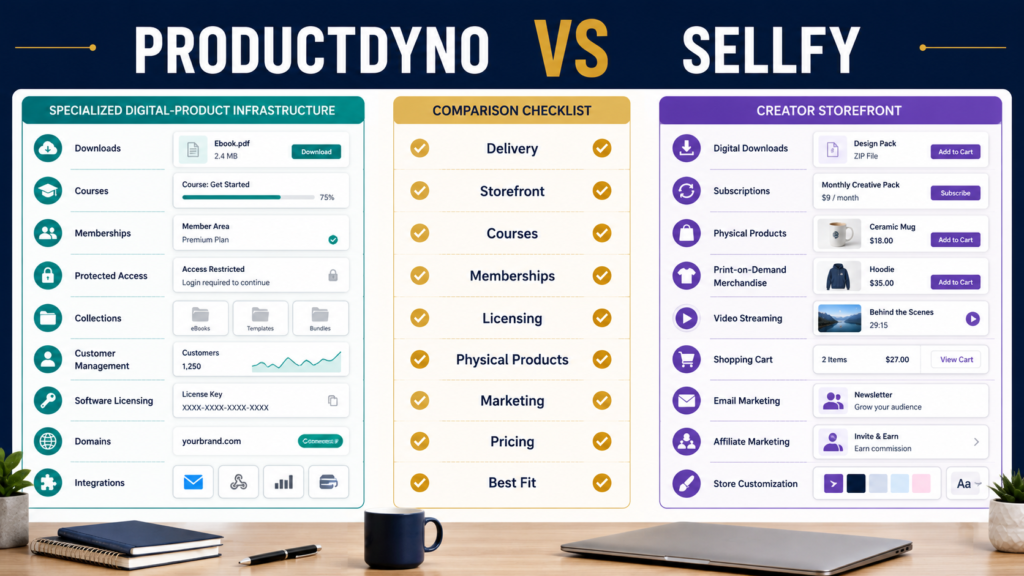
ProductDyno and Sellfy can both participate in a digital-product business.
But they solve the problem from different starting points.
ProductDyno emphasizes creating, securing, licensing, organizing, and delivering digital content, courses, memberships, and customer access.
Sellfy emphasizes building a creator storefront where you can sell digital downloads, subscriptions, physical products, and print-on-demand merchandise while using built-in ecommerce and marketing tools.
That means the central decision is:
Do you primarily need specialized digital-product infrastructure—or a complete creator storefront?
Review Methodology: This comparison is based on official ProductDyno and Sellfy pricing pages, feature descriptions, and current public documentation reviewed on August 26, 2026. No firsthand product testing or personal experience is claimed.
Affiliate Disclosure: This article contains affiliate links. If you purchase through one of these links, I may earn a commission at no additional cost to you. Affiliate compensation does not determine the conclusions or recommendations presented in this article.
Quick Verdict
ProductDyno may be better when your business needs protected digital delivery, courses, memberships, collections, customer access management, software licensing, and integration with an existing marketing stack.
Sellfy may be better when you want a ready-made online storefront for digital products plus subscriptions, physical products, print-on-demand merchandise, email marketing, and ecommerce selling tools.
The difference becomes even clearer if you already have:
- WordPress.
- Email marketing.
- Checkout.
- Funnels.
In that situation, ProductDyno may fill a specialized delivery gap.
If you need the store itself, Sellfy becomes much more interesting.
What Is ProductDyno?
ProductDyno’s current public platform highlights:
- Digital downloads.
- Online courses.
- Membership sites.
- Protected content.
- AI creation tools.
- Landing pages.
- Payment connections.
- LMS features.
- Custom domains.
- Collections.
- Business intelligence.
- Licensing.
- Team-member capabilities.
My ProductDyno review for beginners provides a broader introduction to that delivery-focused approach.
Review ProductDyno through my affiliate link
What Is Sellfy?
Sellfy describes itself as an online-store platform designed to let creators build a storefront and sell multiple product types.
Its current feature set includes:
- Digital products.
- Physical products.
- Subscriptions.
- Print-on-demand products.
- Video streaming.
- Store customization.
- Shopping cart.
- Custom domains.
- Email marketing.
- Marketing features.
- PayPal and Stripe payments.
- PDF stamping.
- Download controls.
This makes Sellfy much closer to an ecommerce storefront than ProductDyno’s traditional delivery-first identity.
The Core Difference
Think of the platforms this way.
ProductDyno
Customer purchased something. How do I securely organize, deliver, protect, license, and manage access to it?
Sellfy
I need an online store where customers can browse, purchase, and receive products.
There is overlap.
But the starting business problem is different.
Digital Downloads
Both platforms can work for products such as:
- Ebooks.
- PDFs.
- Templates.
- Audio.
- Videos.
- Design files.
- Software files.
- Download bundles.
Sellfy emphasizes placing those items inside a storefront.
ProductDyno emphasizes delivery and access infrastructure.
If you already have a strong sales-page and checkout process, storefront creation may matter less.
Storefront
Sellfy has the stronger focus here.
Its current platform includes:
- Store editor.
- Themes.
- Customization.
- Own-domain connection.
- Shopping cart.
- Mobile optimization.
That can reduce the number of separate systems required by a creator who wants to start selling quickly.
ProductDyno can build delivery and product experiences but is not centered around the same conventional ecommerce-store model.
Product Types
Sellfy has an unusually broad mix for creators.
Its official features currently include:
- Digital products.
- Physical products.
- Subscriptions.
- Print-on-demand merchandise.
This matters if your future business may sell:
ebook + paid subscription + T-shirt + print-on-demand mug
from one store.
A creator who will never sell physical or merchandise products should not give those features much weight.
ProductDyno’s Specialization
ProductDyno becomes more distinctive when products require:
- Membership access.
- Organized collections.
- Course delivery.
- Protected pages.
- Software licensing.
- Customer login management.
- Different types of access.
- External payment integrations.
Those capabilities may matter more to a digital-product operation with several offers.
Software Licensing
This is an important distinction.
ProductDyno explicitly promotes software licensing and user-management capabilities.
That makes it potentially relevant for:
- Web applications.
- Software.
- Plugins.
- Licensed tools.
Sellfy can sell downloadable software files, but its public feature positioning does not center on specialized software-license management in the same way.
If licensing is important, ProductDyno deserves closer scrutiny.
Courses
ProductDyno explicitly provides online course and LMS-related capabilities.
Sellfy can sell course-related digital products and content, but its primary public feature positioning is store-based ecommerce rather than a specialized learning-management environment.
A creator building a substantial structured course should compare the exact learning experience rather than assuming every platform using the word “course” provides the same LMS functionality.
Subscriptions
Sellfy supports subscription products with recurring billing periods.
ProductDyno supports membership-style access.
Ask whether your recurring offer is primarily:
subscription commerce
or:
managed membership access.
The distinction may affect how you want customers organized.
Print on Demand
Sellfy has a clear advantage if you want built-in print-on-demand merchandise.
Its current platform promotes products such as:
- T-shirts.
- Hoodies.
- Mugs.
- Hats.
Sellfy handles production and fulfillment for supported print-on-demand products.
ProductDyno is not primarily a print-on-demand ecommerce platform.
For a digital-only business, this advantage may be irrelevant.
Email Marketing
Sellfy includes built-in email marketing.
Current Sellfy pricing documentation assigns different email-credit allowances to the Starter, Business, and Premium tiers.
That could reduce the need for a separate email tool for some creators.
But if you already use a dedicated platform you like, built-in email may create duplication rather than savings.
Marketing Features
Sellfy’s higher tiers currently add features such as:
- Upselling.
- Cart abandonment.
- Affiliate marketing.
Those are useful commerce capabilities.
ProductDyno can operate inside an existing funnel and affiliate-marketing stack instead of necessarily replacing those tools.
Sellfy Pricing
Sellfy’s current help documentation lists three paid plans.
On monthly billing:
- Starter: $39/month.
- Business: $79/month.
- Premium: $159/month.
Its help center also lists annual totals of:
- Starter: $348/year.
- Business: $708/year.
- Premium: $1,428/year.
The plans currently have annual sales thresholds of up to $10,000, $50,000, and $200,000 respectively.
Sellfy says it charges no platform transaction fee on the paid plans, although Stripe or PayPal processing fees still apply.
Sellfy’s Trial
Sellfy currently offers a 14-day trial.
Its documentation states that checkout is disabled during the trial, meaning you can test the environment but need to upgrade before accepting actual product sales.
That is worth knowing before planning a live launch around the trial.
ProductDyno Pricing Requires Verification
ProductDyno’s current public pricing page deserves careful checking at the exact time of purchase.
The page currently advertises a 14-day test drive and includes promotional pricing language, while different sections of the same public page describe billing in ways that are not perfectly consistent.
Because of that, verify the live checkout for:
- Exact price.
- Billing frequency.
- Promotional terms.
- Trial terms.
- Included add-ons.
- Product limits.
- Customer limits.
Do not rely on an old review or screenshot for the final price.
Sellfy May Be Better If You Want
- A ready-made storefront.
- Digital downloads.
- Physical products.
- Print-on-demand merchandise.
- Subscriptions.
- Shopping cart.
- Built-in email marketing.
- Upsells.
- Cart abandonment on applicable plans.
- Affiliate marketing on applicable plans.
- Store customization.
- A traditional creator-ecommerce workflow.
ProductDyno May Be Better If You Want
- Protected digital delivery.
- Courses.
- Memberships.
- Collections.
- Customer access management.
- Software licensing.
- LMS features.
- Integration with tools you already own.
- A specialized digital-product infrastructure layer.
The more established your existing marketing stack is, the more useful specialization may become.
Compare ProductDyno With Other Selling Models
My ProductDyno vs SendOwl comparison examines a more direct digital-delivery and checkout competitor.
My ProductDyno vs systeme.io comparison covers the different question of specialized delivery versus an all-in-one funnel, email, and marketing environment.
These comparisons help clarify what category of platform you actually need.
Existing Tools Change the Answer
Suppose you already use:
- WordPress for the website.
- Dedicated email marketing.
- A checkout platform.
- Established funnels.
- Affiliate tracking.
In that case, Sellfy could duplicate several functions.
ProductDyno might fit more cleanly as the delivery layer.
Now imagine you have none of those systems and simply want:
store → checkout → payment → delivery → follow-up.
Sellfy may reduce setup considerably.
Calculate the Whole Stack
Do not compare only:
ProductDyno subscription vs Sellfy subscription.
Compare the complete operating stack.
Ask what else each option requires for:
- Website.
- Checkout.
- Email.
- Funnels.
- Delivery.
- Memberships.
- Affiliate management.
- Licensing.
- Physical fulfillment.
Sometimes a higher-priced platform costs less overall because it replaces other tools.
Sometimes an all-in-one platform costs more because you already own everything it replaces.
Final Buying Questions
Before choosing, answer:
- Do I need a storefront?
- Do I sell only digital products?
- Will I sell physical products?
- Do I want print-on-demand?
- Do I need recurring subscriptions?
- Do I need a structured course environment?
- Do I need software licensing?
- Do customers need protected member access?
- Do I already have email marketing?
- Do I already have checkout?
- Do I already have affiliate tracking?
- What is the total yearly software cost?
- Can I export my customer data?
- How much migration work would switching create?
Final Verdict
ProductDyno and Sellfy are both useful platforms, but they serve different operating models.
Choose ProductDyno when the central problem is managing and securely delivering digital products, memberships, courses, collections, customer access, or licensed software—particularly when other marketing systems are already in place.
Choose Sellfy when the central problem is creating a storefront that can sell digital downloads, subscriptions, physical products, and print-on-demand merchandise while providing ecommerce and marketing tools in the same platform.
ProductDyno is more specialized around the product-access infrastructure.
Sellfy is more storefront-centered.
Conclusion
The ProductDyno vs Sellfy decision becomes easier when you stop asking which platform has more features and instead ask what part of your business is currently missing.
If you already have traffic, email, checkout, and sales pages but need stronger digital delivery and licensing, ProductDyno may be the more logical addition.
If you need an online store where customers can browse, purchase, and receive several types of products, Sellfy may be the more direct solution.
Choose the platform that fills the real operational gap without forcing you to pay for or rebuild systems you already have.