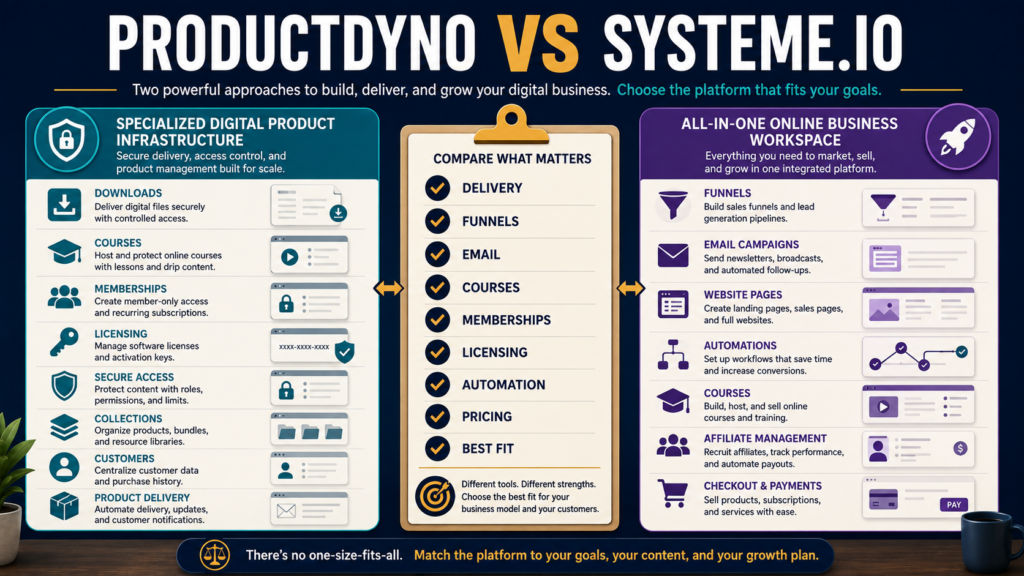
ProductDyno and systeme.io can both play important roles in a digital-product business, but they approach the job from different directions.
ProductDyno is strongly oriented toward creating, protecting, delivering, licensing, and managing digital products, courses, memberships, and customer access.
systeme.io is positioned as a broader all-in-one online-business platform combining funnels, email marketing, websites, automation, course hosting, affiliate management, and product sales.
For a beginner, that means the decision should not begin with:
Which platform has more features?
It should begin with:
Do I need specialized digital-product infrastructure, or do I need one platform to replace several marketing tools?
Review Methodology: This comparison is based on official ProductDyno and systeme.io websites, pricing information, feature descriptions, help documentation, and publicly available information reviewed on August 24, 2026. No firsthand product testing or personal experience is claimed.
Affiliate Disclosure: This article contains affiliate links. If you purchase through one of these links, I may earn a commission at no additional cost to you. Affiliate compensation does not determine the conclusions or recommendations presented in this article.
Quick Verdict
ProductDyno may be better when your priority is managing and securely delivering multiple types of digital products, memberships, courses, software licenses, customer access, and protected content.
systeme.io may be better when you want one system that combines your funnel builder, email marketing, website, automation, courses, affiliate management, and selling tools.
A business that already owns strong email and checkout tools may see more value in ProductDyno’s specialized delivery role.
A beginner who wants to minimize the number of separate subscriptions may find systeme.io’s integrated approach attractive.
What Is ProductDyno?
ProductDyno describes itself as a platform for selling, licensing, securing, and delivering digital content.
Its official website currently highlights capabilities including:
- Online courses.
- Digital downloads.
- Membership sites.
- AI creation tools.
- Landing pages.
- Payment connections.
- LMS features.
- Custom domains.
- Collections.
- Business intelligence.
- Licensing.
- Team-member access.
You can also review my broader ProductDyno review for beginners for a closer look at the type of business problem the platform is designed to solve.
What Is systeme.io?
systeme.io positions itself as an all-in-one platform for online entrepreneurs.
Its current feature set includes:
- Sales funnels.
- Email marketing.
- Websites.
- Marketing automation.
- Affiliate management.
- Online courses.
- Communities.
- Booking.
- CRM-style pipelines.
- Evergreen webinars.
- Physical and digital product selling.
The platform’s email, funnels, courses, and automations are designed to operate inside the same environment.
That integration is systeme.io’s biggest conceptual difference from ProductDyno.
Specialized Platform vs All-in-One Platform
This is the center of the comparison.
ProductDyno Approach
ProductDyno says:
You have products. Let us help you manage access, delivery, memberships, courses, licensing, and customers.
It can connect into a broader software stack.
systeme.io Approach
systeme.io says:
Run much of the online business from one account.
That includes acquisition, email, funnels, selling, delivery, courses, and automation.
Neither philosophy is automatically superior.
Digital Product Delivery
ProductDyno has a strong emphasis on delivery.
Its official site describes support for downloadable files, protected pages, videos, audio, images, paid access, free access, and public access. It also supports software licensing.
That makes it relevant for businesses selling:
- Ebooks.
- Checklists.
- Templates.
- Courses.
- Memberships.
- Software.
- Download libraries.
- Bundles.
- Private resource areas.
systeme.io also sells and delivers digital content, especially within funnels and courses, but its value proposition is broader.
If secure product-management infrastructure is the primary concern, ProductDyno deserves serious consideration.
You can explore ProductDyno’s current digital-product platform.
Sales Funnels
This is an area where systeme.io’s all-in-one approach becomes more obvious.
systeme.io’s official feature information currently includes a funnel builder with elements such as templates, drag-and-drop page creation, A/B testing, upsells, order bumps, and connected email marketing.
ProductDyno has expanded its page-building and marketing capabilities, but a buyer whose primary need is:
opt-in funnel → email follow-up → sales funnel → purchase → course
may appreciate having those steps inside systeme.io.
Email Marketing
systeme.io includes email marketing as a core platform component.
Its current features include broadcasts, automated campaigns, tagging, segmentation, and unlimited sending across plans, with the list connected directly to the platform’s funnels, courses, and products.
ProductDyno should not automatically be viewed as a replacement for a dedicated email-marketing platform simply because it has communication and marketing capabilities.
If you already use a dedicated email system that you like, ProductDyno’s more modular approach may be an advantage rather than a weakness.
You do not necessarily need another platform to replace something that already works.
Online Courses
Both platforms can host courses.
ProductDyno
ProductDyno includes online courses and optional learning-management capabilities, and its current platform promotes course delivery alongside memberships and other digital products.
systeme.io
systeme.io’s course environment includes modules, lessons, downloadable files, drip scheduling, enrollment, and integration with its sales funnels and automations.
The decision depends on whether the course is:
one product inside a broader digital-product catalog
or
one component of an all-in-one marketing funnel.
Memberships
ProductDyno places memberships near the center of its product-delivery proposition.
systeme.io can also control paid access through courses, communities, and related tools.
If you expect to manage:
- Multiple products.
- Multiple memberships.
- Download areas.
- Collections.
- Different customer access levels.
ProductDyno’s product-management orientation may fit well.
Software Licensing
This is one of ProductDyno’s notable differences.
ProductDyno currently promotes software licensing and user-management capability as part of its platform.
That matters if you sell:
- Software.
- Plugins.
- Web applications.
- Licensed digital tools.
A buyer who only sells ebooks and courses may not care.
A software seller might.
Affiliate Program Management
systeme.io includes affiliate-program management inside its broader platform. Its current feature page says sellers can create affiliate links, set commission rates, track referrals, and manage payouts.
This can reduce the need for another affiliate-management tool.
Do not assign value to that feature unless you actually plan to recruit affiliates.
Pricing Requires Careful Verification
This comparison needs a caution because ProductDyno currently presents promotional and pricing pathways on different official pages.
One current ProductDyno page promotes an unlimited plan and a 14-day trial, while other promotional offers may use different payment structures.
Therefore, verify the exact current checkout, billing schedule, included add-ons, and whether an offer is recurring or lifetime before purchasing.
systeme.io’s current pricing information includes a free tier with up to 2,000 contacts, unlimited email sending, three funnels, one course, one affiliate program, and one custom domain. Paid tiers increase limits, while its Unlimited tier currently lists unlimited contacts at $97 per month.
Pricing can change, so these amounts should be treated as a snapshot rather than a permanent promise.
systeme.io’s Free Plan Is a Major Buying Consideration
For a beginner testing an idea, systeme.io’s free plan lowers the cost of experimentation.
That can allow someone to test:
- Funnel creation.
- Email collection.
- Basic automation.
- One course.
- Affiliate management.
- Product selling.
before committing to another subscription.
Free does not automatically mean best.
The correct question is whether its workflow fits the business you want to operate.
ProductDyno May Be Better If You Want
- A specialized digital-product platform.
- Multiple digital downloads.
- Memberships.
- Courses.
- Collections.
- Protected content.
- Software licensing.
- Customer-access management.
- A platform that can fit into an existing marketing stack.
- Less pressure to move your entire business into one system.
The more products you manage, the more important a dedicated delivery structure can become.
systeme.io May Be Better If You Want
- A sales-funnel builder.
- Email marketing.
- Automation.
- Website pages.
- Course hosting.
- Affiliate management.
- One connected account.
- A free starting option.
- Fewer separate monthly software subscriptions.
It is especially relevant for a beginner starting from almost no existing infrastructure.
Existing Software Changes the Answer
Suppose you already have:
- A WordPress website.
- An email platform.
- A checkout system.
- Established sales pages.
- Affiliate tracking.
Replacing all of that solely because systeme.io includes similar functions may create unnecessary migration work.
In that situation, ProductDyno can serve as a more focused delivery layer.
Conversely, if you are starting with no funnel builder, no email platform, no course host, and no affiliate system, an all-in-one solution may simplify setup.
This is why software should be evaluated as part of a stack, not in isolation.
Do Not Pay Twice for the Same Job
Before buying either platform, make a simple inventory:
| Business Function | Tool You Already Have | Keep or Replace? |
|---|---|---|
| Website | ? | ? |
| ? | ? | |
| Checkout | ? | ? |
| Digital Delivery | ? | ? |
| Courses | ? | ? |
| Funnels | ? | ? |
| Affiliate Program | ? | ? |
| Licensing | ? | ? |
This exposes duplication quickly.
Compare ProductDyno With Other Delivery Platforms Too
If ProductDyno’s specialized approach appeals to you, it is useful to compare it against other course and delivery platforms rather than only against an all-in-one marketing suite.
For example, my ProductDyno vs Kajabi comparison examines another version of the specialized-versus-all-in-one decision.
The recent ProductDyno vs LearnWorlds comparison is more relevant when course delivery and learning features are the priority.
Questions to Ask Before Choosing
What Do I Sell?
- Downloads?
- Courses?
- Memberships?
- Software?
- Coaching?
- Physical products?
What Do I Already Own?
Avoid rebuilding functioning systems without a reason.
Do I Want One Platform or Several Specialized Tools?
Neither answer is automatically correct.
Do I Need Software Licensing?
This may push ProductDyno higher on the list.
Do I Need Built-In Email Marketing?
This strengthens the case for systeme.io.
Do I Need Built-In Affiliate Management?
systeme.io deserves closer consideration.
Do I Want to Test the Business at Minimal Cost?
systeme.io’s current free tier has an advantage.
Will I Manage Many Separate Digital Products?
ProductDyno’s product-delivery orientation may become more valuable.
Final Verdict
ProductDyno and systeme.io overlap, but they are not the same kind of platform.
ProductDyno is the stronger candidate when your main problem is digital-product infrastructure—delivery, access, memberships, courses, protected content, collections, and licensing.
systeme.io is the stronger candidate when your main problem is assembling the entire marketing system—funnels, email, websites, automation, courses, affiliate management, and selling—from one account.
For someone with an established marketing stack, ProductDyno may fill a more specific gap.
For a beginner starting with very little software, systeme.io may reduce the number of separate systems required.
Conclusion
The ProductDyno vs systeme.io decision becomes much easier after you list the jobs your current software already performs.
Do not pay for an all-in-one platform merely because it contains more tools.
Do not buy a specialized delivery platform if what you actually need is an entire funnel-and-email system.
Choose the platform that removes the biggest missing piece from your current business without forcing you to rebuild working systems unnecessarily.