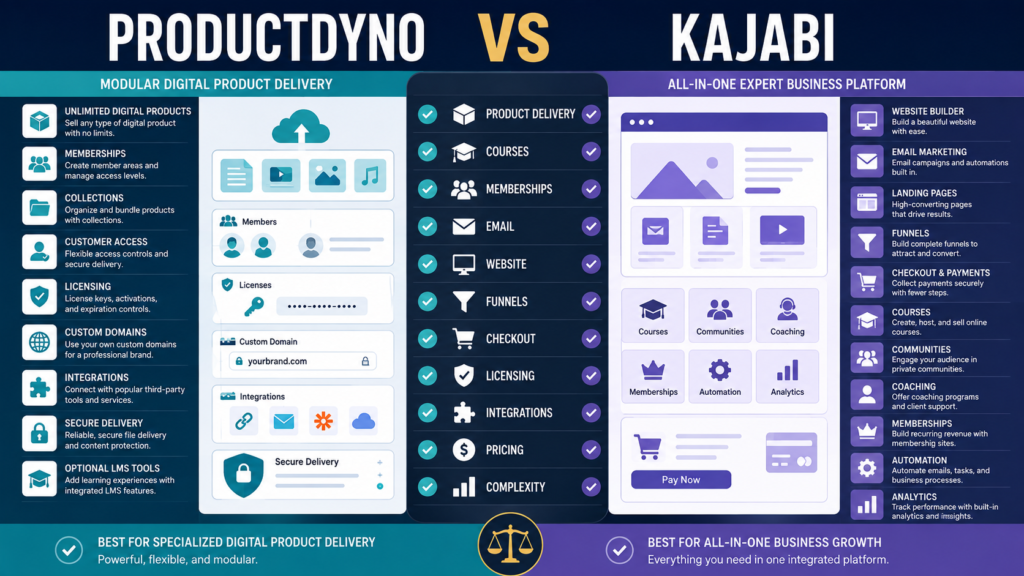
ProductDyno and Kajabi can both deliver digital products, memberships, and educational content.
But their business philosophies are substantially different.
ProductDyno focuses heavily on digital-product delivery, memberships, collections, customer access, licensing, custom domains, integrations, and optional learning-management functionality. Its current promotional pricing page emphasizes unlimited digital products, memberships, collections, members/customers, and 0% ProductDyno transaction fees across its listed Starter, Growth Plus+, and Teach Pro+ plans.
Kajabi is designed to replace a larger portion of an online-business technology stack. Its current platform combines products, website, landing pages, marketing email, funnels, checkout, communities, contacts, automations, and other expert-business features.
That makes this comparison fundamentally about architecture:
Do you want a specialized delivery platform that works with other tools?
or:
Do you want one platform to operate much of the business?
Review Methodology: This comparison is based on official ProductDyno and Kajabi pricing pages, product pages, and publicly available documentation reviewed on August 19, 2026. No firsthand product testing or personal experience is claimed.
Key Takeaways
- ProductDyno’s current promotional Pricing New page lists Starter at $49/month billed annually, Growth Plus+ at $69/month billed annually, and Teach Pro+ at $99/month billed annually.
- Those ProductDyno tiers currently advertise unlimited digital products, memberships, collections, customers/members, custom domains, and 0% ProductDyno transaction fees.
- Kajabi currently lists Basic at $179/month monthly or $143/month when billed annually.
- Kajabi Growth currently costs $249/month monthly or $199/month with annual billing.
- Kajabi Pro currently costs $499/month monthly or $399/month billed annually.
- Kajabi Basic currently supports five products, 2,500 contacts, one website, one community, and two admin users; higher tiers expand those limits.
- Kajabi includes unlimited marketing emails, landing pages, and funnels across its current standard plans.
- Kajabi’s higher subscription price reflects the fact that it attempts to replace more separate business tools.
Affiliate Disclosure: This article contains affiliate links. If you purchase through one of these links, I may earn a commission at no additional cost to you. Affiliate compensation does not determine the conclusions or recommendations presented in this article.
What Is ProductDyno?
ProductDyno is built for creating, selling, licensing, protecting, and delivering digital content.
Its current product site highlights:
- Online courses.
- Membership sites.
- Digital downloads.
- AI creator tools.
- Landing pages.
- Payments.
- Integrations.
- LMS features.
- Software licensing.
You can review ProductDyno through Michael’s approved affiliate link if a dedicated digital-product delivery layer matches your requirements.
MichaelELeeReviews also has a detailed ProductDyno review focused on digital-product delivery.
What Is Kajabi?
Kajabi describes itself as an all-in-one operating platform for experts selling knowledge and transformation.
Its current platform supports:
- Courses.
- Coaching.
- Digital products.
- Memberships.
- Communities.
- Website.
- Email.
- Landing pages.
- Funnels.
- Checkout.
- Payments.
- Automations.
- Analytics.
That is a much broader scope.
The Most Important Difference
ProductDyno Approach
Use specialized tools.
Example:
WordPress → GetResponse → Checkout Platform → ProductDyno
Each component has a specific job.
Kajabi Approach
Use one environment.
Example:
Kajabi Website → Kajabi Email → Kajabi Funnel → Kajabi Checkout → Kajabi Course
Neither architecture is automatically better.
Product Delivery
ProductDyno’s strongest identity is delivery infrastructure.
Its current Starter offer includes:
- Unlimited digital products.
- Unlimited memberships.
- Unlimited collections.
- Unlimited members/customers.
- Software/SaaS licensing.
- Unlimited custom domains.
- Integrations.
- White-label/branding removal.
This can be especially attractive when the rest of your business stack already works.
Kajabi Product Creation
Kajabi currently lets users build knowledge-based products including:
- Courses.
- Memberships.
- Communities.
- Coaching.
- Digital products.
Its key difference is that these products sit inside the same platform as marketing and customer management.
Website
Kajabi Basic and Growth currently include one website; Pro includes three.
ProductDyno is not primarily a replacement for a public content website.
A ProductDyno user may continue using WordPress as the main publishing and SEO platform.
If you already like your website, that modular approach can be appealing.
Email Marketing
Kajabi currently lists unlimited marketing emails on Basic, Growth, and Pro.
This can potentially replace a separate email-marketing subscription for some businesses.
With ProductDyno, you may continue using a dedicated email system.
That means ProductDyno’s subscription cost should not be compared with Kajabi’s cost in isolation.
You should compare the complete stack.
Example Stack Comparison
ProductDyno-Based Stack
Website: WordPress
Email: Separate email platform
Checkout: Separate checkout/payment system
Delivery: ProductDyno
Analytics: Separate tools
Kajabi-Based Stack
Website: Kajabi
Email: Kajabi
Funnels: Kajabi
Checkout: Kajabi
Products: Kajabi
Community: Kajabi
The monthly software totals may become closer—or farther apart—depending on the systems you already own.
Funnels and Landing Pages
Kajabi currently includes unlimited:
- Landing pages.
- Funnels.
across Basic, Growth, and Pro.
ProductDyno includes page-building and sales capabilities, but its fundamental strength remains product infrastructure rather than replacing every marketing system.
Communities
Kajabi’s current plans include:
- Basic: one community.
- Growth: one community.
- Pro: three communities.
Access groups are currently unlimited across the main plans.
ProductDyno also supports membership and community-style delivery, including discussions and related LMS/member features.
If community engagement is central, test the actual member experience.
Licensing
This is a meaningful ProductDyno differentiator.
Its current core pricing lists a Software/SaaS Licensing Module even on Starter.
If you sell:
- Software.
- Licensed tools.
- Digital resources requiring controlled access.
this may matter substantially.
Kajabi is more heavily centered on expert and knowledge products.
Contacts
Kajabi’s current limits are:
Basic
2,500 contacts.
Growth
25,000 contacts.
Pro
100,000 contacts.
If you already have a separate email database, consider whether moving contacts into Kajabi actually simplifies the business.
Product Limits
Kajabi currently allows:
Basic
5 products.
Growth
50 products.
Pro
Unlimited products.
ProductDyno’s current promotional core plans advertise unlimited digital products.
A business with many individual products should include this in the comparison.
Pricing: ProductDyno
Current promotional Pricing New page:
Starter
$49/month equivalent, billed annually.
Growth Plus+
$69/month equivalent, billed annually.
Teach Pro+
$99/month equivalent, billed annually.
ProductDyno labels these as promotional lifetime-discount renewal prices and states that the listed plans are billed annually.
Because ProductDyno also has other official pricing presentations, verify the exact checkout you are purchasing.
Pricing: Kajabi
Current Kajabi pricing:
Basic
$179/month monthly.
$143/month annual equivalent.
Growth
$249/month monthly.
$199/month annual equivalent.
Pro
$499/month monthly.
$399/month annual equivalent.
Kajabi currently offers a 14-day trial for these plans.
Transaction and Payment Fees
ProductDyno’s Pricing New page currently advertises 0% ProductDyno transaction fees.
Kajabi’s current U.S. Kajabi Payments card-processing rates shown on its pricing page are:
- Basic: 2.9% + $0.30.
- Growth: 2.8% + $0.30.
- Pro: 2.7% + $0.30.
Kajabi also lists additional platform fees for some third-party payment providers, excluding PayPal and Kajabi Payments, with the percentage varying by plan.
Payment-processing terms vary by country and provider, so verify your actual setup.
Kajabi’s All-in-One Advantage
Kajabi becomes most compelling when you would otherwise pay separately for:
- Website.
- Email.
- Funnels.
- Landing pages.
- Course platform.
- Community.
- Automation.
- Checkout-related infrastructure.
If you genuinely use all of those inside Kajabi, the higher subscription cost may replace several other bills.
Kajabi’s All-in-One Risk
The advantage can also become a dependency.
If:
- Website.
- Email.
- Courses.
- Funnels.
- Customer data.
all live in one platform, switching later can become a larger migration.
That is not necessarily a reason to avoid Kajabi.
It is a factor to understand.
ProductDyno’s Modular Advantage
With a modular stack, you can replace one layer.
Example:
Change email provider without rebuilding the course platform.
That flexibility can be useful.
It also creates more integrations to maintain.
ProductDyno’s Modular Risk
More tools can mean:
- More logins.
- More billing.
- More integrations.
- More troubleshooting.
- More handoffs between platforms.
The cheapest individual tools can produce an expensive operational system.
Existing ProductDyno Comparisons
MichaelELeeReviews already has a ProductDyno vs. ThriveCart Academy comparison.
That comparison focuses more heavily on checkout/course-delivery architecture.
Kajabi represents a broader decision because it attempts to replace much more of the business stack.
Use a Total-Cost Worksheet
List:
Website
Current monthly cost.
Current monthly cost.
Checkout
Current monthly cost.
Course/Delivery
Current monthly cost.
Community
Current monthly cost.
Funnel Builder
Current monthly cost.
Integrations
Current monthly cost.
Then compare:
Current stack total
against
Kajabi total
Do not compare $49 ProductDyno against $179 Kajabi without accounting for everything else.
Use a Free Trial as a Migration Test
If evaluating Kajabi, do not merely create a sample page.
Try to recreate one actual customer journey:
Visitor → lead → email → sales page → purchase → course access → follow-up
For ProductDyno:
Visitor on existing site → existing email → existing checkout → ProductDyno delivery
Then compare the operational experience.
The site’s software free-trial evaluation guide can help structure the test.
Who Should Consider ProductDyno?
ProductDyno may fit better if:
- You already have a website you like.
- You already have email software.
- You already have checkout.
- You want specialized digital-product delivery.
- You sell several types of digital products.
- Licensing matters.
- You prefer modular software.
- You want unlimited products under the current offer.
Who Should Consider Kajabi?
Kajabi may fit better if:
- You want one platform for most of the business.
- Courses are important.
- Coaching is important.
- Community is important.
- You want built-in email.
- You want funnels and landing pages.
- You want integrated customer management.
- You prefer fewer third-party integrations.
Final Verdict
Choose ProductDyno when you already have a functioning marketing stack and primarily need a flexible digital-product delivery, membership, or licensing platform.
Choose Kajabi when you want to consolidate the website, marketing, selling, community, and product-delivery experience into one larger platform.
ProductDyno is the stronger modular choice.
Kajabi is the stronger consolidation choice.
Conclusion
ProductDyno vs. Kajabi is not simply a course-platform comparison.
It is a decision about how you want the entire online business organized.
ProductDyno lets you build with separate specialized components.
Kajabi tries to put most of those components under one roof.
Before choosing, draw your actual technology stack.
Then circle every tool Kajabi could realistically replace—or every tool you would still need alongside ProductDyno.
The best platform is the one that makes the complete business simpler to operate, not the one with the longest feature list.