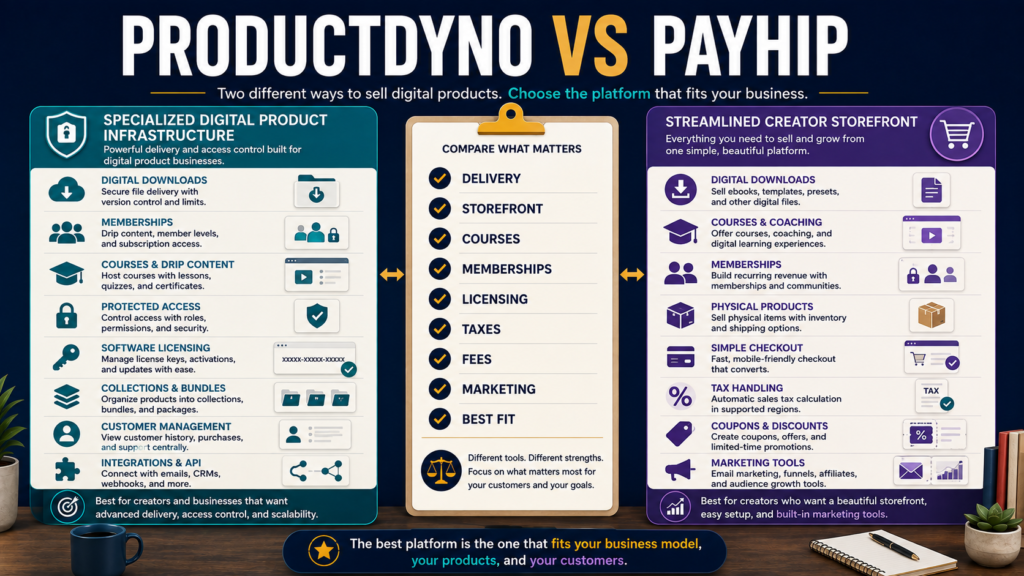
ProductDyno and Payhip can both help creators sell digital products, but they begin from different business priorities.
ProductDyno emphasizes digital-product management, delivery, protected access, courses, memberships, collections, software licensing, and related infrastructure.
Payhip emphasizes an accessible online storefront and checkout environment for selling downloads, courses, coaching, memberships, and other products.
That creates a useful buying distinction:
Do you need specialized product-delivery infrastructure, or do you primarily need an easy storefront and commerce system?
Review Methodology: This comparison is based on official ProductDyno and Payhip product, feature, and pricing information reviewed on August 25, 2026. No firsthand product testing or personal experience is claimed.
Affiliate Disclosure: This article contains affiliate links. If you purchase through one of these links, I may earn a commission at no additional cost to you. Affiliate compensation does not determine the conclusions or recommendations presented in this article.
Quick Verdict
ProductDyno may be the better fit if you manage multiple types of digital products and place a high value on product delivery, memberships, protected access, collections, courses, software licensing, and integration with an existing marketing stack.
Payhip may be the better fit if you want a straightforward storefront that combines checkout, digital-product delivery, courses, memberships, marketing tools, and tax-related commerce features with a simple pricing structure.
Payhip’s free plan also makes it attractive for testing a small product business before committing to a larger fixed software expense.
What Is ProductDyno?
ProductDyno is built around digital-product infrastructure.
Its current official information highlights capabilities such as:
- Digital downloads.
- Online courses.
- Membership sites.
- Protected content.
- Collections.
- Customer management.
- Learning-management features.
- Custom domains.
- Software licensing.
- AI creation tools.
- Landing pages.
- Payment connections.
- Business intelligence.
- Team members.
My ProductDyno review for beginners provides a broader introduction to that product-delivery approach.
If that infrastructure matches what you need, you can review ProductDyno through my affiliate link.
What Is Payhip?
Payhip is a commerce platform designed for creators selling directly online.
Its current feature information includes support for:
- Digital downloads.
- Online courses.
- Coaching.
- Memberships.
- Physical products.
- Storefront creation.
- Payments.
- Marketing tools.
- Coupons.
- Affiliate tools.
- Email-related functionality.
- Tax handling features.
This makes Payhip appealing to someone who wants to launch a storefront without assembling several commerce components separately.
The Central Difference
A useful mental model is:
ProductDyno
Product infrastructure first.
Payhip
Creator storefront and commerce first.
There is overlap, but the workflow emphasis is different.
Digital Downloads
Both platforms can serve a creator selling:
- Ebooks.
- PDFs.
- Templates.
- Checklists.
- Workbooks.
- Audio.
- Resource bundles.
Payhip combines selling and delivery within its storefront environment.
ProductDyno emphasizes managing products and customer access as part of a more specialized digital-delivery system.
If you already have your preferred website, checkout, and email tools, the modular ProductDyno approach can make sense.
If you need a simple place to list and sell products quickly, Payhip’s storefront approach may reduce setup.
Storefront
This is one of Payhip’s strongest conceptual advantages.
A creator can build a store where products are displayed and purchased without needing to create an entirely separate ecommerce website first.
For someone selling only a few straightforward products, that convenience may be more valuable than deeper delivery infrastructure.
ProductDyno can participate in a broader sales system, but it is not primarily positioned around the same simple storefront-first idea.
Checkout and Payments
Payhip connects the storefront directly to checkout and delivery.
ProductDyno supports payment integrations and product access, but many businesses may combine it with external checkout or marketing tools depending on their stack.
Ask:
Do I want checkout and storefront tightly bundled?
or:
Do I already have checkout and mainly need delivery?
That question can eliminate unnecessary software duplication.
Pricing: Payhip
Payhip currently publishes three primary pricing levels:
Free Forever
- $0 monthly.
- 5% Payhip transaction fee.
Plus
- $29 per month.
- 2% Payhip transaction fee.
Pro
- $99 per month.
- 0% Payhip transaction fee.
Payhip says the plans include the same core feature set and unlimited products, with the main pricing difference centered on monthly cost and Payhip transaction fees. Payment-processor fees can still apply separately.
This structure makes break-even analysis important.
Calculate the Payhip Fee Tradeoff
Suppose a business sells $1,000 per month.
Ignoring payment-processor fees for this simple illustration:
Free plan at 5%:
$50 Payhip fee.
Plus at $29 + 2%:
$49 total Payhip cost.
At that sales level, the cost can be very similar.
At higher revenue, the paid plan may become increasingly attractive.
Do the calculation with your actual expected revenue rather than choosing automatically.
ProductDyno Pricing Needs Careful Verification
ProductDyno’s current promotional pricing environment should be checked directly before purchase because official pages can display specific promotional structures, terms, trials, or billing arrangements that may change.
The safest buying process is to verify:
- Current price.
- Monthly or annual billing.
- Any lifetime or promotional terminology.
- Trial period.
- Included add-ons.
- Product limits.
- Customer limits.
- Licensing features.
- Refund terms.
Do not rely on an old review for the final checkout decision.
Platform Transaction Fees
ProductDyno’s pricing approach and Payhip’s percentage-fee approach create different budgeting models.
Payhip explicitly connects lower monthly costs with platform transaction fees at the Free and Plus tiers.
With any platform, consider:
Monthly software fee + platform transaction fee + payment-processor fee + other required tools.
That produces a better comparison than looking only at the subscription.
Online Courses
Both platforms support courses.
Payhip’s current course features include functionality for organizing lessons and delivering different types of course content, with capabilities such as videos, files, quizzes, assignments, drip scheduling, and certificates depending on the workflow.
ProductDyno also supports online courses and optional LMS-related functionality as part of its broader product-delivery environment.
The better choice depends on how complex the learning experience needs to be.
Memberships
Both can support recurring or protected customer experiences.
Ask:
- Is the membership mostly recurring content?
- Are there several separate products?
- Do customers need bundled access?
- Will products be organized into collections?
- Do you need different access levels?
- Do you need software licenses?
ProductDyno’s infrastructure orientation may become more valuable as product-access arrangements become more complex.
Software Licensing
This is one area where ProductDyno deserves special attention.
Its official platform information includes licensing capabilities, which can matter when selling:
- Software.
- Plugins.
- Web tools.
- Licensed applications.
Someone selling only ebooks may never use this.
Someone selling software may consider it a major requirement.
Payhip’s primary value proposition is broader creator commerce rather than specialized software-license management.
Tax Handling
Payhip emphasizes tax-related commerce support as part of its selling environment.
Tax obligations depend on the seller, customer location, business structure, and applicable law, so do not assume software eliminates every compliance responsibility.
But built-in commerce handling may simplify operations for some sellers.
Marketing Tools
Payhip incorporates marketing features around its storefront, including promotional tools designed to help creators sell products.
ProductDyno can connect into a larger marketing stack where email, funnels, checkout, and promotion may already be handled elsewhere.
This creates two different strategies:
Integrated Simplicity
Use Payhip for more of the creator-commerce workflow.
Modular Stack
Use ProductDyno primarily where specialized delivery and access management are needed.
ProductDyno May Be Better If You Want
- Multiple digital-product types.
- Protected delivery.
- Customer access management.
- Memberships.
- Collections.
- Courses.
- Licensing.
- Software-product support.
- Integration with existing marketing tools.
- A specialized delivery layer.
The stronger your existing stack, the more attractive specialization can become.
Payhip May Be Better If You Want
- A storefront.
- Easy product listing.
- Checkout.
- Digital delivery.
- Courses.
- Memberships.
- Coaching sales.
- Physical-product support.
- Built-in marketing tools.
- A $0 starting tier.
For someone validating a first offer, the low fixed cost is a meaningful advantage.
Compare Payhip With Other Product-Commerce Platforms
If Payhip’s streamlined selling approach is appealing, it is worth comparing similar commerce-focused alternatives.
My ProductDyno vs SendOwl comparison examines another platform built around digital selling and delivery.
The ProductDyno vs systeme.io comparison looks at a different question: specialized product delivery versus a broader all-in-one marketing platform.
These comparisons can help you decide which category of software you actually need before selecting a specific vendor.
Existing Tools Change the Answer
Suppose you already have:
- WordPress.
- Email marketing.
- Checkout.
- Funnels.
- Affiliate tracking.
In that situation, replacing several working tools merely to obtain a storefront could create unnecessary migration.
ProductDyno’s specialized role may fit better.
Now suppose you are starting from zero and want:
store → checkout → digital delivery → coupon → simple marketing
Payhip may be easier.
Always evaluate the new platform against what you already own.
Calculate Total Cost
Create a simple table:
| Function | ProductDyno Stack | Payhip Stack |
|---|---|---|
| Storefront | Existing/other | Included |
| Checkout | Existing/integration | Included |
| Delivery | ProductDyno | Included |
| Existing | Available tools/integrations | |
| Courses | Available | Available |
| Memberships | Available | Available |
| Licensing | Strong consideration | Not primary focus |
| Platform fees | Verify current offer | 0–5% depending plan |
Then add actual prices.
This exposes duplication quickly.
Who May Not Need Either Platform?
You may not need another platform if:
- Your current delivery system works.
- You sell through a marketplace that already handles delivery.
- You have only one simple product and no operational problem.
- Migration would create more work than value.
- You are buying because a promotion feels urgent rather than because a business function is missing.
Software should solve a defined problem.
Questions to Ask Before Buying
- What products do I sell?
- Do I need a storefront?
- Do I already have checkout?
- Do I need memberships?
- Do I need courses?
- Do I need software licensing?
- Who handles taxes?
- What are the platform fees at my expected sales?
- What other subscriptions are still required?
- Can I export customer and product information?
- How difficult would migration be?
- Which platform eliminates the most actual work?
Final Verdict
ProductDyno vs Payhip is largely a choice between two different operating models.
ProductDyno is the stronger candidate when specialized digital-product infrastructure, customer access, memberships, courses, collections, and licensing are central requirements.
Payhip is the stronger candidate when a creator wants a straightforward storefront, checkout, digital delivery, courses, memberships, marketing tools, and a low-cost way to begin selling.
The free Payhip tier makes experimentation inexpensive, while ProductDyno may provide more value for a business with a larger product catalog or more specialized access requirements.
Conclusion
Do not choose ProductDyno or Payhip based only on which platform lists more features.
Map your actual workflow:
Traffic → product page → checkout → payment → delivery → customer access → support → future products.
Then identify which parts are already handled.
If the missing piece is primarily specialized product delivery and management, ProductDyno deserves closer consideration.
If the missing piece is primarily a simple storefront and selling system, Payhip may be the more direct solution.
The best platform is the one that fills the real gap in your business without forcing you to rebuild systems that already work.