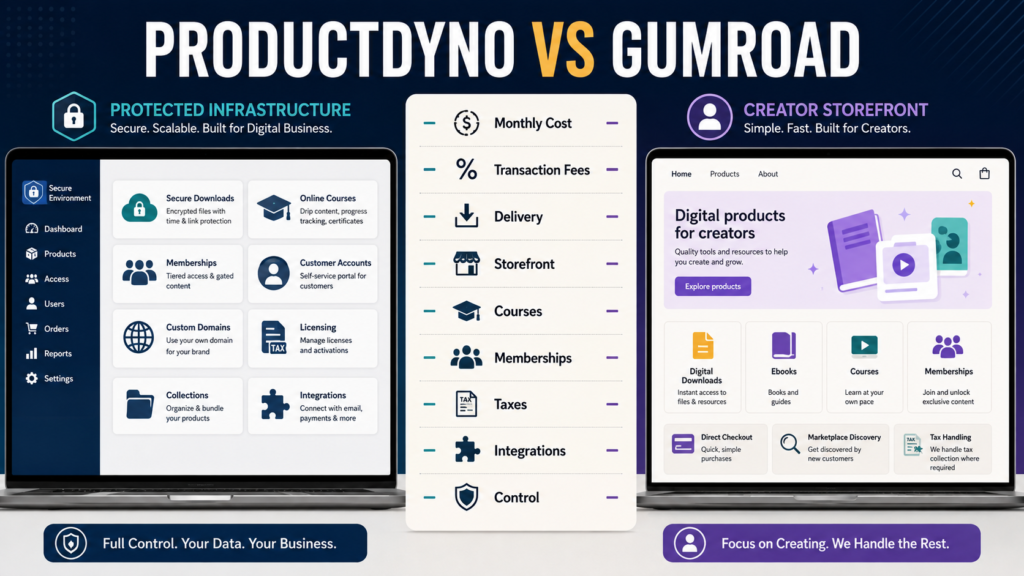
ProductDyno and Gumroad can both help you sell digital products, but their business models are almost opposite.
ProductDyno is designed as a digital-product infrastructure and delivery system, with capabilities around courses, memberships, downloads, customer access, domains, collections, integrations, and product protection.
Gumroad focuses on making it simple for a creator to begin selling without a monthly platform subscription, then charges transaction fees when sales occur.
That creates a useful buying question:
Do you want to pay primarily for a dedicated platform that becomes part of your business infrastructure, or do you prefer a transaction-based platform that makes starting simple?
Neither answer is universally correct.
Review Methodology: This comparison is based on official product information, current pricing pages, and publicly available documentation reviewed on August 16, 2026. No firsthand product testing or personal experience is claimed.
Key Takeaways
- ProductDyno emphasizes secure digital-product delivery, memberships, courses, customer access, domains, collections, and integrations.
- Gumroad has no monthly platform charge under its current pricing model.
- Gumroad currently charges 10% + $0.50 for sales through a creator’s profile or direct links.
- Gumroad currently charges 30% when a new customer finds and buys the product through Gumroad Discover.
- Gumroad acts as Merchant of Record for applicable sales-tax handling and says it has managed global sales-tax obligations in that role since January 1, 2025.
- ProductDyno’s current public pricing page advertises a 14-day trial and an Unlimited plan at $199/month, while other wording on the same page references a flat service fee. Buyers should verify the actual checkout and renewal terms before purchasing.
- High sales volume can make transaction-based pricing materially different from fixed software pricing.
Affiliate Disclosure: This article contains affiliate links. If you purchase through one of these links, I may earn a commission at no additional cost to you. Affiliate compensation does not determine the conclusions or recommendations presented in this article.
What Is ProductDyno?
ProductDyno is a digital-product platform built around creating, protecting, delivering, and managing access to digital content.
Its current official pricing page promotes an Unlimited plan containing:
- Unlimited online courses.
- Unlimited memberships.
- Unlimited digital products.
- Unlimited members/customers.
- Unlimited custom domains.
- Unlimited collections or academies.
- Unlimited landing/sales pages.
- Team-member capacity.
- LMS and additional platform functionality.
ProductDyno also states that it does not take a percentage of sales revenue.
You can review ProductDyno’s current offer through Michael’s approved affiliate link if protected delivery and a more dedicated product infrastructure match your requirements.
What Is Gumroad?
Gumroad is a creator-commerce platform built around straightforward selling.
Its official pricing page currently states:
- No monthly charge.
- 10% + $0.50 per transaction for profile or direct-link sales.
- 30% for purchases where customers discover and buy the product through Gumroad Discover.
Gumroad says creators can sell products including digital products, ebooks, courses, tutorials, and memberships.
This makes Gumroad easy to understand from a cost perspective:
No sale → no platform transaction fee.
Sale → platform takes the applicable fee.
Payment and other financial details should still be confirmed for your country and account.
The Biggest Difference: Infrastructure vs Transaction-Based Simplicity
A useful way to compare the two:
ProductDyno
I want a dedicated product-delivery environment that I control as part of a broader business stack.
Gumroad
I want to start selling with minimal fixed software expense and I am willing to pay a percentage when I sell.
That difference can matter more than an individual feature.
Monthly Cost vs Transaction Fees
This is the heart of the comparison.
Gumroad
Current direct-sale platform fee:
10% + $0.50 per sale.
Suppose you sell a $20 product.
Before considering other applicable financial factors, Gumroad’s listed platform charge on a direct sale would be:
- 10% = $2.
- Fixed component = $0.50.
- Total listed Gumroad charge = $2.50.
At low volume, that may be attractive because you are not paying a monthly subscription during months when nothing sells.
At higher volume, percentages add up.
ProductDyno
ProductDyno’s current pricing page advertises an Unlimited plan after a 14-day trial and states that it does not take a percentage of sales revenue.
That creates a different economic structure.
Your platform cost is less directly tied to each individual sale.
Run a Break-Even Comparison
Do not argue about pricing in the abstract.
Use your actual numbers.
Suppose your direct Gumroad sales produce $5,000 in monthly revenue across many transactions.
A percentage-based platform fee can become substantial.
Suppose you sell only two $15 ebooks in a month.
A no-monthly-fee platform may be attractive.
Build a spreadsheet containing:
Product price
Expected sales
Expected revenue
Platform transaction cost
Fixed monthly software cost
Payment-processing or other costs
Net difference
That will tell you more than a generic review.
Gumroad’s Merchant-of-Record Model
Gumroad’s official pricing page states that it acts as Merchant of Record and handles applicable sales-tax collection and remittance worldwide under that model. It says the change took effect January 1, 2025.
That can remove a meaningful administrative burden for creators selling internationally.
However, Merchant-of-Record tax handling does not mean a creator has no accounting, income-tax, reporting, or business obligations of their own.
Consult an appropriate tax professional for your situation.
ProductDyno’s Delivery Emphasis
ProductDyno is more attractive when customer-access infrastructure matters.
Examples:
- Protected download libraries.
- Multiple courses.
- Membership areas.
- Bundled collections.
- Several custom domains.
- Ongoing customer accounts.
- Product ecosystems.
A customer can continue to access multiple resources in a structured environment rather than receiving only a purchase link.
Gumroad’s Selling Simplicity
Gumroad can be particularly attractive when the product is simple.
Examples:
- Ebook.
- Template.
- Workbook.
- Download.
- Tutorial.
- Membership.
- Small course.
You can create the product, publish the offer, send people to it, and pay platform fees when sales happen.
That reduces the need to assemble a larger ecommerce stack before testing an idea.
Marketplace Discovery
Gumroad Discover introduces another dimension.
If a customer discovers and purchases your product through Gumroad’s marketplace, Gumroad currently lists a 30% fee for that transaction.
That is much higher than the direct-sale rate.
The tradeoff is that the marketplace may introduce a buyer you did not bring yourself.
Do not evaluate the 30% fee as though it applies to every sale.
Do not evaluate marketplace discovery as though it guarantees sales either.
Product Control
ProductDyno’s public materials emphasize control over your content, members, and buyers and describe options for protecting existing pages and delivering products through customer login experiences.
That can matter when you are building:
- A long-term product library.
- Multiple memberships.
- A course catalog.
- Customer accounts.
- A more branded product-delivery experience.
What About Courses?
Both products can participate in course businesses.
Gumroad says courses can be sold through the platform.
ProductDyno’s current Unlimited plan explicitly promotes unlimited online courses and LMS functionality.
The right question is:
How complicated is the course?
If you sell a short video tutorial with several files, a simple commerce system may be enough.
If you manage:
- Many courses.
- Student accounts.
- Collections.
- Multiple domains.
- Membership access.
a dedicated delivery platform may fit better.
What About Memberships?
Gumroad explicitly supports memberships according to its current pricing FAQ.
ProductDyno also emphasizes unlimited memberships under its current Unlimited offer.
Again, compare the customer experience.
Ask:
- How does login work?
- How do recurring payments work?
- Can content be organized clearly?
- Can access be controlled?
- What happens after cancellation?
- How easy is support?
ProductDyno Pricing Needs Verification
There is one issue buyers should handle carefully.
ProductDyno’s current public pricing page prominently advertises a 14-day trial followed by a $199/month Unlimited plan, while its FAQ on the same page also uses language describing a flat annual service fee.
Those statements are not perfectly aligned.
Therefore:
Do not rely on an old review or one sentence from the pricing page.
Before purchasing:
- Open the exact checkout.
- Confirm the charge.
- Confirm billing frequency.
- Confirm renewal terms.
- Confirm included features.
- Save the applicable offer terms.
That is prudent for any software purchase when public pricing language appears inconsistent.
Existing ProductDyno Coverage
MichaelELeeReviews has a verified ProductDyno review focused on digital-product delivery in its internal content inventory.
There is also a ProductDyno vs. ThriveCart Academy comparison if your decision involves a different course and checkout architecture.
Who Should Consider Gumroad?
Gumroad may fit better when:
- You want to start with no monthly platform subscription.
- You have one or a few products.
- You are testing demand.
- Your products are straightforward.
- Merchant-of-Record tax handling is valuable.
- You accept transaction-based fees.
- You want the possibility of marketplace discovery.
- You value speed and simplicity.
Who Should Consider ProductDyno?
ProductDyno may fit better when:
- Digital products are a significant part of the business.
- Secure delivery matters.
- You need multiple courses.
- You operate memberships.
- Customer accounts matter.
- You use custom domains.
- You want collections or academies.
- You expect your delivery system to become permanent infrastructure.
- You prefer avoiding a percentage platform fee on each sale.
A Simple Example
Creator A
One ebook.
$17 price.
Uncertain sales.
No existing customer-delivery system.
Gumroad may be easier to test.
Creator B
Eight ebooks.
Three courses.
Membership.
Existing email platform.
Existing website.
Growing customer library.
ProductDyno may make more sense as dedicated infrastructure.
The product count alone does not decide it.
The complete workflow does.
Run a Real Test
Create the same sample offer on both platforms.
Test Product:
$27 digital guide plus two bonus files.
Evaluate:
- Product setup.
- Sales-page setup.
- Checkout.
- Customer email.
- Access.
- Download process.
- Updating the file.
- Customer support.
- Branding.
- Cost at 10, 100, and 500 sales.
The last step is especially important.
A platform can be inexpensive at ten sales and expensive at 500—or the reverse.
Final Verdict
Choose Gumroad when you prioritize low fixed cost, fast setup, simple commerce, merchant-of-record tax handling, and a transaction-based pricing structure.
Choose ProductDyno when you want a more dedicated digital-product delivery infrastructure supporting courses, memberships, customer access, product collections, domains, and a growing product ecosystem.
For a beginner validating a first simple product, Gumroad can make the barrier to starting very low.
For an established digital-product business that expects significant direct sales and needs a structured customer-delivery environment, ProductDyno deserves serious consideration.
Conclusion
ProductDyno and Gumroad are not simply two versions of the same software.
They represent different business philosophies.
Gumroad says:
Start selling without a monthly platform charge and pay us when transactions happen.
ProductDyno says:
Build a dedicated product-delivery system and operate it as part of your business infrastructure.
Before deciding, calculate your costs at realistic sales levels and map the customer journey from:
Product page → purchase → delivery → future access → support
The platform that handles that complete journey with the least unnecessary complexity is the better choice.