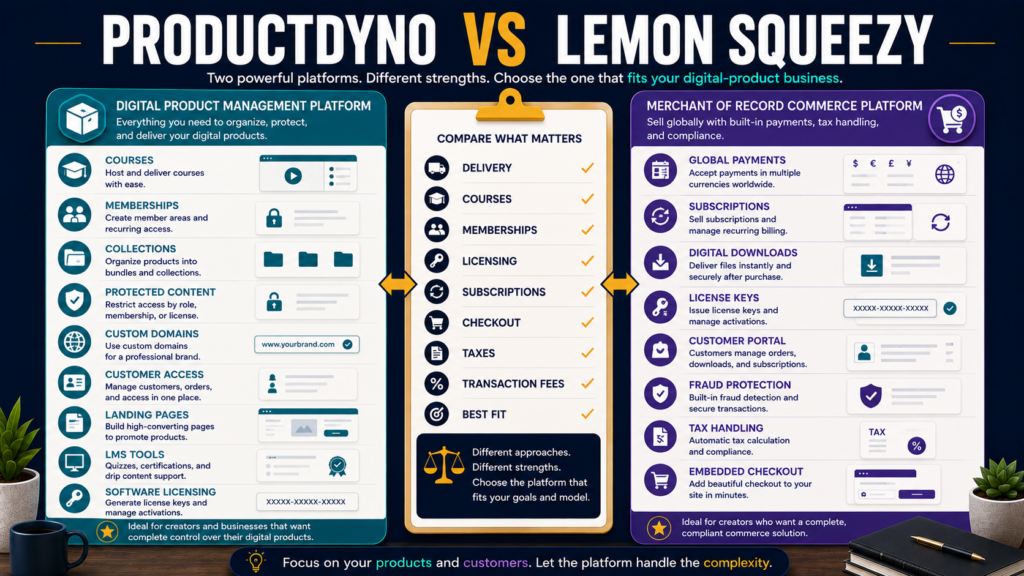
ProductDyno and Lemon Squeezy both serve businesses selling digital products.
They even overlap in areas such as:
- Digital downloads.
- Payments.
- Subscriptions or recurring access.
- Software licensing.
- Customer management.
But they approach the problem from different directions.
ProductDyno focuses heavily on the product-delivery and member-access side of the business: courses, memberships, collections, protected content, customer access, landing pages, LMS features, domains, and licensing.
Lemon Squeezy focuses heavily on commerce infrastructure: global payments, merchant-of-record responsibilities, subscriptions, digital downloads, software license keys, customer billing, fraud handling, checkout, and tax collection.
This makes the decision less about:
“Which platform can sell a PDF?”
and more about:
“Do I need a product-delivery environment, or do I need merchant-of-record commerce infrastructure?”
Review Methodology: This comparison is based on official ProductDyno and Lemon Squeezy pricing pages, product documentation, licensing documentation, and publicly available information reviewed on August 28, 2026. No firsthand product testing or personal experience is claimed.
Affiliate Disclosure: This article contains affiliate links. If you purchase through one of these links, I may earn a commission at no additional cost to you. Affiliate compensation does not determine the conclusions or recommendations presented in this article.
Quick Verdict
ProductDyno may be the better fit if you want courses, memberships, collections, protected delivery areas, LMS features, customer-access management, custom domains, and software licensing inside a digital-product platform.
Lemon Squeezy may be the better fit if your biggest challenges involve payment processing, subscriptions, software licensing, global digital commerce, sales-tax handling, customer billing, checkout, and merchant-of-record responsibilities.
For a course or membership creator, ProductDyno may provide the more natural product experience.
For a SaaS or software seller, Lemon Squeezy’s billing and licensing infrastructure can be especially compelling.
What Is ProductDyno?
ProductDyno’s current official platform highlights:
- Online courses.
- Digital downloads.
- Membership sites.
- Landing pages.
- Payments.
- LMS functionality.
- Domain and access controls.
- Collections.
- Business intelligence.
- Licensing.
- Team-member capabilities.
You can review ProductDyno through my affiliate link.
The verified ProductDyno review for beginners provides a broader introduction to this delivery-oriented model.
What Is Lemon Squeezy?
Lemon Squeezy describes its ecommerce platform around selling digital goods and software.
Current capabilities include:
- One-time payments.
- Recurring subscriptions.
- Digital downloads.
- Software license keys.
- Checkout.
- Fraud handling.
- Customer portal.
- Sales-tax handling as merchant of record.
- Multiple currencies.
The product is especially oriented toward software, SaaS, subscriptions, and global digital commerce.
What Does Merchant of Record Mean?
This is one of the largest differences.
Lemon Squeezy acts as the merchant of record for transactions processed through its platform.
Its documentation says the merchant of record handles responsibilities related to the purchase such as payment processing, applicable sales-tax collection, refunds, chargebacks, and PCI-related commerce responsibilities.
That can remove a significant operational burden for digital sellers operating across multiple jurisdictions.
ProductDyno is fundamentally a digital-product platform rather than a merchant-of-record provider in the same model.
Lemon Squeezy Pricing
Lemon Squeezy’s current ecommerce pricing begins with:
5% + $0.50 per transaction
with no monthly charge for its core ecommerce features.
Its pricing page notes that some transactions can have additional fees and that volume pricing may be available.
This means:
No sales = no standard ecommerce subscription fee.
But the platform cost increases with transaction volume.
ProductDyno Pricing
ProductDyno’s current primary pricing page advertises a 14-day test drive followed by a $199-per-month offer for its promoted unlimited configuration.
ProductDyno has also run other promotional structures and offers, so verify the exact checkout before buying.
Do not assume a price shown in an older review remains the active offer.
The Pricing Models Are Almost Opposite
Lemon Squeezy
Lower fixed ecommerce cost.
Transaction fee with each sale.
ProductDyno
Recurring platform cost under the current promoted main pricing.
ProductDyno says it does not take a percentage of sales under that offer.
That creates a volume calculation.
Simple Example
Suppose Lemon Squeezy processes:
100 transactions at $50 each
Revenue:
$5,000
Using the standard base platform pricing:
5% of $5,000 = $250
100 × $0.50 = $50
Approximate base Lemon Squeezy transaction charges:
$300
before any additional applicable fee adjustments described by the platform.
At a lower sales volume, transaction-based pricing may be attractive.
At a larger volume, a flat platform fee may become economically interesting.
Cost alone should not decide the platform because the services included are different.
Digital Downloads
Both can sell and deliver downloads.
Lemon Squeezy says download links can be securely signed and throttled to reduce abuse.
Its product system supports:
- Digital downloads.
- Subscriptions.
- Product variants.
- File versions.
- Different pricing models.
ProductDyno also puts digital delivery near the center of its platform, with customer access and protected delivery areas.
Courses
This is an important ProductDyno strength.
ProductDyno explicitly markets course creation and supports course formats involving text or video, along with broader LMS-related functionality.
Lemon Squeezy can sell digital course products and secure digital content, but its primary strength is not a full course-LMS environment comparable to a dedicated course platform.
If you need:
- Course structure.
- Lessons.
- Student experience.
- LMS features.
ProductDyno deserves more attention.
Memberships
ProductDyno explicitly supports membership sites and protected access.
Lemon Squeezy supports recurring subscription products and customer self-service subscription management.
The difference is important.
ProductDyno
Membership experience and content access.
Lemon Squeezy
Subscription billing and commerce lifecycle.
You may need one more than the other.
Software Licensing
Both platforms support licensing.
This makes the comparison particularly useful for software sellers.
ProductDyno
ProductDyno says it can license software and manage application users as part of its broader content-delivery platform.
Lemon Squeezy
Lemon Squeezy can automatically generate license keys after a sale.
Its license system supports:
- License duration.
- Activation limits.
- Subscription-linked licenses.
- License validation API.
- License activation and deactivation.
For developers building software licensing directly into an application, Lemon Squeezy’s API-oriented licensing model deserves careful evaluation.
Subscription Billing
Lemon Squeezy provides a strong subscription-commerce model.
Its current documentation supports billing periods including:
- Daily.
- Weekly.
- Monthly.
- Yearly.
It also supports free trials and subscription lifecycle management.
The platform also promotes:
- Upgrades.
- Downgrades.
- Pauses.
- Usage-based billing.
- Subscription management.
This is valuable for SaaS.
Customer Portal
Lemon Squeezy includes a customer portal where buyers can manage:
- Payment methods.
- Subscription changes.
- Billing history.
- Invoices.
- Files.
- Licenses.
That self-service infrastructure can reduce support work for subscription businesses.
Checkout
Lemon Squeezy supports no-code checkout links and embeddable checkout experiences.
This makes it possible to sell from an existing website without building a full custom payment system.
ProductDyno also supports payment connections and landing/sales-page functionality, but its platform identity is broader around delivery and member access.
Global Sales and Tax
This is where Lemon Squeezy’s Merchant-of-Record model becomes especially significant.
Lemon Squeezy says it handles global sales-tax collection and remittance responsibilities on transactions it processes as Merchant of Record.
For sellers who do not want to build their own international tax infrastructure, that can be a major advantage.
Still consult appropriate tax or legal professionals about your own business obligations.
Merchant-of-record handling does not eliminate every accounting or tax responsibility of the business owner.
ProductDyno May Be Better If You Want
- Online courses.
- Membership sites.
- Protected member areas.
- Collections.
- Customer access management.
- LMS features.
- Custom domains.
- Landing pages.
- Digital downloads.
- Software licensing.
- A broader product-delivery environment.
Lemon Squeezy May Be Better If You Want
- Merchant-of-record commerce.
- No standard monthly ecommerce charge.
- Transaction-based pricing.
- Global payments.
- Sales-tax handling.
- Subscriptions.
- SaaS billing.
- License keys.
- Licensing API.
- Customer billing portal.
- No-code checkout.
- Digital downloads.
Compare ProductDyno With Other Commerce Alternatives
The verified ProductDyno vs SendOwl comparison looks at a digital-selling and delivery competitor.
The verified ProductDyno vs Payhip comparison is useful if a creator storefront and simpler commerce model are higher priorities.
These comparisons help clarify whether your business needs:
delivery infrastructure, storefront commerce, or merchant-of-record infrastructure.
A Course Creator Example
Imagine you sell:
- Ebook.
- Video course.
- Membership.
- Resource library.
You already use an external checkout.
Your main problem is:
customer access and content organization.
ProductDyno may be a natural fit.
A SaaS Example
Imagine you sell:
- Software application.
- Monthly subscription.
- Annual subscription.
- Multiple pricing tiers.
- License keys.
You need:
- Global checkout.
- Subscription lifecycle.
- License validation.
- Tax handling.
- Customer billing portal.
Lemon Squeezy may fit the problem more directly.
A Simple Ebook Example
Suppose you only sell one $19 PDF.
You may not need either platform’s full depth.
Calculate:
- Cost.
- Checkout complexity.
- Delivery.
- Tax responsibilities.
- Existing software.
Do not buy infrastructure before the product requires it.
Migration Matters
Moving between digital-product systems can affect:
- Customers.
- Subscription billing.
- License keys.
- Files.
- Customer logins.
- Product URLs.
- Affiliate links.
- Email automations.
- Support documentation.
The more established the business, the more important migration planning becomes.
Questions to Ask Before Buying
- Do I need a full course environment?
- Do I need memberships?
- Do I sell software?
- Do I need license keys?
- Do I need an API for license validation?
- Do I need Merchant-of-Record tax handling?
- Do I sell subscriptions?
- What will transaction fees cost at my expected revenue?
- What will a fixed platform subscription cost?
- Do I already have checkout?
- Do I already have email marketing?
- How difficult would migration be?
Final Verdict
ProductDyno vs Lemon Squeezy is not a simple feature-for-feature comparison.
They are strongest in different parts of the digital-product stack.
ProductDyno is the stronger candidate when courses, memberships, collections, protected access, customer delivery, LMS functionality, and product management are central requirements.
Lemon Squeezy is the stronger candidate when payments, subscriptions, global commerce, Merchant-of-Record responsibilities, software license keys, customer billing, and SaaS infrastructure are central requirements.
A software company may value Lemon Squeezy’s billing and licensing infrastructure more.
A knowledge-product creator may value ProductDyno’s member and content-delivery environment more.
Conclusion
Choose ProductDyno or Lemon Squeezy by identifying the operational problem you need the platform to solve.
If the question is:
“How do I organize and securely deliver courses, memberships, downloads, and customer access?”
ProductDyno deserves closer attention.
If the question is:
“How do I accept global payments, manage subscriptions, issue software licenses, and reduce the complexity of digital tax handling?”
Lemon Squeezy may provide the better infrastructure.
Calculate the real economics, verify current pricing at checkout, and choose the platform whose strongest capabilities match the part of the business you actually need to simplify.